How much does a kettle cost per boil?
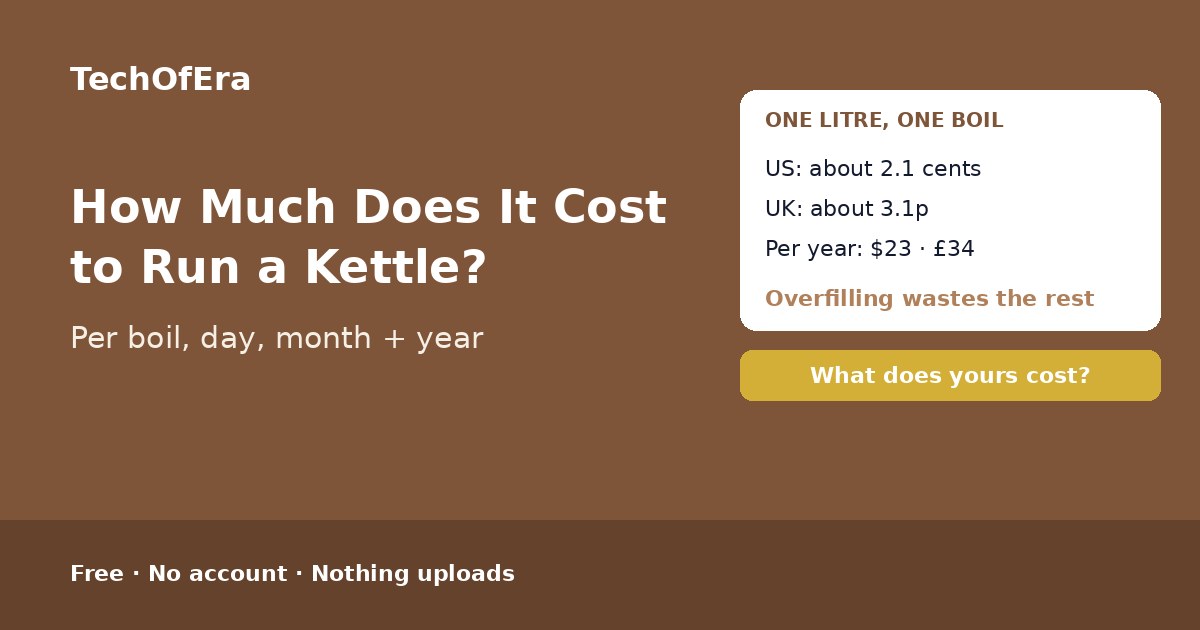
It comes down to two numbers: how much water you boil, and your price per kilowatt-hour. Heating one litre of water from a cold tap (about 15 °C) to a boil takes 0.099 kWh of heat, and a real kettle puts about 85% of the electricity it draws into the water — the rest heats the metal body and escapes as steam — so the meter sees about 0.116 kWh per litre. Multiply that by your price per kWh and you have the cost per boil: about 2.1 cents at the US average residential rate of 18.16 cents per kWh, or about 3.1p at the UK Ofgem price cap of 26.32p per kWh. The table below works it out for the usual amounts, at US and UK rates — enter your own numbers in the calculator above for your exact figure.
| Water boiled | Energy used | Time at 1,500 W | Time at 3,000 W | US cost per boil | UK cost per boil |
|---|---|---|---|---|---|
| 0.25 litres — one mug | 0.029 kWh | 1 min 10 s | 35 seconds | 0.5¢ | 0.8p |
| 0.5 litres — two mugs | 0.058 kWh | 2 min 19 s | 1 min 10 s | 1.1¢ | 1.5p |
| 1 litre — about four cups | 0.116 kWh | 4 min 39 s | 2 min 19 s | 2.1¢ | 3.1p |
| 1.7 litres — a full kettle | 0.198 kWh | 7 min 54 s | 3 min 57 s | 3.6¢ | 5.2p |
US rate: 18.16 cents per kWh (US Energy Information Administration, average residential rate, August 2026). UK rate: 26.32p per kWh (Ofgem price cap, 1 October to 31 December 2026). All figures are estimates, at 85% kettle efficiency.
How much electricity does a kettle use?
A kettle uses about 0.116 kWh for every litre it boils — so three boils of a litre a day use about 127 kWh a year. That is less than a fridge uses in a month, which is why a kettle is one of the cheapest appliances in the kitchen to run. The wattage on the label is the maximum power, not the energy: a 3,000-watt kettle boils a litre in about half the time of a 1,500-watt one, but both draw the same 0.116 kWh for it. The cost comes from the litres and the boils, not the kettle. A household that boils a full kettle eight times a day pays for 13.6 litres of heated water a day; a household that boils one mug at a time pays for two litres.
Does a higher-wattage kettle cost more to run?
No. The energy a boil needs is fixed by physics: heating a litre of water from a cold tap to a boil takes about 0.099 kWh of heat, whatever heats it. A 3,000-watt kettle delivers that energy in about 2 minutes 19 seconds; a 1,500-watt kettle takes about 4 minutes 39 seconds for the same litre. Both draw about 0.116 kWh from the meter for it, and both cost the same. Buying a bigger kettle to save money does not work — boiling less water does. The one thing wattage does change is the wait: if you boil little and often, a fast kettle is worth having for the time, not the money.
Kettle, microwave or stovetop — which is cheapest?
For one litre, published comparisons put an electric kettle at about 0.116 kWh, a microwave at about 0.100 kWh and an electric stovetop burner at about 0.200 kWh — so the microwave is slightly cheaper per litre and the stovetop is nearly twice as dear as the kettle. In practice the kettle usually wins on the mug: it heats only the water you put in it, it switches itself off, and it is faster than the stove. A gas hob is harder to price the same way, because gas is sold by the kWh of gas and a gas ring loses much of its heat around the sides of the pan. Whichever you use, the amount of water matters far more than the appliance: a full kettle on the cheapest method still costs more than one mug on the dearest.
How much does overfilling the kettle waste?
More than the boil itself. Filling a 1.7-litre kettle to make one 250 ml mug wastes about 1.45 litres on every boil — about 0.169 kWh, which is about 4.4p per boil at the UK Ofgem price cap, or about £48.57 a year at three boils a day. At the US average rate the same habit wastes about 9.2 cents a day, about $33.51 a year. The water you boil but do not use is paid for and poured away (or left to go cold and re-boiled, which costs the same again). The calculator above shows your own waste: enter how much you boil and how much you actually need, and it prices the gap per boil, per month and per year.
How to work out your own cost
- Pick your country. The calculator fills in the published average electricity price — the US Energy Information Administration average, the UK Ofgem price cap, Eurostat for Germany, and published averages for Canada and Australia. Your own bill is more accurate: check the price per kWh on it and enter that instead.
- Say how many watts your kettle draws. Check the rating plate under the kettle or its box. US kettles are usually 1,500 watts; UK and European kettles go up to about 3,000 watts. The wattage sets how fast the boil is, not what it costs.
- Say how much water you boil, and how much you actually need. A mug is about 0.25 litres, a large mug about 0.35; a full kettle is usually 1.7 litres. The gap between the two is the overfill — heated, paid for, and wasted.
- Say how many boils a day, and how many days a month. The calculator gives you the cost per boil, per day, per month and per year — and the energy used, in kWh, at each step, with the time each boil takes.
- Read the saving. The card next to the cost band shows what boiling only what you need would save you a year. That is the one number worth acting on.
What makes this calculator different
The pages that rank for this search are mostly guides and tables: a per-boil cost at one rate, a table of wattages, a cost by US state. They answer the average case, not yours. The calculators that exist are US-only, or they ask for a rate without saying where it comes from, or they stop at the monthly cost and never price the overfill. This page is the interactive answer for your exact kettle: your wattage, your litres, your boils, your rate — with country presets grounded in published figures (the US EIA, the UK Ofgem price cap, Eurostat), a cost band that says plainly whether the result is cheap or pricey, a yearly total, and the overfill saving next to it. And it is a different appliance from the other cost calculators on this site: a kettle is boiled in minutes, so the cost is per boil and the water volume decides it — a space heater runs for hours, so its cost is per hour and the thermostat decides it. For a heater, use the How Much Does It Cost to Run a Space Heater? Calculator.
When should you check the cost?
When your bill jumps — because the boils, not the kettle, are usually what changed. When you move house or change tariff — because the rate is the other half of the answer, and a dear tariff makes every overfilled litre cost more. When you buy a new kettle — because the wattage does not change the cost, so buy for speed and size, not for savings. And when the tea round grows — because a household that boils a full kettle eight times a day is paying for a different appliance than a household that boils one mug at a time.
Honest limitations
Estimates, not your bill
Every figure here is an estimate. Your real cost depends on your tariff, how much water you actually boil, whether you re-boil water that has gone cold, and the fixed standing charge on your bill — which is not included, because you pay it whether the kettle runs or not.
Rates change — check your bill
The preset rates are published averages: the US EIA average, the UK Ofgem price cap for October to December 2026, Eurostat for Germany, and published averages for Canada and Australia. Your tariff may be higher or lower, and caps reset — your own bill is the most accurate input.
Efficiency is an average, not a measurement
The calculator assumes a kettle puts 85% of the electricity it draws into the water. Published figures run from about 80% to 90% depending on the model, the water left in the base and how much steam escapes — so a very efficient kettle costs a little less than shown, and a limescaled one a little more.
Keep-warm costs extra
Variable-temperature kettles that hold water hot after the boil cycle on and off at low power — roughly 50 to 100 watts while they hold. Left in keep-warm mode for two hours a day, that adds about 37 to 73 kWh a year. This calculator prices boils only; it does not price keep-warm time.
Canada and Australia are approximate
Canada has no single national electricity rate — Quebec is far cheaper than Alberta — and Australian rates vary by state and network. The presets for both are published averages and are labelled approximate: enter your own rate from your bill for a figure you can rely on.
Cost only — a different appliance from a heater
This calculator answers what a kettle costs to run, per boil. It is not the space heater, underfloor heating or hot tub calculator: those appliances run for hours or all year, and their cost is worked out per hour, not per boil. Each has its own page, with its own maths.