How much does it cost to run a hot tub per hour?
It comes down to four numbers: the heater power in kW, the heat-loss factor for your season, insulation, cover and temperature, and your price per kilowatt-hour. A kilowatt-hour is the unit your bill uses — one kilowatt of power running for one hour. A portable acrylic tub with a 4 kW heater costs about 73 cents for one hour of heating at the US average residential rate of 18.16 cents per kWh, or about £1.05 an hour at the UK Ofgem price cap of 26.32p per kWh. The table below works it out for the usual tubs, at 2 heating hours a day for 30 days, in a mild season with average insulation and a good cover at 38 °C — enter your own numbers in the calculator above for your exact figure.
| Hot tub | US per day | US per month | UK per day | UK per month |
|---|---|---|---|---|
| Inflatable, 800 L, 1.5 kW | $0.54 | $16.34 | £0.79 | £23.69 |
| Portable acrylic, 1,200 L, 4 kW | $1.45 | $43.58 | £2.11 | £63.17 |
| Large acrylic, 1,800 L, 5.5 kW | $2.00 | $59.93 | £2.90 | £86.86 |
| Swim spa, 6,000 L, 6 kW (4 h a day) | $4.36 | $130.75 | £6.32 | £189.50 |
US rate: 18.16 cents per kWh (US Energy Information Administration, average residential rate, August 2026). UK rate: 26.32p per kWh (Ofgem price cap, 1 October to 31 December 2026). All figures are estimates, at 2 heating hours a day — a thermostat cycling the heater off more brings them down, and winter pushes them up.
How much electricity does a hot tub use per day?
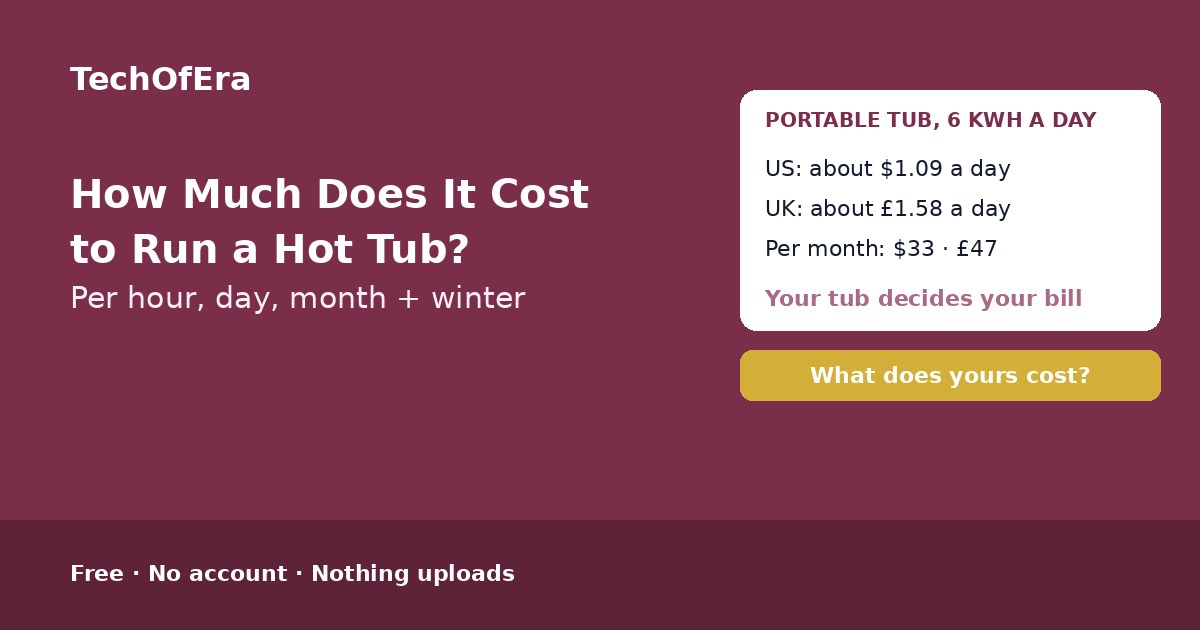
A typical hot tub uses 3 to 12 kWh a day, according to RunCosts, with 6 kWh a day as the middle of the range — more in winter and outdoors, less in summer with a good cover. At the US average rate that is about $1.09 a day, or about $32.69 a month over 30 days. The heater only runs to replace the heat that leaks out, so the cover and the insulation decide the number more than the heater size does: a bigger heater warms the water faster, it does not by itself use more per day. An inflatable tub on a 1.5 kW heater uses about 3 kWh a day; a large tub or swim spa can pass 20 kWh a day in winter. Angi's 2026 ranges agree in shape: inflatable tubs $30–$50 a month, portable acrylic $40–$70, in-ground $80–$100, swim spas $90–$120 — the running cost is mostly electricity, with chemicals, filters and water adding roughly $15–$50 a month on top.
Is it cheaper to leave a hot tub on all the time or turn it off?
For a weekend, leave it on. Heating a 1,200-litre tub from a cold fill at 15 °C to 38 °C takes about 32.1 kWh — about $5.83 at the US average rate — while keeping it hot costs about $1.09 a day, so two days of standing heat costs less than one reheat. For a week or more away, switching it off saves money: a week of standing heat costs about $7.63 against a $5.83 reheat. The exception is freezing weather: a tub left off in a frost can freeze and crack its pipes, so if you switch it off for winter, winterize it properly. If you are not sure whether to winterize or keep it running, use the Do I Need to Winterize My Hot Tub? Checker — it works out the verdict from how often you soak, how long the tub sits unchecked, and your climate.
How to work out your own cost
- Pick your country. The calculator fills in the published average electricity price — the US Energy Information Administration average, the UK Ofgem price cap, Eurostat for Germany, and published averages for Canada and Australia. Your own bill is more accurate: check the price per kWh on it and enter that instead.
- Say what kind of tub it is, and how much water it holds. The tub type fills in the usual volume and heater size — an inflatable tub is about 800 litres on a 1.5 kW heater, a portable acrylic tub about 1,200 litres on 4 kW, a swim spa about 6,000 litres on 6 kW. Change either number if yours is different.
- Say how many hours a day the heater runs. Count the hours the heater is actually running to hold the temperature, not the hours the tub sits hot. A well-covered tub in a mild season needs about 1 to 2 hours a day; an uncovered tub outdoors in winter can need far more.
- Say the temperature, the season, the insulation and the cover. Each one changes how fast the tub loses heat: winter costs about half as much again as a mild season, a thin-walled tub loses heat faster than a full-foam shell, and a missing cover is the biggest leak of all.
- Say how many days a month, and how many winter months. The calculator gives you the cost per heating hour, per day, per month and per winter — and the electricity used, in kWh, at each step — plus the one-off cost of heating up from a cold fill.
What makes this calculator different
The pages that rank for this search are mostly guides: what a tub costs to buy, and a table of monthly costs at one rate. The one interactive calculator that ranks, RunCosts, asks only for your location and works from a fixed 6 kWh a day for every tub — it cannot tell an inflatable tub in summer from a swim spa in winter. This page is the interactive answer for your exact tub: your volume and heater size, your heating hours, your target temperature, your season, your insulation and your cover — with country presets grounded in published figures (the US EIA, the UK Ofgem price cap, Eurostat), a cost band that says plainly whether the result is cheap or pricey, a winter-season total, and the one-off heat-up cost of a fresh fill. And the difference from the room-heater question is kept clear: this calculator answers the cost of heating a tub of water, not a plug-in heater — for that, use the How Much Does It Cost to Run a Space Heater? Calculator. For the cost of heating a floor, use the How Much Does It Cost to Run Underfloor Heating? Calculator.
When should you check the cost?
Before you buy a tub — run the numbers while you are choosing between an inflatable and an acrylic tub, because the running cost is decided before the first soak and the purchase price is paid once. Before the first cold snap — because the season and the cover are decided before the first use. When your bill jumps — because the hours and the cover, not the tub, are usually what changed. When you go away for a week or more — because the calculator shows whether leaving it on or switching it off costs less, and the winterize checker shows whether switching it off is safe. And when you replace the cover — because a new fitted cover is the cheapest running-cost upgrade a tub has.
Honest limitations
Estimates, not your bill
Every figure here is an estimate. Your real cost depends on your tariff, how well the tub is insulated, how often the cover is on, how long the tub takes to heat up from cold, and the fixed standing charge on your bill — which is not included, because you pay it whether the tub runs or not.
Rates change — check your bill
The preset rates are published averages: the US EIA average, the UK Ofgem price cap for October to December 2026, Eurostat for Germany, and published averages for Canada and Australia. Your tariff may be higher or lower, and caps reset — your own bill is the most accurate input.
The heating hours are a guess
The hours the heater runs each day is the number the answer turns on, and it is a guess. A tub heated from cold draws full power for longer before the thermostat starts cycling; in a warm, well-covered tub the heater may run far less than you pick. Watch your meter for a week and adjust it.
Running cost only — not chemicals or water
This calculator answers what a tub costs to heat, not what it costs to keep. Chemicals, filters and water typically add $15–$50 a month (Angi, 2026), and the pump and jet energy sits on top of the heater — small beside the heat, but not zero.
Canada and Australia are approximate
Canada has no single national electricity rate — Quebec is far cheaper than Alberta — and Australian rates vary by state and network. The presets for both are published averages and are labelled approximate: enter your own rate from your bill for a figure you can rely on.
Heat-up assumes a 15 °C fill
The heat-up cost assumes the tub is filled with water at 15 °C. A colder winter fill costs more to heat; a warm summer fill costs less. The figure is the energy in the water itself — a heater that is less than 100% efficient, or a tub losing heat while it warms, needs a little more.