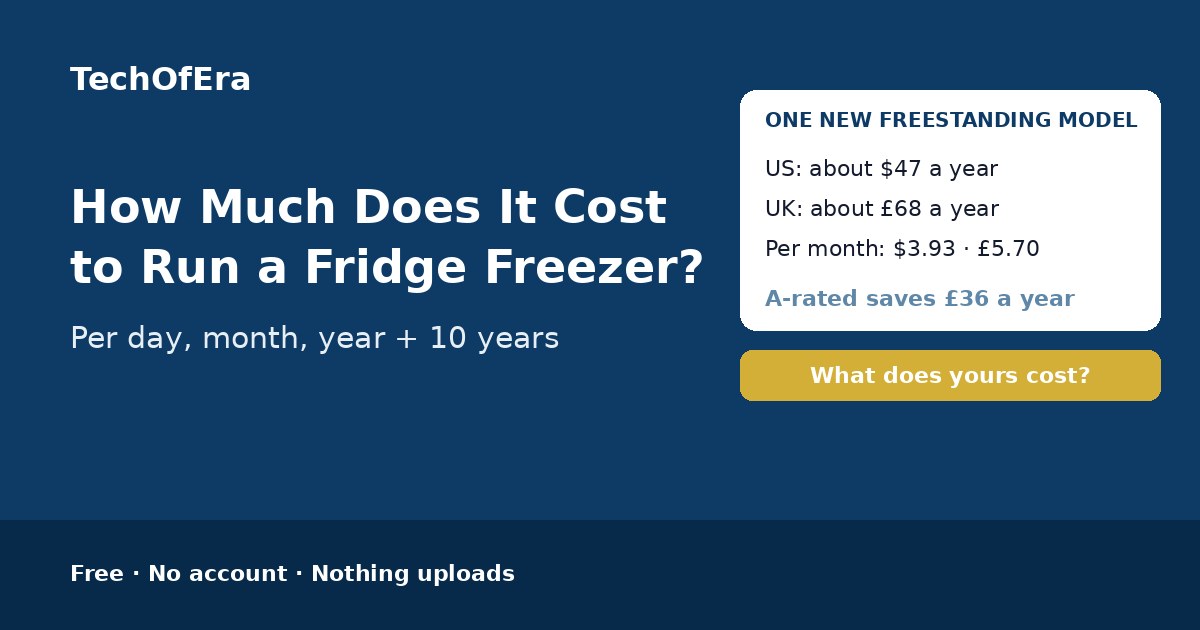
How much does a fridge freezer cost per year?
It comes down to two numbers: how much energy your model uses in a year, and your price per kilowatt-hour. A fridge freezer runs around the clock, so the honest unit is the annual energy use in kWh — printed on the energy label — not the wattage on the back, which is only what the compressor draws while it is running. A new freestanding model uses about 260 kWh a year, costing about $47.22 at the US average residential rate of 18.16 cents per kWh, or about £68.43 at the UK Ofgem price cap of 26.32p per kWh. The table below works it out for the usual types, at US and UK rates, for a modern medium model under 5 years old — enter your own numbers in the calculator above for your exact figure.
| Type | Energy used per year | US cost per year | UK cost per year |
|---|---|---|---|
| Freestanding fridge freezer | 260 kWh | $47.22 | £68.43 |
| Integrated fridge freezer | 240 kWh | $43.58 | £63.17 |
| American-style fridge freezer | 350 kWh | $63.56 | £92.12 |
| Fridge only (no freezer) | 160 kWh | $29.06 | £42.11 |
| Chest freezer | 250 kWh | $45.40 | £65.80 |
US rate: 18.16 cents per kWh (US Energy Information Administration, average residential rate, August 2026). UK rate: 26.32p per kWh (Ofgem price cap, 1 October to 31 December 2026). These are estimates for modern medium models — older or larger models use more, and your model's energy label gives its own figure. All figures are estimates.
How many kWh does a fridge freezer use a year?
A new freestanding fridge freezer uses about 184 to 258 kWh a year, according to a November 2026 check of the 20 best-selling models — the cheapest to run used 184 kWh, the dearest 257.6 kWh. An A-rated model can use as little as 109 kWh a year, while an E-rated model of the same size uses about 244 kWh. American-style models use about 226 to 317 kWh a year when new. The figure that misleads people is the wattage on the back: fridges are usually rated at 100 to 800 watts, and multiplying that by 24 hours a day suggests far more than the real figure — because the compressor only runs part of the time. That is why the honest unit is the annual kWh on the energy label, and why this calculator works from that figure first, and only estimates from the type, size and age when you do not know it.
Does an old fridge freezer cost more to run?
Yes — older models can use twice as much energy as a new one. A modern 22 cu ft ENERGY STAR fridge uses about 52 kWh a month, while a pre-2008 legacy second fridge uses about 135 kWh a month. This calculator charges a fridge freezer 5 to 10 years old about 25% more than a new one, and one over 10 years old about 60% more — conservative estimates, and the page labels them as such. A 10-year-old American-style model in Germany, for example, uses about 700 kWh a year and costs about €253.40 a year at the German average rate — against about €126.70 for a new medium American-style model. If your model is over 10 years old, the replacement card above shows what a new one would save.
Is it worth replacing an old fridge freezer?
It depends on the gap between what yours uses and what a new one would use. An A-rated model using 109 kWh a year costs about £28.69 a year at the UK price cap, against £64.22 for an E-rated model using 244 kWh — a saving of £35.53 a year. The Energy Saving Trust puts the saving from choosing an A-rated model instead of an E-rated one at around £360 over a 17-year lifetime. Enter your model's annual kWh, the new model's figure and its price in the calculator above and it works out the saving per year, over 10 years, and how many years the new model takes to pay for itself. A new model only pays when the gap is wide — a new A-rated model replacing a 10-year-old American-style one saves about €181.00 a year in Germany and pays for a €900 model in about 5 years.
How to work out your own cost
- Pick your country. The calculator fills in the published average electricity price — the US Energy Information Administration average, the UK Ofgem price cap, Eurostat for Germany, and published averages for Canada and Australia. Your own bill is more accurate: check the price per kWh on it and enter that instead.
- Pick your type, size and age. Freestanding, integrated, American-style, fridge only or chest freezer — then small, medium or large, then under 5 years, 5 to 10, or over 10. US full-size models are usually large, so pick large if yours is a big American fridge.
- Enter the annual kWh from the energy label, if you can find it. It is printed on the energy label itself in the UK and EU, and on the yellow EnergyGuide label in the US. That one figure replaces the whole estimate — it is the most accurate input there is.
- Read the cost. The calculator gives you the cost per day, per month, per year and over 10 years — and the energy used, in kWh, at each step, with the Which? average next to it for comparison.
- Read the saving. The card next to the cost band shows what replacing your model with a new one would save you a year — and, if you enter the new model's price, how many years it takes to pay for itself. That is the one number worth acting on.
What makes this calculator different
The pages that rank for this search are mostly guides and tables: an average cost per year, a table of models, a cost by US state. They answer the average case, not yours. The one dedicated fridge-freezer calculator that ranks uses a single fixed 30-watt assumption for every model, and the generic wattage calculators price the label watts times 24 hours — which overstates the cost, because the compressor cycles on and off. The US refrigerator calculators price a 60-watt average draw with no way to enter your model's own figure, and none of them prices the replacement. This page is the interactive answer for your exact fridge freezer: your model's annual kWh from the energy label — or an estimate from its type, size and age when you do not know it — your rate, with country presets grounded in published figures (the US EIA, the UK Ofgem price cap, Eurostat), a cost band that says plainly whether the result is cheap or pricey, a 10-year total, and the replacement saving with the payback. And it is a different question from the other fridge tools on this site: the Is My Fridge & Freezer Temperature Safe? Checker tells you whether your fridge and freezer are cold enough to keep food safe, and the Fridge, Freezer or Pantry? Food Storage Checker tells you where a food belongs. This page answers only what it costs to run. For the rest of the kitchen, use the How Much Does It Cost to Run a Dishwasher? Calculator or the How Much Does It Cost to Run a Washing Machine? Calculator.
When should you check the cost?
When your bill jumps — because the fridge freezer runs around the clock, it is one of the first suspects, and a failing seal or a dusty condenser can push its use up without any visible change. When you move house or change tariff — because the rate is the other half of the answer, and a dear tariff makes every kWh cost more. When you buy a new fridge freezer — because an A-rated model uses about 109 kWh a year against 244 kWh for an E-rated one of the same size, so the saving is real. And when yours passes 10 years old — because that is when the gap between old and new gets wide enough to pay for a replacement.
Honest limitations
Estimates, not your bill
Every figure here is an estimate. Your real cost depends on your tariff, your model's true annual energy use, the room temperature, and the fixed standing charge on your bill — which is not included, because you pay it whether the fridge freezer runs or not.
Rates change — check your bill
The preset rates are published averages: the US EIA average, the UK Ofgem price cap for October to December 2026, Eurostat for Germany, and published averages for Canada and Australia. Your tariff may be higher or lower, and caps reset — your own bill is the most accurate input.
The estimate is a range, not a measurement
The calculator estimates 260 kWh a year for a modern medium freestanding model, 240 for integrated, 350 for American-style, 160 for a fridge only and 250 for a chest freezer — estimates inside the published ranges. Your model's energy label gives its own figure; enter it above and the estimate disappears.
US models run bigger than UK ones
US full-size refrigerators are typically 16 to 22 cu ft, against about 300 litres for a UK family model, and use 400 to 700 kWh a year. If yours is a big US model, pick Large — or better still, enter the annual kWh from the EnergyGuide label.
Canada and Australia are approximate
Canada has no single national electricity rate — Quebec is far cheaper than Alberta — and Australian rates vary by state and network. The presets for both are published averages and are labelled approximate: enter your own rate from your bill for a figure you can rely on.
Cost only — a different question from safety or storage
This calculator answers what a fridge freezer costs to run, per day and per year. It does not say whether your fridge is cold enough — that is the Is My Fridge & Freezer Temperature Safe? Checker — or where a food belongs — that is the Fridge, Freezer or Pantry? Food Storage Checker. Each has its own page, with its own answer.