How the fridge and freezer temperature check works
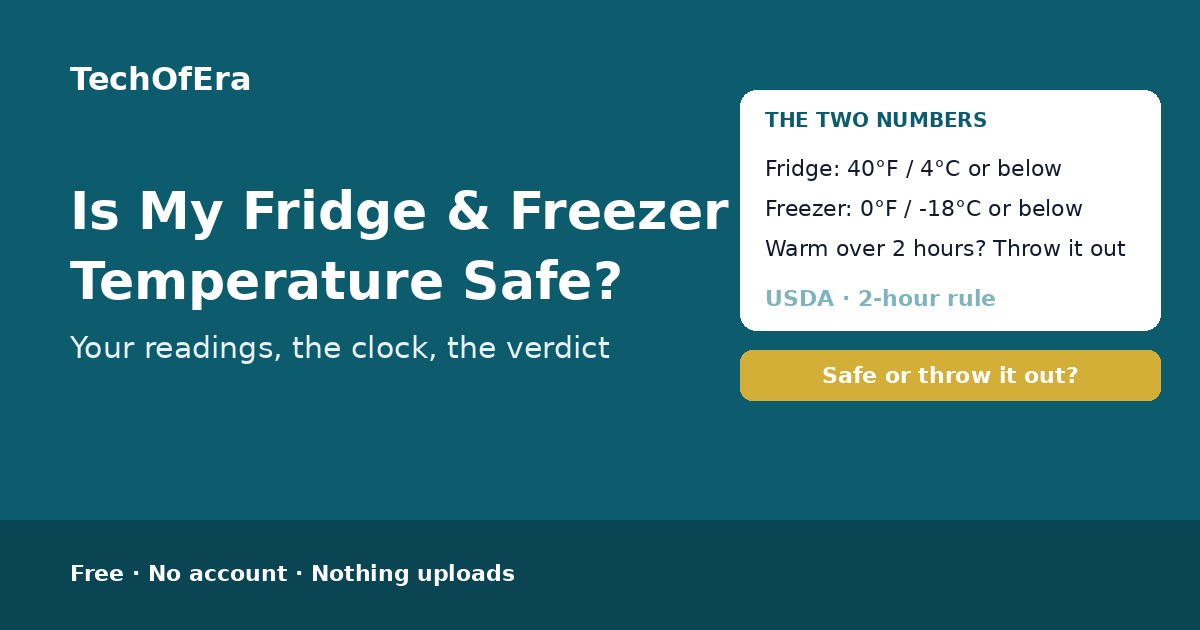
The USDA says to keep the refrigerator at or below 40°F (4°C) and the freezer at or below 0°F (-18°C). Above 40°F, food enters the “danger zone” (40–140°F), where bacteria grow fastest — and the USDA’s 2-hour rule says refrigerated perishable food held above 40°F for more than 2 hours should be discarded, because the bacteria that make people sick give no sign you can see or smell. But a number on a dial is not a verdict: a fridge at 45°F for twenty minutes is a different answer from a fridge at 45°F for three hours, and a freezer at 10°F holding ice cream is a different answer from a freezer at 10°F holding raw chicken. This checker combines four clues — the two thermometer readings, how long they have been that warm, what is most at risk inside, and who will eat it — and gives you a verdict for your exact fridge and freezer, with the next steps.
To use it:
- Enter both thermometer readings. Read an appliance thermometer in each compartment — on a middle shelf in the fridge, between frozen packets in the freezer — and enter the numbers in °C or °F. A dial or a digital display shows a target, not a measurement, so a thermometer is the only way to know.
- Say how long it has been this warm. The verdict turns on the clock: under 2 hours is still inside the USDA window, over 2 hours is past it. Work it out from when the power went out, when the door was last shut properly, or when you last checked.
- Say whether the power is on. A power cut is the most common reason a fridge and a freezer go warm together — and the clock starts when the power went out, not when you noticed.
- Say what is most at risk and who will eat it. Raw meat, dairy, eggs and leftovers are perishable and follow the 2-hour rule; condiments, jam and drinks do not follow the same rule. Children, pregnant people, older adults and anyone with a weak immune system get foodborne illness more often and more seriously — the discard call is stricter for them.
- Tick any signs you can see. Milk that smells off, food that feels warm, condensation, a door left open — in the fridge. Soft ice cream, bendy packets, ice crystals — in the freezer. The ice cream goes first: if it is soft, the rest is warming too.
What makes this checker different
The pages that rank for this search are guides and product roundups — fridge.com’s refrigerator temperature settings guide, which has an interactive dial advisor that answers which dial setting to pick, not whether the readings you already have are safe; thermometer roundups that review which device to buy; and business temperature-logging apps such as TempChecker and ThermoTrack, which need an account, a paid plan and a sensor in the fridge. There is no free, standalone checker that takes the thermometer readings you already have, the clock, the power, what is inside and who will eat it — and gives you a verdict: safe, at risk, throw it out, or check first because the clock is unknown — with the 2-hour rule applied to your exact numbers. This page is that answer: eight questions, an instant verdict for your exact fridge and freezer, the blockers named, and the next steps. It is a self-assessment, so it says plainly what it cannot know: it cannot read your thermometer or see your food, and where the clock is unknown it says so instead of guessing.
When is this the right check?
After a power cut, when the lights come back and you need to know what survives. When the milk spoils early twice in a row and you suspect the fridge is running warm. When the ice cream stays soft and the freezer will not hold 0°F. When you come home to a door left ajar and a warm fridge. When you buy a second-hand fridge or move into a new flat and want to know whether the box you inherited is actually cold enough. And whenever the thermometer and your gut disagree — because that is when a guide leaves you guessing and a checker earns its keep.
Honest limitations
A self-assessment, not food-safety advice
This checker cannot read your thermometer or see your food. It cannot check the temperature on the middle shelf or how the packets actually look. If anyone who ate the food feels ill, call a doctor.
Looking fine proves nothing
The bacteria that make people sick give no sign you can see or smell. Food held above 40°F for more than 2 hours should be discarded even if it looks and smells perfect — that is the USDA’s own rule.
The smell test cuts one way only
Milk that smells off is spoiled, whatever the thermometer says. But food that smells fine is not proof it is safe — spoilage and sickness are caused by different bacteria.
The US and UK lines differ by a degree
The USDA ceiling for a fridge is 40°F (4°C); the UK Food Standards Agency allows 0–5°C. This checker judges against the stricter US line and says so where the two disagree.
A freezer at 0°F is safe, not eternal
At 0°F food is safe indefinitely, but quality degrades over time — use the oldest packets first, and do not treat a year-old steak as a fresh one.
Rules from official sources, dated November 2026
The rules here are the USDA / FoodSafety.gov cold-chain lines and the 2-hour rule, with the UK Food Standards Agency and Health Canada lines named where they differ, as they read in November 2026. Guidance changes: recheck with your local food-safety authority if anything changes.