How many calories are in a Christmas dinner — and how this estimate is built
Most pages that rank for this question give one number for a “typical” plate — about 1,000 to 1,250 kcal for the main course, about 3,000 kcal for the whole day — and then leave you to work out where your plate sits. The one interactive calculator that ranks asks you to tick boxes and press Calculate, with fixed portions and no way to say you had six roast potatoes or skipped the stuffing. This estimator does the missing job: every item has its own portion stepper, so the plate is yours — seconds included — and the total updates live, with the lighter swaps computed from the plate you actually built.
To use it:
- Pick the main. Turkey with skin is 266 kcal a portion; skinless turkey is 225; ham 151; roast beef 247; a nut roast 314. Set the portions to 2 if you go back for seconds — the main is the line most people underestimate.
- Tap + on everything on your plate. Each tap adds one typical portion: four roast potatoes (322 kcal), three pigs in blankets (199), two stuffing balls (177), and so on. The vegetables barely move the total — sprouts 26 kcal, carrots 23 — so be generous with those and honest with the potatoes.
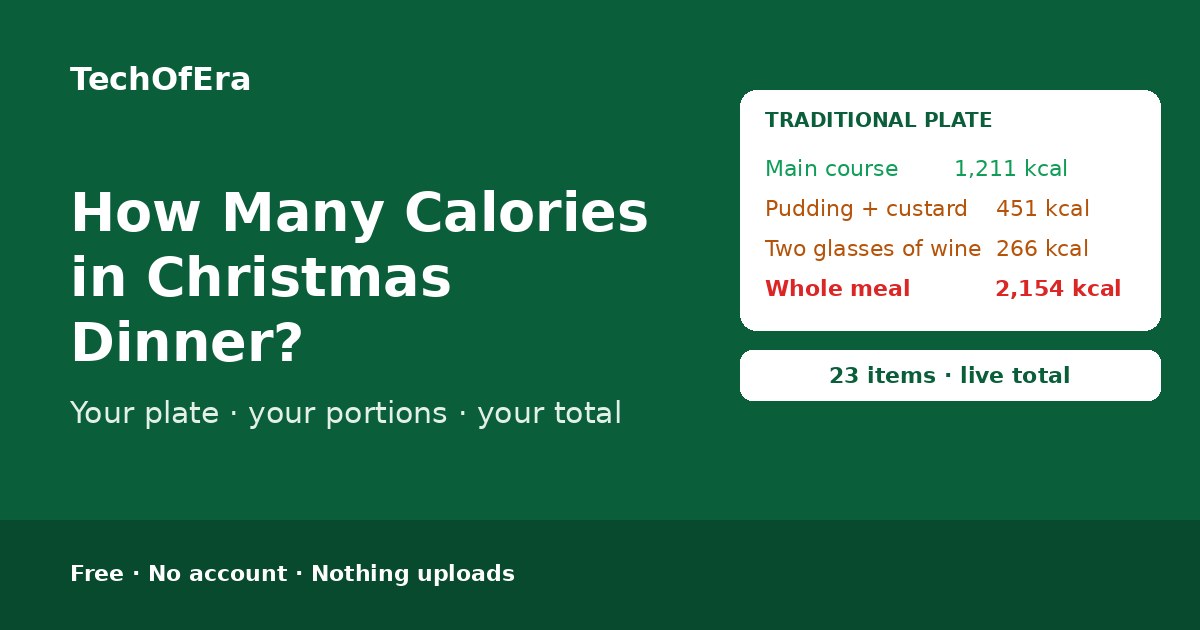
- Add pudding and drinks. Christmas pudding is 314 kcal a slice, 451 with custard, 535 with custard and brandy butter. Two glasses of red wine add 266 kcal. Pudding and drinks together are usually a third of the Christmas total — leaving them out is how a 2,000-kcal meal gets reported as 1,200.
- Read the total against a whole day. The NHS uses about 2,000 kcal a day for an average woman and 2,500 for an average man. A typical main course is about 1,211 kcal — 61% of a woman's day — and the full meal with pudding and drinks is about 2,154 kcal.
- Check the swaps. The estimator works out what each lighter version would save from your plate: skin off the turkey, one fewer roast potato, trifle instead of pudding. Nothing drops a course — every swap keeps the dinner recognisable.
- Remember it is an estimate. The figures come from published food-composition tables (CoFID 2021 and USDA FoodData Central), not from weighing your cooking. Your recipe, brand and portion move the numbers, so treat the total as a guide, not a measurement.
Christmas dinner calories at a glance
The table below is built from the same figures as the estimator, so it can never disagree with your total. Each row is a whole preset plate, totalled by the engine.
| Plate | Share of a day | What to know |
|---|
What makes this estimator different
The pages that rank for this search are articles — careful dish-by-dish tables from the same published data, worked examples for a “typical” plate, and the advice that roast potatoes and pigs in blankets carry the meal. They are good reading, but they cannot total your plate: your portions, your seconds, your pudding, your drinks. The one interactive calculator that ranks is a tick-box list with fixed portions and a Calculate button — it cannot say what six roast potatoes do, or what swapping the pudding for trifle saves. This page is that answer: adjustable portions for every item, four presets from a traditional dinner to a kids' plate, a live total against both daily references, and lighter swaps computed from the plate you built — with nothing to install, no account, and nothing uploaded. It is an estimate, so it says plainly what it cannot know: your recipe, your brand, your exact portion.
When is this the right check?
Whenever you are wondering whether Christmas dinner really is a whole day of calories — it usually is, once pudding and drinks are counted, and this shows which course does it. Whenever you want a lighter Christmas without dropping a course: the swaps list is the whole point, and it is computed from your plate, not a generic list. And whenever you are comparing plates — yours against your partner's, this year against last year, the traditional dinner against the vegetarian one. If you are costing the same dinner as well as counting it, the companion checker in the footer prices the menu; if you are wondering whether the ham is still safe to eat, that checker is there too.
Honest limitations
Estimates, not measurements
The figures come from published food-composition tables (CoFID 2021 and USDA FoodData Central), not from weighing your cooking. Roast potatoes cooked in goose fat run higher than the 322 kcal here, and a bigger slice of pudding than 110 g runs higher too.
Recipes vary
Stuffing, gravy, trifle and Christmas cake change with the recipe: sausagemeat stuffing is 177 kcal a portion, a packet ball is nearer 133, and tin gravy with the fat left in is roughly double the granules figure. The portions are typical servings, not your servings.
UK and US figures, mixed honestly
Most figures are from the UK government's CoFID 2021 tables; ham, cranberry sauce and eggnog come from USDA FoodData Central, because CoFID does not list them. The page says which is which, and the totals are a guide on either side of the Atlantic.
Portions are typical, not yours
One portion is the serving shown on each item — four roast potatoes, three pigs in blankets, one slice of pudding. If your roast potatoes are twice the size, tap + twice; if your slice of pudding is a sliver, the total overstates it.
Not medical or dietary advice
This is general information about food energy, not medical or dietary advice. If you manage a health condition or follow a prescribed diet, these numbers do not replace your clinician's or dietitian's advice.
Drinks add up fast
Two glasses of red wine are 266 kcal — about the same as the turkey. Mulled wine and eggnog are heavier still at about 230 and 225 kcal a serving. The estimator counts drinks only if you add them, so add them honestly.