How the heated airer vs tumble dryer check works
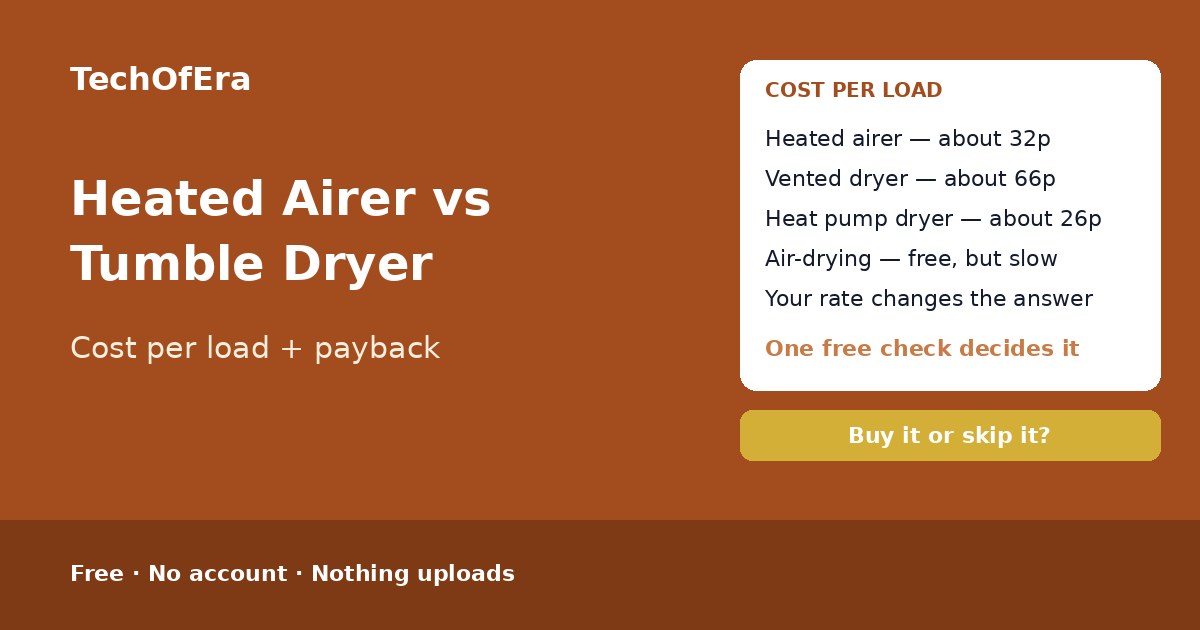
Whether a heated airer is worth buying is not one decision — it is a calculation, and it is different for every household. A 300 W heated airer running four hours uses 1.2 kWh and costs about 32p at the Ofgem price cap of 26.32p per kWh, while a vented or condenser tumble dryer uses around 2.5 kWh a load and costs about 66p. A heat pump dryer is the exception: Which? puts it at about £43 a year for three big loads a week, roughly 1.0 kWh a load, which is cheaper than an airer and far faster. And air drying is free — but it takes many hours, often overnight or longer in winter, and it puts the water into the room instead of outside. This calculator weighs all of it — how many loads you dry a week, what your electricity costs, what kind of dryer you have (if any), the airer's wattage, how long a load takes on it, whether drying indoors causes damp, whether you have about a square metre of floor space, and what an airer would cost to buy — and gives you the cost per load, the cost per year, the saving, the payback in months, and a verdict for your household.
To use it:
- Say how many loads of laundry you dry a week. Count the wash loads in a typical week — most households do three to five. The saving only adds up if you dry often enough: at one load a week the saving is too small to justify buying an airer, while at five loads a week it pays for itself in months.
- Say what your electricity costs. Pick the UK preset — the Ofgem price cap, 26.32p per kWh, for 1 October to 31 December 2026 on a standard variable tariff paid by Direct Debit — or the US preset, about 17 cents per kWh, the typical residential rate. Anywhere else, type the rate from your own bill: the comparison uses exactly the number you enter.
- Say what kind of tumble dryer you have. A vented or condenser dryer uses around 2.5 kWh a load; a heat pump dryer uses about 1.0 kWh a load. If you have no dryer, the comparison is against free air-drying — and the airer wins on time, not on money.
- Say how powerful the heated airer is. Most three-tier airers are 300 W. Smaller winged airers are around 230 W and cost less per hour but dry more slowly; large airers and drying pods run to 400 W and dry faster but use a third more electricity.
- Say how long a load takes on the airer. Which? tested heated airers drying a cotton load in four to seven hours. A zip-up cover typically finishes a load about a third faster, because it holds the warm air against the fabric instead of letting it drift to the ceiling. Heavy items like towels and bedding take the longest.
- Say whether drying laundry indoors causes damp. A heated airer puts the water from a full load into the room air. If the windows stream or the walls feel damp when laundry dries indoors, the airer needs a dehumidifier with it — about 22.5 W, roughly 5p a load.
- Say whether you have about 1 sq m of floor space. A heated airer needs about a square metre of floor while it runs — a corner of a bedroom or the bathroom usually does it. Without the space, the airer would live folded in a cupboard and never get used.
- Say what a heated airer would cost to buy. A typical 300 W three-tier airer costs around £60 in the UK or about $70 in the US. The payback in months is worked out from this price and the saving per load.
The five verdicts, and what each one means
Buy a heated airer
The airer is clearly cheaper per load than the dryer you have — about 32p a load against about 66p for a vented dryer — and you have the space for it. A £60 airer typically pays for itself in one to two years at three or more loads a week — faster with a cover, which cuts the hours per load. The trade-off is time: four to eight hours a load against the dryer's hour or two, so run it overnight or while you are out.
Buy a heated airer — and pair it with a dehumidifier
On cost alone the airer wins, but drying indoors already causes damp here, and a heated airer puts the water into the room instead of outside. Pair it with a dehumidifier (about 22.5 W, roughly 5p a load) or open a window a crack while it runs, and wipe any condensation dry in the morning.
Stick with your dryer
You already own the efficient option: a heat pump dryer uses about 1.0 kWh a load, about 26p at the cap, which is cheaper than an airer and finishes in an hour or two. There is nothing to gain by buying an airer — except gentleness, if you dry a lot of delicates that cannot go in the dryer.
Do not buy one
Either the saving is too small — at one load a week a £60 airer would take years to pay for itself — or there is nowhere to put one. Keep air-drying for free, and use a laundrette dryer for the occasional load that needs to be dry fast.
Cannot tell yet
Two numbers are missing: how many loads you dry a week, and what your electricity costs. Without those there is nothing to compare — a household drying four loads a week on a vented dryer saves about 34p a load, while a household drying one load a week saves almost nothing.
What makes this calculator different
The pages that rank for this search are guides and roundups — a Which? guide to whether heated airers are worth it, an Ideal Home list of benefits and drawbacks, a Homes & Gardens account of one writer's airer, a cost comparison from ClearScore, and a per-load cost article that does include a small wattage calculator for the airer alone. Every one of them answers the question in general: an airer is cheaper per hour than a dryer. None of them asks how many loads you dry a week, what your electricity rate is, what kind of dryer you already own, whether drying indoors causes damp in your home, or whether you have the floor space — and none of them gives you your own per-load and per-year numbers, your saving, or your payback in months. There is no free, standalone calculator that takes your loads, your rate, your dryer, your damp and your space and turns them into a buy-or-don't-buy verdict for your household, with the heat pump exception and the dehumidifier warning named. This page is that answer: eight questions, an instant comparison, the blockers named, and the next steps. It is a self-assessment, so it says plainly what it cannot know: it cannot read your bill, time how fast your laundry dries, or see whether the room gets damp.
When is this the right check?
When the heating is on, the washing line is out of use, and the laundry is piling up indoors — because that is when the airer-versus-dryer question actually matters, and when the guides' general answer (cheaper per hour) does not tell you whether it is cheaper for you. When you already own a vented dryer and wonder whether an airer would pay for itself — because at three or more loads a week it usually does, in a year or two. When you have no dryer at all and wonder whether an airer is worth £60 — because the answer is about time, not money: four to seven hours a load instead of overnight or longer on a plain rack. And when the windows stream every time laundry dries indoors — because then the airer needs a dehumidifier with it, and the honest cost includes that 5p a load.
Honest limitations
A self-assessment, not an energy survey
This calculator cannot read your electricity bill, time how fast your laundry dries, or see whether the room gets damp. It cannot tell you how much money you will actually save — only what the numbers you enter add up to. If the windows stream when laundry dries indoors, check the room itself.
One household at a time
A family drying five loads a week and a single person drying one load a week get opposite answers from the same calculator. The verdict is for the numbers you enter: run it again if the laundry volume changes.
Rates change
The UK default is the Ofgem price cap for 1 October to 31 December 2026, and the US default is the typical residential rate of about 17 cents per kWh. Tariffs end and caps move: if your rate is different, type your own — the saving moves with it.
The dryer figures are typical, not yours
The 2.5 kWh a load for a vented or condenser dryer and 1.0 kWh for a heat pump dryer are typical figures from the published tests, not measurements of your machine. An old dryer, a half-empty drum, or a load that went in soaking wet all use more.
Time is not in the price
The calculator compares money, not time. An airer takes four to eight hours a load against a dryer's hour or two — if you need a school uniform dry in an hour, no saving makes the airer the right choice for that load.
Rules from published tests, dated November 2026
The rules here are the Ofgem price cap (26.32p per kWh, 1 October to 31 December 2026), the Which? heated airer tests (four to seven hours a cotton load; £66 to £160 a year; heat pump dryer about £43 a year for three big loads a week), and the ClearScore and NimbleFins experiment (airer 48p a load, dehumidifier 5p, dryer £1.09; about 140 loads to pay back the purchase), as they read in November 2026. Figures change: recheck if anything about your laundry or your tariff changes.