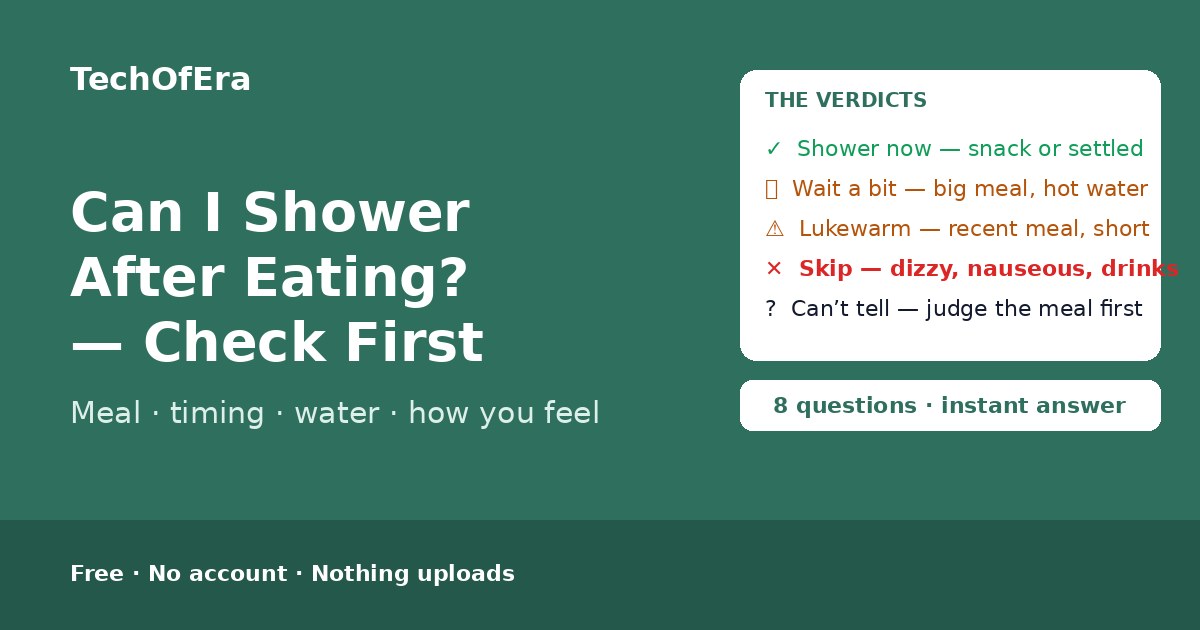
How to decide whether to shower after eating
Most pages that rank for this question give the same short answer — wait 30 minutes, or an hour, or two hours — and then leave you to work out what that means for the meal you just ate: a snack or a feast, five minutes ago or two hours ago, hot water or lukewarm, heartburn or dizziness, one glass of wine or three. The honest starting point is that for healthy adults there is no credible evidence that showering after eating is dangerous, and no medical guideline forbids it: the blood-flow shift a shower causes is small, and the body keeps supplying the gut. What the sources do agree on is comfort: a very hot shower right after a very large meal can leave some people light-headed or uncomfortable, because hot water dilates blood vessels in the skin and lowers blood pressure while digestion is already drawing blood to the gut. The practical advice that follows is modest — wait 20–60 minutes after a large meal, keep the water lukewarm, keep it short — not a ban. This checker asks exactly what decides it.
To use it:
- Judge the meal. A light snack needs no wait at all. A normal meal needs no wait if the water is lukewarm. A large meal is the only case worth waiting for — 30–60 minutes — and a feast, eating until stuffed, is worth at least an hour.
- Check the clock. Digestion peaks in the first hour after a meal. Under 30 minutes is when the blood-flow shift is strongest; over an hour, the heavy work is done and there is no waiting time left to observe.
- Decide the water. Lukewarm means 29–35°C (85–95°F) — neutral to the touch, tested with your wrist. Hot water (over 40°C) dilates blood vessels and lowers blood pressure; cold water constricts vessels and can tighten the stomach after a big meal. Lukewarm is the only temperature that works with digestion instead of against it.
- Check how you feel. Bloating and heartburn are comfort signals — wait a bit, or shower lukewarm and short. Dizziness or nausea after eating mean skip the shower and rest. Chest pain, breathlessness or confusion are not shower questions — they need medical care now.
- Count the drinks. One drink with the meal is fine; several drinks plus a hot shower stack two blood-pressure drops at once, and that is the classic recipe for feeling faint in the shower. Wait until you feel steady, then shower lukewarm.
- Stay upright. With heartburn or reflux, the problem is position: lying down or bending over after a meal is what lets stomach acid rise, and a shower asks you to do both. Wait 1–2 hours, keep the water lukewarm, and do not bend over to wash your feet.
- Take a walk instead of waiting in a chair. Movement helps digestion more than heat does. A 10–15 minute walk after a large meal does more for your stomach than a hot shower — and by the time you are back, the wait is over.
Showering situations and what to do at a glance
The table below is built from the same rules as the checker, so it can never disagree with your verdict. Your meal size, the time since you ate, the water temperature and how you feel decide together.
| Showering situation | Verdict | What to know |
|---|
What makes this checker different
The pages that rank for this search are guides — careful explanations of why hot water dilates blood vessels, why the blood-flow shift is small, and why 30 minutes is the usual advice — but they leave you to apply a general rule to your own meal: whether a snack counts, whether an hour is enough after a feast, whether heartburn changes the answer, whether low blood pressure or a glass of wine changes it, and whether feeling dizzy means wait or skip. They also disagree with each other — 20 minutes, 30–60 minutes, 1.5–2.5 hours — without saying that no study pins an exact timeline. This page is that answer: eight questions, an instant verdict, the reason named, the disagreement stated plainly instead of hidden, and the red flags stated plainly instead of buried in the text — with nothing to install, no account, and nothing uploaded. It is a self-assessment, so it says plainly what it cannot know: a web page cannot measure your blood pressure, check your pulse, or know your medical history, so anything you mark “Not sure” stays on the list until you confirm it.
When is this the right check?
Whenever you finish a meal and wonder whether to get straight in the shower: the big Sunday lunch, the buffet dinner, the heavy takeaway, the meal with a few drinks. Also whenever the meal came with something else — bloating, heartburn, dizziness, nausea — and you need to know whether the shower is still an option at all. And whenever the question is not really about the shower but about the meal: whether a snack counts, whether an hour is enough, whether lukewarm water changes the answer. If the answer is “wait a bit”, the checker names the wait and the safer shape of shower too. A bath is a different question, with different risks: sitting in hot water instead of standing in it. If you want that answer, see the companion checker in the footer below — and if the question is whether to shower while you are ill rather than after a meal, the shower-when-sick checker is the one for that.
Honest limitations
A self-assessment, not a diagnosis
This checker works only from the answers you enter. It cannot diagnose you — no web page can measure your blood pressure, check your pulse, or know your medical history. If an answer is wrong, the verdict is wrong. When in doubt, wait 30–60 minutes and shower lukewarm — or ask a clinician.
The waiting advice is about comfort, not danger
For healthy adults there is no evidence that showering after eating is dangerous, and no medical guideline forbids it. The 30–60 minute wait after a large meal is comfort advice: it avoids light-headedness, bloating and nausea, not a medical emergency. Do not treat it as a rule with a penalty.
No study pins an exact timeline
The ranked guides disagree — 20 minutes, 30–60 minutes, 1.5–2.5 hours — because no study has measured the exact waiting time. This checker uses the mainstream 30–60 minute figure after a large meal and says so, rather than pretending the science is more precise than it is.
Red flags override everything
Chest pain, breathlessness or confusion after eating mean medical care, not a shower. Dizziness or nausea mean skip the shower and rest. Those are not shower questions — do not try to shower first and decide later.
Reflux has its own rule
With acid reflux or GERD, the waiting time is longer — 1–2 hours — and position matters more than water temperature: lying down or bending over after a meal is what brings reflux on. If heartburn is new, severe, or comes with chest pain, get medical advice instead of showering.
Rules from Healthline, NHS and Biology Insights guidance
The rules here follow Healthline guidance on showering after eating, NHS guidance on digestion and reflux, and Biology Insights guidance, as they read in November 2026. Guidance can be revised, so re-check if a new edition appears.