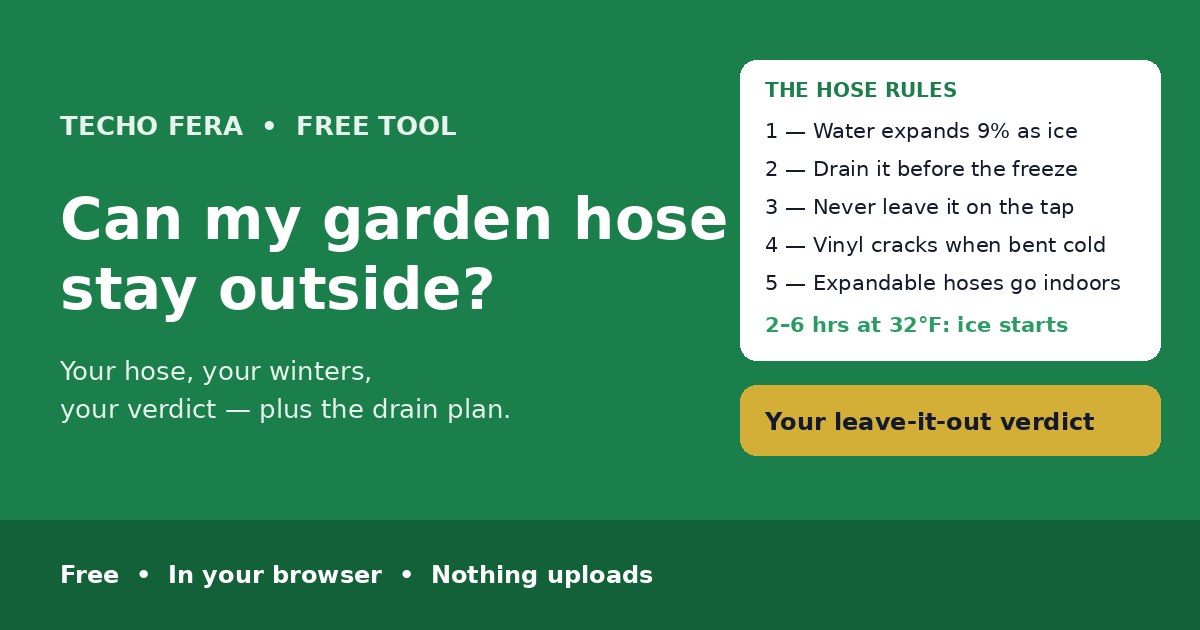
Can your garden hose stay outside this winter?

One freezing night is all it takes: water left inside a hose expands by about 9 percent as it freezes, and that pressure splits the hose — or the tap pipe behind the wall, if the hose is still connected. Answer eight questions about your hose, and this checker tells you whether it can stay out, whether it needs draining first, or whether it belongs indoors — with a drain-and-store plan. Free, in your browser, nothing uploads.

  • 9% ice expansion rule
  • Rubber vs vinyl vs expandable
  • Drain-and-store plan included
  • Free, no account, nothing uploads
Can I leave my garden hose outside in winter? Check your hose in seconds.

Check whether your hose can stay outside

Try a preset:
0 of 8 answered

Your result

Answer the questions Your verdict appears here as you answer.
Recommended action

Answer the questions above and the recommended action will appear here.

Your plan

    Blockers

    Things that do not fit

    Things to check

    Still to confirm

    What to do next

      Your result summary


      Answer the questions above — the verdict updates live.

      Privacy you can verify, not just trust

      Checking whether your hose can stay outside by uploading your home details to a website would be backwards — the check should never be the leak. This one can't: your answers are checked in your browser, and they never leave the device — the only third-party requests are the site's own analytics, which count page views. Don't take our word for it:

      New cross-origin requests during use: 0
      1. Press F12 to open developer tools, then the Network tab.
      2. Answer a question above. Watch: apart from the site's analytics, nothing new is requested — no uploads, and no data ever leaves your device.
      3. Extra credit: disconnect your internet after this page loads — the checker still works.

      How the garden hose winter check works

      A hose left outside for winter is a small job with a big failure mode: water left inside expands by about 9 percent as it freezes, and that pressure splits the hose — or, if the hose is still connected, the tap pipe behind the wall. The guides that rank for this search all say the same thing — drain it, disconnect it, store it — and leave you to judge your own hose. This checker asks eight questions — what the hose is made of, whether it is drained, whether it is still on the tap, what is still screwed onto it, where it will spend the winter, how cold your winters get, and what condition it is in — and turns the answers into a verdict and a step-by-step plan, in the order you should do the job.

      To use it:

      1. Say what the hose is made of. Rubber stays flexible down to about -20°F (-29°C). Vinyl turns stiff and brittle near 32°F (0°C). Polyurethane stays pliable below freezing. An expandable hose has a thin inner tube that ice damages easily. Stainless steel is the toughest of the common types.
      2. Say whether it is drained. Pick it up and listen for water sloshing inside. Even a little water left inside can freeze and do damage — and a hose can only stay outside if it is fully drained.
      3. Say whether it is still connected to the tap. A hose left connected traps water inside the tap as well as the hose, and that water can split the pipe inside the wall — even on a frost-free tap, which only drains when nothing is attached to it.
      4. Say whether anything is still screwed onto the far end. Nozzles, splitters and timers hold water in their plastic housings and valves, and that water cracks them when it freezes.
      5. Say where the hose will spend the winter. Indoors is best. A hose lying on the ground outside faces the worst of it: it freezes solid and gets knocked about.
      6. Say how cold your winters get. A hard freeze is below 28°F (-2°C) for hours. A full hose can start forming ice in 2 to 6 hours at 32°F (0°C) — that timing is the maker's estimate, not a guarantee.
      7. Look the hose over. Cracks, bulges, soft spots and leaking couplings, and the rubber washer inside each female coupling. Replace a flattened or cracked washer now.
      8. Read the verdict — and the plan. The verdict tells you whether the hose can stay out, whether it needs draining first, or whether it belongs indoors. The plan lists the steps in order, so you can walk through them one by one.

      What makes this checker different

      The pages that rank for this search are garden guides and hose-maker product pages. Every one of them gives the same general advice — drain it, disconnect it, store it indoors — and none of them asks what your hose is made of, whether it is actually drained, or where it will spend the winter. None of them tells you that a drained rubber hose can stay outside while a drained vinyl hose in a hard-freeze winter cannot, or that a connected hose is a different emergency from a disconnected one. This page is that answer: eight questions, five verdicts, and a plan that changes with the hose — including the act-today plan for a hose still connected and full of water with a freeze coming, and the bring-it-in plan for vinyl and expandable hoses. It is a planning aid, so it says plainly what it cannot know: it cannot see your hose, and where your answers are uncertain it says so instead of guessing.

      When is this the right check?

      When autumn is ending and the hose is still lying in the garden — because the job has to be done before the first night below freezing, not after it. When you have just bought an expandable hose and wonder whether it can live outside — because it cannot, not in a freezing winter. When the first freeze has already happened and the hose is still full — because that is the moment to check for splits before the thaw turns them into leaks. And when you are not sure what the hose is made of — because the material is half the answer, and the checker tells you how to tell.

      Honest limitations

      A planning aid, not plumbing advice

      This checker cannot see your hose, your tap or your forecast. It cannot tell you exactly how cold your garden gets at night, or whether a hose you cannot see has already split. If you can see water where it should not be, or a tap that leaks when you turn it on, call a plumber.

      The split you cannot see

      A hose that froze full of water often splits where you cannot see it — inside a coupling, or in the pipe behind the wall. The damage shows only when the ice thaws and the water starts leaking, which is why the checker tells you to run the tap briefly and watch for a leak after the first freeze.

      Drained means fully drained

      Half-drained is not drained. Water pools in the low spots of a coiled hose, and even a little water left inside can freeze and split the tube. Lift one end, walk the length, shake it gently — and do not stop until nothing more comes out.

      A cover is not a drain

      Wrapping a hose in a blanket or a hose cover keeps the wind off it, but it does not stop the water inside from freezing. A cover is extra insurance for a drained hose — it is not a substitute for draining it, and a vinyl or expandable hose outside in a hard freeze is still a gamble under a cover.

      Vinyl cracks when bent cold

      Vinyl turns stiff and brittle near freezing, so a vinyl hose that was fine in September can crack the first time you bend it on a cold morning. Coil it in wide loops while it is still mild outside, and do not move it or bend it once the cold has set in.

      Rules from the hose makers and the garden guides, dated November 2026

      The rules here are the published guidance as they read in November 2026: the hose makers on draining before freezing and on the cold limits of each material, and the garden guides on the 9 percent expansion, the trapped-water risk of a connected hose, and the drain-by-walking-the-length method. Guidance changes: recheck with those sources if anything about your plans changes.

      Frequently asked questions

      Can I leave my garden hose outside in winter?

      Yes — but only if it is fully drained before freezing temperatures arrive. A drained rubber, polyurethane or stainless steel hose can stay outside through most winters. A vinyl or expandable hose should come indoors when hard freezes are normal, because vinyl turns stiff and brittle near 32°F (0°C) and an expandable hose has a thin inner tube that ice damages easily. And never leave a hose connected to the tap: a connected hose traps water inside the tap, where it can split the pipe inside the wall. This checker turns your hose, your draining and your climate into a verdict.

      What happens if water is left inside a garden hose in winter?

      Water expands by about 9 percent when it turns to ice, and inside a hose that pressure has nowhere to go — it pushes against the weakest spot, so it splits the inner tube, cracks a coupling, or bursts the tap pipe behind the wall. A full hose can start forming ice in 2 to 6 hours at 32°F (0°C), and faster the colder it gets — that timing is the maker's estimate, not a guarantee. Even a little water left inside can freeze and do damage, and a split often shows only when the ice thaws and the water starts leaking.

      Does it matter what my garden hose is made of?

      Yes — the material decides how much cold the hose itself can take. Rubber stays flexible down to about -20°F (-29°C), so a drained rubber hose is the safest to leave out. Vinyl turns stiff and brittle near 32°F (0°C) and can crack if it is bent while cold, so coil it while it is still mild and carry it indoors. Polyurethane and hybrid hoses stay pliable below freezing. An expandable hose has a thin inner tube that ice damages easily, so it belongs indoors for winter. Stainless steel hose is the toughest of the common types.

      Do I need to disconnect the hose from the tap?

      Yes — disconnect every hose before the first freeze. A hose left connected traps water inside the tap as well as the hose, and that trapped water can freeze back into the wall and split the pipe out of sight, even on a frost-free tap: a frost-free sillcock only drains when nothing is attached to it. After disconnecting, open the tap briefly to let the line drain, and if your home has an indoor shut-off valve for that line, close it and leave the tap open through winter.

      How do I drain a garden hose properly?

      Disconnect the hose from the tap and take off every nozzle, splitter and timer. Open the nozzle end, lift one end of the hose, and walk its length so gravity empties it — shake it gently to dislodge water trapped in low spots. For an expandable hose, leave the nozzle end open and low and let it shrink back on its own; do not stretch it or wring the fabric cover to speed things up. Once nothing more comes out, coil it in wide loops while it is still mild enough to bend.

      Can an expandable hose stay outside in winter?

      No — an expandable hose belongs indoors for winter. Its inner tube is thin and easily damaged by ice and sharp edges, and the fabric cover does not protect it from freezing. Let it shrink fully with the nozzle end open and low, drain it, dry it, and store it indoors in wide loops. A hose cover does not replace draining it, and a cover on an expandable hose outside in a hard freeze is still a gamble.

      Where should I store my garden hose for winter?

      Indoors is best — a heated room if you can, or at least a garage or shed where it will not be knocked about. Coil it in wide loops while it is still mild outside, and do not hang a heavy wet hose by its full weight from one nail. If the hose has to stay outside, it must be fully drained first, coiled on a reel or hanger off the ground, and even then only a hardy rubber, polyurethane or stainless steel hose is a safe bet in a hard-freeze winter.

      Does this checker give plumbing advice?

      No. This checker is a planning aid: it runs your answers against the published guidance as it reads in November 2026, entirely in your browser, and nothing you enter leaves your device. A web page cannot see your hose, your tap or your forecast, so it says plainly what still needs checking — above all, whether the hose has actually been drained, and whether it is still connected to the tap.