How to tell whether poinsettias are a risk for your cat
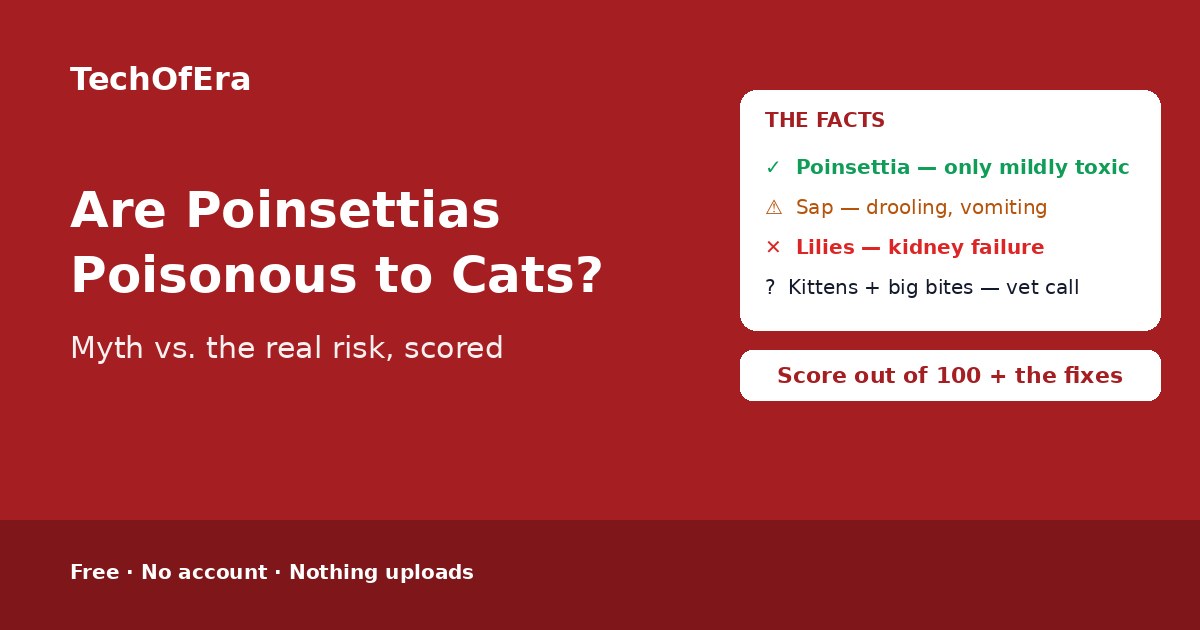
Poinsettias have a bad rap, and the Pet Poison Helpline says it is mostly undeserved: the plant is only mildly toxic to cats and dogs. The milky white sap in the leaves, bracts and stems contains diterpenoid euphorbol esters and saponin-like detergents — chemicals that irritate the mouth, stomach, skin and eyes, but that are not deadly in the amounts a cat usually eats. When a cat chews the leaves, the usual result is drooling, lip-licking, one vomit, or rarely diarrhoea, and the signs are generally self-limiting: the cat has an episode or two and then is fine, and medical treatment is rarely needed unless the signs are severe or persistent. No deaths from poinsettia ingestion in a dog or cat have been reported. One often-quoted veterinary estimate puts the scale of it: a 50-pound child would have to eat about 500 poinsettia leaves to approach a toxic dose. So the question is never really “is this plant poisonous?” — it is “how much did my cat eat, what symptoms does it have, and what else is in the room?” That is what this checker scores.
To use it:
- Answer the ten questions honestly. Which cat it is, what it ate or touched, how much, when it happened, the symptoms so far, how long they have lasted, whether the cat is still eating and drinking, what other holiday plants are nearby, whether the plant is still within reach, and any health condition. If you are not sure about an answer, say so — the checker scores the unknown as a small risk and lists it as something to confirm, rather than guessing.
- Read the score and the biggest factor. The verdict is a score out of 100, and the biggest factor is named in plain words. Amount eaten is usually the one that matters most — but a lily in the same room, sap in the eyes, or a cat that has stopped eating can outweigh it.
- Fix the blockers first. Anything in the blockers list needs a vet today, or a change today: lilies in the house, repeated vomiting, several symptoms at once, symptoms lasting more than 24 hours, a cat that will not eat or drink, or sap in the eyes. If your cat has several severe symptoms at once, that is a call-your-vet-now verdict, not a low score.
- Work down the cautions. Every caution is a small fix or a thing to watch: wipe sap off the fur, move the plant out of reach, pick up fallen leaves, check the food and water bowls tonight. Each one moves the score up — re-run the checker after the fixes to see the new verdict.
- Keep the cat away from the plant until it is fixed. A verdict of “worth a vet call today” or worse means the cat should not be left alone with the plant. A high shelf is not enough — cats climb. Shut the plant in a room the cat cannot enter, or move it out of the house.
- Know the warning signs. Repeated vomiting, diarrhoea, lethargy, hiding, unsteadiness, loss of appetite, or a cat that will not eat or drink after eating poinsettia mean call your vet the same day. Sap in the eyes means call your vet for advice the same day, even if the cat seems fine otherwise.
Exposure and what to do at a glance
The table below is built from the same rules as the checker, so it can never disagree with your verdict. The biggest factor decides, not the number of small ones.
| Situation | Verdict | What to know |
|---|
What makes this checker different
The pages that rank for this search are guides — thorough explanations from the Pet Poison Helpline, Purina, Chewy, the Old Farmer’s Almanac and Daily Paws of why poinsettias are only mildly toxic, what the symptoms are, and what to do if your cat eats one — but they leave you to judge your own cat: to weigh a few leaves against a large amount, a kitten against an adult, drooling against repeated vomiting, a poinsettia against the lilies sitting next to it, and to decide which of those matters most. None of them gives you a verdict for your cat. This page is the answer for your cat: ten questions in, a score out of 100, the single biggest factor named, and a verdict that says mild risk, keep watching, or call the vet — with the next steps in the order that matters, and the emergency case handled as an emergency, not a low score. It is a self-assessment, so it says plainly what it cannot know: a web page cannot watch your cat or examine your cat, so anything you mark “Not sure” stays on the list until you confirm it. And it is about what the plant does to your cat — not how to keep the plant alive. For plant care, see our How to Keep a Poinsettia Alive? Checker.
When is this the right check?
Whenever a poinsettia comes into a house with a cat: the day you bring one home, the day you notice chewed leaves, the day the cat starts drooling or vomiting after the plant went up, or the day you find sap on the fur. Also whenever the situation changes — a kitten arrives, someone brings lilies into the house, the cat eats a lot more than a nibble, or the symptoms last into a second day. And whenever something has already happened: repeated vomiting, a cat that will not eat or drink, or sap in the eyes — those last ones are vet calls, not checklists.
Honest limitations
A self-assessment, not a diagnosis
This checker works only from the answers you enter. It cannot diagnose your cat — no web page can watch your cat, examine your cat, or know your cat’s medical history. If an answer is wrong, the verdict is wrong. When in doubt, move the plant out of reach — or ask your vet.
The score is a guide, not a guarantee
A high score means the risks you described are mild — not that nothing can happen. A cat that took one nibble today can eat half the plant tomorrow, and a single swallowed lily petal is an emergency whatever the score was. Re-check whenever the cat’s behaviour changes.
Mildly toxic is not the same as safe
Poinsettias are only mildly toxic, but “mildly toxic” still means an irritant: drooling, vomiting and diarrhoea are real symptoms, and a large amount in a kitten or a cat with a kidney condition is a vet call. The myth is that poinsettias kill — the truth is that they make cats feel rough, and sometimes rough enough to need a vet.
Cats hide illness
Cats are good at hiding pain, so by the time the signs are obvious — repeated vomiting, not eating, a painful belly — the damage may already be serious. After the plant goes up, watch for the small signs: drooling, hiding, a cat that will not eat, or a cat that is drinking less than usual.
Warning signs override the verdict
Repeated vomiting, lethargy, unsteadiness, loss of appetite, or a cat that will not eat or drink mean call your vet the same day, whatever the checker said. Sap in the eyes means call your vet for advice the same day. Never try to make your cat vomit, and never give it medicine unless your vet tells you to.
Rules from veterinary sources
The rules here follow guidance from the Pet Poison Helpline, the ASPCA, Chewy’s veterinary team, Purina and the Old Farmer’s Almanac, as they read in November 2026. Guidance can be revised, so re-check if a new edition appears — and a vet who can see your cat always outranks a web page.