How the pain check works
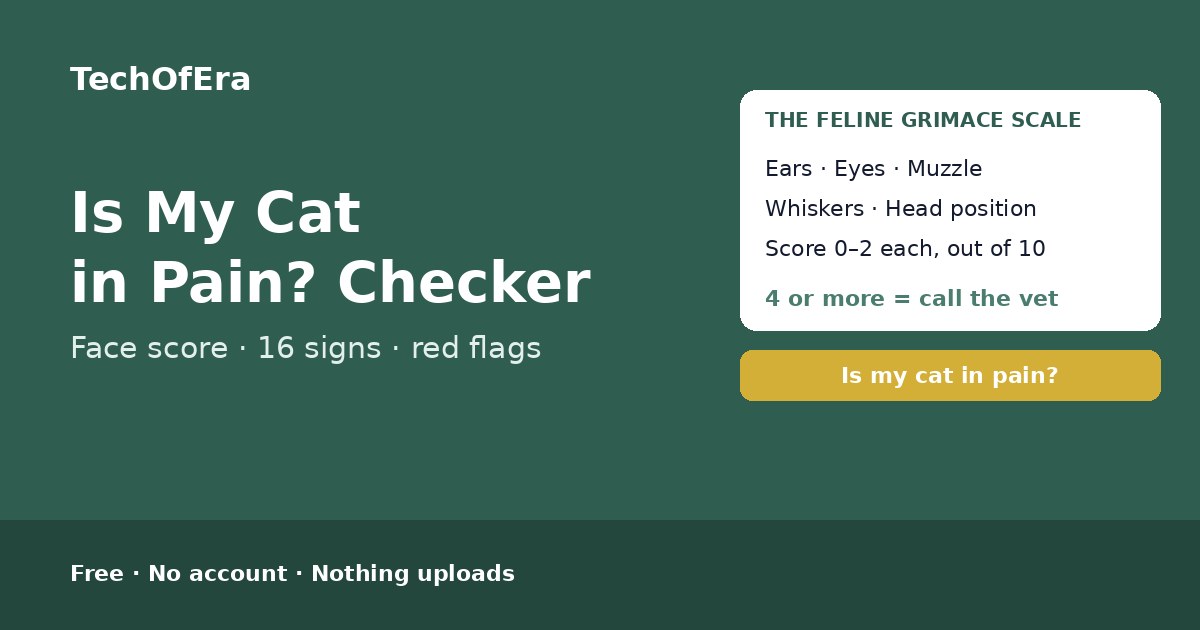
Cats hide pain — it is a survival instinct, and it is one reason caring owners can miss early warning signs. So the check does not look for one dramatic sign: it looks at two things. First, the face: the Feline Grimace Scale, developed by researchers at the Université de Montréal and validated in 2019, scores five facial features — ear position, eye narrowing, muzzle tension, whisker position and head position — from 0 to 2, for a total out of 10. A total of 4 or more suggests the cat is in pain and needs veterinary care. Second, behaviour: researchers at the University of Lincoln found 19 feline-medicine experts agree on 25 behaviours that point to pain when they appear — movement changes, eating and grooming changes, litter box changes, and mood changes — and this checker lists sixteen of them in five groups. One sign alone does not prove pain. A new sign that stays, or several signs together, is a reason to see a vet — and that is exactly how this checker scores: it counts the signs, weighs the face score, and a week or more of signs moves the verdict one band up. A red flag (open-mouth breathing, collapse, straining to urinate, trauma, pale gums, a seizure) is an emergency on its own, whatever else is scored or ticked.
To use it:
- Score the face. Watch your cat for about 30 seconds while it is not eating, grooming or sleeping, and score each of the five features 0, 1 or 2 against how the cat looks when comfortable. If you cannot see a feature clearly, leave it on “not sure” — the checker says so instead of guessing.
- Tick every behaviour sign that is new for your cat. Work through the five groups — movement, activity, behaviour, daily habits, and body and face. Compare against your cat’s normal, not against other cats: a slow change in your own cat is the signal.
- Check the red flags. Open-mouth breathing, collapse, straining to urinate with little or no urine, trauma, pale or blue gums, or a seizure are emergencies. If any of them is true, stop reading and call a vet now.
- Say how long the signs have been there. Pain that stays is a stronger signal than pain that just appeared, so a week or more moves the verdict one band up. If you are not sure, the checker says so instead of guessing.
- Say how old your cat is. Kittens, adults and seniors get pain for different reasons — arthritis is common in seniors, injury more often in kittens — so the advice changes with the life stage.
- Read the verdict, then take the summary to the vet. The copy, download and print buttons give you a summary with the face score, the signs, how long they have lasted and your cat’s life stage — the notes vets need, because the vet may not see the signs in the clinic.
What makes this checker different
The pages that rank for this search are guides — howpetcare.com’s triage chart, cattcountycatnippers.org’s 25-sign guide, serligblog.com’s 15-sign list, theidealcat.com’s hidden-signs guide, and pawsintograce.com’s hospice guide — all of them explain the Feline Grimace Scale and the behaviour signs, and none of them lets you use them. There is no free, standalone checker that scores the five face features for you and combines the score with the behaviour signs into a verdict: watch and log, book a vet visit, or call one now — with the face score, the signs grouped, the duration weighed, and a vet-visit summary to take with you. The quality-of-life quizzes that do exist answer a different question: they score seven areas on the HHHHHMM scale for end-of-life decisions in seriously ill or senior cats, not “my cat seems off today — is it pain?”. This page is that answer: five face features, sixteen signs, six red flags, an instant verdict for your cat, and the next steps.
When is this the right check?
When your cat seems off and you cannot put your finger on why — a little stiffer, a little quieter, a little less interested in the game. When a limp or a new behaviour has appeared and you are not sure whether it needs a vet or just watching. When your cat has stopped jumping to its usual spot and you want to know whether that counts. When you are about to call the vet and want your notes in order first. And whenever a guide gives you a list of signs without telling you what to do with them: the list is only useful once it becomes a verdict.
Honest limitations
A self-assessment, not veterinary advice
This checker cannot examine a cat. Only a vet who has seen your cat can diagnose pain or advise treatment. If you are worried, it is always okay to call your vet — the checker helps you describe what you see, it does not replace the examination.
No single sign proves pain
Every sign here can also mean something else: hiding can be fear, a limp can be a thorn, over-grooming can be stress. The verdict counts signs and weighs the face score, because several signs together — or one sign that stays — is the signal, not any one tick.
The face is one piece of the picture
The Feline Grimace Scale is validated for acute pain, but a cat’s expression also changes with fear, anxiety, nausea and stress, and some features are hard to see on long-haired or flat-faced cats. The checker treats the face score as supporting evidence alongside the behaviour signs, and says plainly when only some features could be scored.
Purring does not mean a cat is comfortable
Cats also purr to self-soothe when distressed. A purring cat that is also hunched, with flattened ears and squinted eyes, is not telling you it is fine. Judge the whole cat — face, posture and behaviour together — not the sound alone.
Never give human pain medicine
Paracetamol is fatal to cats, even in small doses, and ibuprofen and aspirin are dangerous too. The safe thing to do at home is rest, comfort and a vet visit — not a tablet from your own cabinet.
Signs grounded in veterinary guidance, dated November 2026
The signs here are the Feline Grimace Scale (Evangelista et al., 2019), the 25 behaviours agreed by 19 feline experts (Merola and Mills, 2016), Cornell Feline Health Center and International Cat Care guidance, checked in November 2026. Guidance changes: if your cat is getting worse, call the vet — do not wait for a web page to agree with you.