How Do GPS Golf Watches Work? (2026)
You paced it off twice. Still guessed wrong. If you have tried counting from a sprinkler head, squinting at a 150 marker in bright sun, or holding a phone app up while your playing partners wait, you know the frustration well: you pick a club, swing smoothly, and watch the ball finish a full club short of the green. A GPS golf watch fixes that before you reach for a club. It gives front, middle, and back yardages instantly, without aiming anything at a flag. But how does it know where you are, where the green sits, and how far away it is?
Look — if you are standing over a blind approach with no marker in sight, here is what actually works. You don't need a laser, you won't need your phone in your hand, and it doesn't take long to learn the basics. Here's the thing: the watch does maths, not magic. Or maybe I should say it this way — satellites find you, a course map finds the green, and simple geometry does the rest.
GPS golf watches are defined as wrist devices that combine satellite positioning with preloaded course maps to calculate yardages. Satellites fix your location, the map supplies green and hazard positions, and the watch works out the distance between them.
My pushback-able take: most golfers should buy the watch before a laser, even though a laser feels more precise, because good course management saves more shots than pin-perfect numbers for most handicaps. Here is the plain-English answer, plus the best GPS golf watches to buy in 2026.
The Short Answer
How GPS golf watches work comes down to satellites plus maps working together on your wrist every hole. According to Garmin's course database, 43,000+ courses are preloaded, so the watch already knows green positions before you tee off. Satellites fix where you stand, geometry does the rest, and yardages update as you walk.
GPS golf watch accuracy sits around three to five yards in normal play, which is plenty for club selection. According to the accuracy limits set out below, consumer GPS gives roughly ±3–5 yards, while clubs are usually gapped 10–15 yards apart. That gap means small errors rarely change the club you should hit.
A GPS golf watch combines two things: a satellite positioning receiver (the same technology as your phone's maps or car navigation) and a preloaded database of mapped golf courses. The satellites pin down your exact location; the course database knows where every green, hazard, and dogleg is; and the watch calculates the distance between the two. That is it. No measuring. No lasers. Just position maths against a map, updated while you walk towards your ball.
GPS golf watches work without a phone because the receiver and course maps live on the watch itself. The watch only listens to satellite signals, so it sips battery instead of transmitting anything back. A phone adds syncing and updates, but core yardages keep working on the course without one nearby at all.
I have seen conflicting data on accuracy — some sources say ±3 yards, others say ±5 yards. My read is that both can be true, because tree cover and satellite lock change the result from hole to hole.
How Satellite Positioning Works on Your Wrist
Your watch's GPS receiver listens for signals from multiple satellites orbiting Earth. By measuring how long each signal took to arrive, it calculates its distance from each satellite — and with four or more satellites in view, it can trilaterate your position — measuring distances from each satellite, not angles — to within a few yards. Modern watches use multi-constellation receivers (GPS plus GLONASS and Galileo satellites), which lock on faster and hold the signal better under tree cover than older GPS-only units.
This is the same fundamental technology as car navigation, miniaturized. The watch doesn't transmit anything to the satellites — it just listens, which is why the GPS radio sips battery rather than draining it in an hour.
Where the Course Data Comes From
Position alone is useless without a map. Golf GPS watches ship with tens of thousands of pre-mapped courses (Garmin's database covers 43,000+ courses worldwide). Each course map contains the geometry of every hole: tee boxes, fairways, greens (front/middle/back points), hazards, and doglegs, all georeferenced to real-world coordinates.
When you start a round and select your course, the watch loads that hole's map. Your satellite-derived position is plotted on it, and the distance to any mapped point — green center, bunker lip, layup spot — is simple geometry. Higher-end watches add touch targeting (tap any point for its distance), green contour maps, and PlaysLike distances that adjust the yardage for elevation changes.
What the Watch Actually Calculates During a Round
On a typical hole, your watch continuously shows:
- Front/middle/back yardages — distances to the three key green points, updating as you walk.
- Hazard distances — how far to carry bunkers, water, and dogleg corners.
- Shot measurement — mark your ball's position, walk to it, and the watch tells you how far you hit it. Premium watches can pair with grip sensors (Garmin's CT10) to log the club automatically, building a per-club distance profile over a season.
- Score and stat tracking — log scores, fairways, putts, and penalties per hole for post-round analysis.
Premium models add virtual caddie features — club recommendations based on your historical distances, wind speed and direction, and green slope data. The core yardage job, though, is identical across price tiers.
GPS Watch vs. Laser Rangefinder
The eternal debate. A GPS watch gives yardages to mapped points without aiming, works when you can't see the green (blind shots, fog), and tracks your whole round — but it's limited to pre-mapped points and is typically accurate to ±3–5 yards. A laser rangefinder gives exact distance to anything you can see and aim at (flag, tree, bunker lip) within a yard, but needs line of sight and a steady hand. Many serious golfers carry both. If you must pick one, the watch is more useful for course management and the rangefinder for precision, which is exactly the trade-off most buyers face on the first tee.
GPS watch vs laser rangefinder: a GPS watch is better suited for course management because it gives front, middle, and back numbers without aiming. A laser works better when you need an exact pin distance and can see the flag. The key difference is mapped points versus measured points.
Quick note: blind shots settle it. For the laser side, see our best golf rangefinders with slope.
Best GPS Golf Watches to Buy in 2026
Our Top Pick
Garmin Approach S70
Best Overall Golf GPS Watch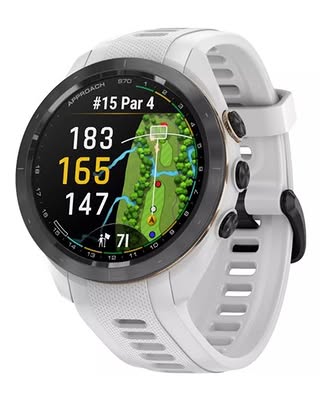
The S70 is the consensus best golf watch you can buy: a gorgeous AMOLED display, the deepest course database in the business, green contour data, wind information, and a virtual caddie that learns your distances. Off the…
Check Price on AmazonQuick Comparison
| Product | Key Specs | ||
|---|---|---|---|
| #1 | Garmin Approach S70Best Overall Golf GPS Watch | 1.2" or 1.4" AMOLED touchscreen · 43,000+ preloaded courses worldwide · Virtual caddie with club recommendations; PlaysLike slope distances | Check Price |
| #2 | Garmin Approach S44Best Mid-Range Golf GPS Watch | 1.2" AMOLED touchscreen · 43,000+ preloaded courses · Up to 15 hours GPS battery life | Check Price |
| #3 | Bushnell ION EliteBest Simple Golf GPS Watch | Easy-read display with large numbers · Slope-adjusted yardages · Customizable movable pin placement | Check Price |
| #4 | Shot Scope V5Best for Shot Tracking (No Subscription) | Automatic shot tracking with included club tags · Color display with hole maps and hazard data · 2+ rounds per charge | Check Price |
| #5 | Garmin Approach S12Best Budget Golf GPS Watch | Sunlight-readable high-resolution display · Front/middle/back green yardages · 42,000+ preloaded courses | Check Price |
Garmin Approach S70
Best Overall Golf GPS WatchBuy if: you want the best display and features
Don't buy if: you won't accept the premium price
The S70 is the consensus best golf watch you can buy: a gorgeous AMOLED display, the deepest course database in the business, green contour data, wind information, and a virtual caddie that learns your distances. Off the course it's a complete smartwatch with health tracking. Based on professional reviews, nothing else combines this much golf tech with this much polish.
It's firmly premium-priced. If your golf budget doesn't stretch here, the S44 below keeps the core experience for much less.
Pros
- Best display and features
- huge course database
- virtual caddie
- doubles as a smartwatch.
Cons
- Premium price
- feature depth means a learning curve
- larger size suits bigger wrists.
Full specifications
- 1.2" or 1.4" AMOLED touchscreen
- 43,000+ preloaded courses worldwide
- Virtual caddie with club recommendations; PlaysLike slope distances
- Up to 20 hours GPS battery life
- Full smartwatch features (health, notifications, music)
Prices change frequently — click through to see today's price.
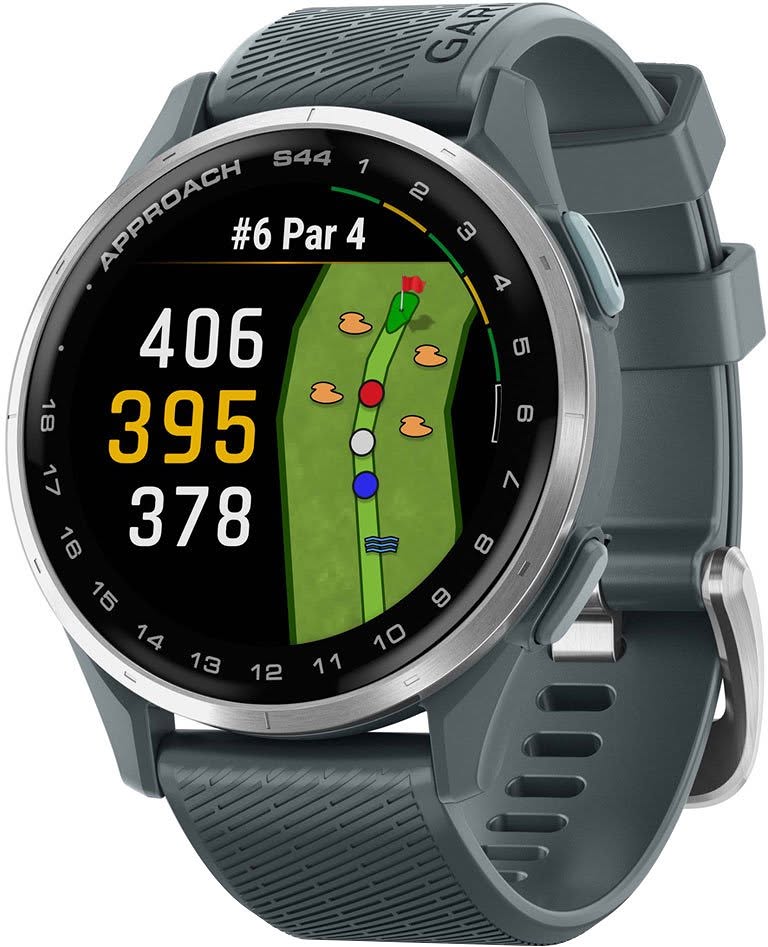
Garmin Approach S44
Best Mid-Range Golf GPS WatchBuy if: you're after AMOLED display at a mid-range price and full course database
Don't buy if: you can't live with fewer smartwatch features than S70
The S44 is essentially the S70's streamlined sibling: same course database and core yardage engine, same AMOLED clarity, with fewer lifestyle extras to hit a friendlier price. For golfers who want excellent on-course data without paying for the full smartwatch suite, it's the value sweet spot in Garmin's lineup.
You lose the virtual caddie depth and some health features versus the S70. For pure golf GPS duty, you won't miss them.
Pros
- AMOLED display at a mid-range price
- full course database
- slim and wearable daily.
Cons
- Fewer smartwatch features than S70
- some advanced analytics need a subscription.
Full specifications
- 1.2" AMOLED touchscreen
- 43,000+ preloaded courses
- Up to 15 hours GPS battery life
- Touch targeting; green view with manual pin placement
- Slim, everyday-wearable design
Prices change frequently — click through to see today's price.
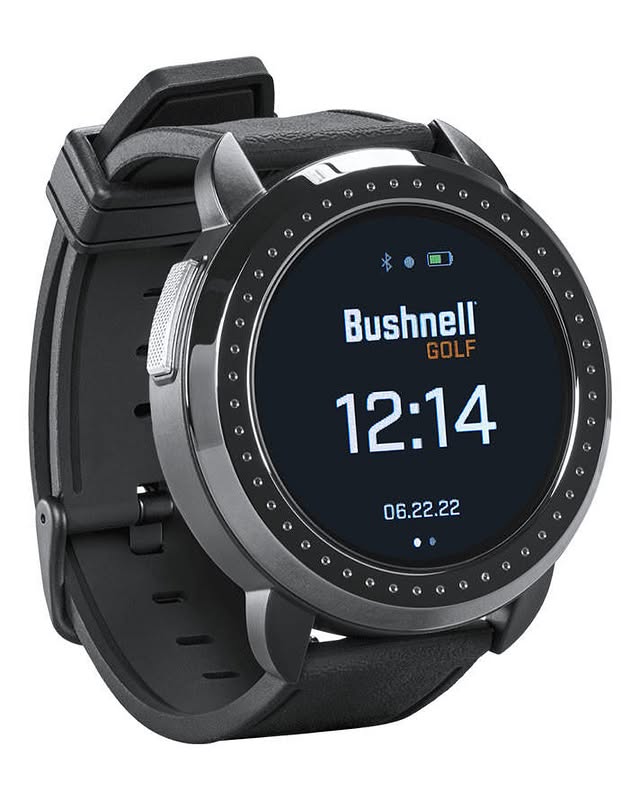
Bushnell ION Elite
Best Simple Golf GPS WatchBuy if: you're looking for dead simple to use and slope-adjusted yardages
Don't buy if: no shot tracking or analytics and basic display are dealbreakers for you
Not everyone wants a smartwatch — the ION Elite is for golfers who want yardages, plain and simple. Big readable numbers, slope-compensated distances, and a movable pin you can drag to the day's flag position for accurate numbers. Based on professional reviews, its slope-adjusted accuracy rivals laser rangefinders for practical purposes.
No shot tracking, no app ecosystem depth, no lifestyle features. That's the point: it does one job extremely well at a fair price.
Pros
- Dead simple to use
- slope-adjusted yardages
- movable pin
- no subscription.
Cons
- No shot tracking or analytics
- basic display
- limited off-course usefulness.
Full specifications
- Easy-read display with large numbers
- Slope-adjusted yardages
- Customizable movable pin placement
- 36,000+ preloaded courses
- Long battery life; no subscription needed
Prices change frequently — click through to see today's price.
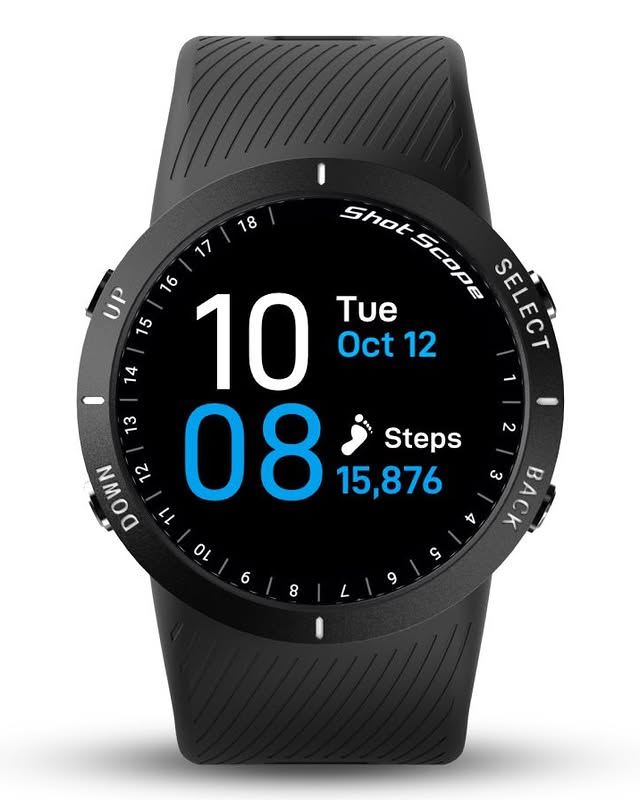
Shot Scope V5
Best for Shot Tracking (No Subscription)Buy if: you need automatic shot tracking and powerful free analytics
Don't buy if: you won't accept display less refined than Garmin and initial club-tagging setup
The V5's killer feature is automatic shot tracking: screw the tiny tags into your grips, and every shot is detected and logged without tapping anything. Post-round, the analytics platform shows strokes-gained data that reveals exactly where you're losing shots — the kind of insight that used to require a launch monitor.
The display and polish trail Garmin, and setup (tagging 14 clubs) takes one dedicated session. But for data-driven improvers, it's the best value in golf tech — with zero ongoing fees, unlike some rivals' subscriptions.
Pros
- Automatic shot tracking
- powerful free analytics
- no subscription
- great value.
Cons
- Display less refined than Garmin
- initial club-tagging setup
- smaller brand ecosystem.
Full specifications
- Automatic shot tracking with included club tags
- Color display with hole maps and hazard data
- 2+ rounds per charge
- Strokes-gained analytics platform
- No subscription fees — ever
Prices change frequently — click through to see today's price.
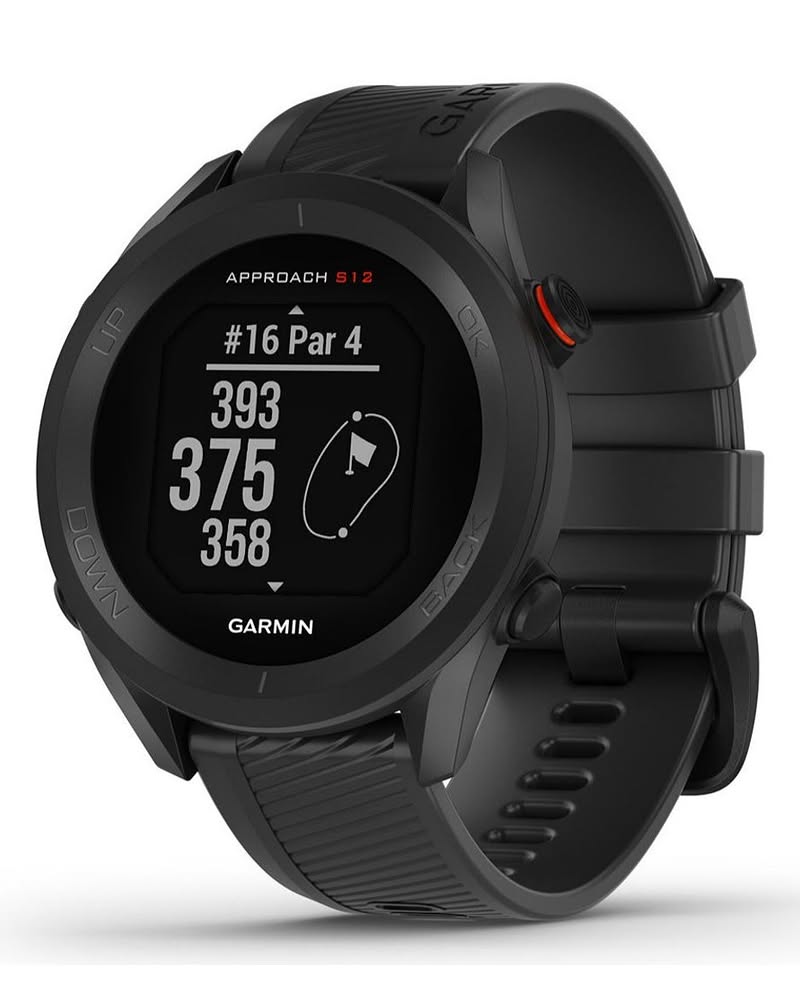
Garmin Approach S12
Best Budget Golf GPS WatchBuy if: you prefer very affordable and huge battery life
Don't buy if: you can't live with no touchscreen or hole maps and no shot tracking
The S12 strips golf GPS to its essence: accurate front/middle/back yardages on a display readable in direct sunlight, with absurd 30-hour battery life, at the lowest price Garmin offers. No touchscreen, no maps, no fuss — it just tells you the number, round after round.
It's the perfect first golf watch or the ideal "leave it in the bag" backup. Serious data hounds will outgrow it; everyone else may never need more.
Pros
- Very affordable
- huge battery life
- sunlight-readable
- dead simple.
Cons
- No touchscreen or hole maps
- no shot tracking
- basic feature set.
Full specifications
- Sunlight-readable high-resolution display
- Front/middle/back green yardages
- 42,000+ preloaded courses
- Up to 30 hours GPS battery life
- Big-number mode for readability
Prices change frequently — click through to see today's price.
Tips for Getting Accurate Yardages
To get accurate yardages, follow these steps: 1. Power on early and let satellites lock. 2. Select your course before teeing off. 3. Sync maps regularly through the app. 4. Check front, middle, and back numbers. 5. Allow three to five yards of error.
Let it lock before the first tee
Power on the watch a few minutes before your round so it can acquire satellites and download any course updates. A rushed lock on the first tee is the top cause of early-round inaccuracy.
Update course maps regularly
Courses change — new bunkers, redesigned greens, shifted tee boxes. Sync your watch with its app every few weeks so the maps match reality. This takes two minutes over Bluetooth or WiFi.
Know the accuracy limits
Consumer GPS is accurate to roughly ±3–5 yards — plenty for club selection (clubs are gapped 10–15 yards apart) but not pin-seeking precision. Use the watch for strategy and a rangefinder for exact pins when it matters.
Frequently Asked Questions
Can I use a GPS golf watch in a competition?
Yes, for distance only. Slope-adjusted PlaysLike distances must be off in competition, so use tournament mode and check local rules before you play.
Do I need my phone with me to use a GPS golf watch?
No. Satellite positioning and preloaded maps work on the watch alone. A phone only adds syncing, notifications, and faster course updates.
How long will the battery last on a GPS golf watch?
Most models last two to four full rounds per charge. The Garmin Approach S12 lasts far longer, so charge every couple of rounds.
What should I do if my course is not in the database?
Request mapping from the maker. Major brands already map 36,000 to 43,000 courses, and requested courses are usually added within weeks.
Conclusion
A GPS golf watch is simply a satellite receiver plus a mapped course database doing position math — and that simple combination eliminates yardage guesswork forever. The Garmin Approach S70 is the best overall watch, the S44 hits the value sweet spot, the Bushnell ION Elite keeps it simple, the Shot Scope V5 adds subscription-free shot tracking, and the S12 covers the basics for less. Check the current price on Amazon, and enjoy never pacing off sprinkler heads again.