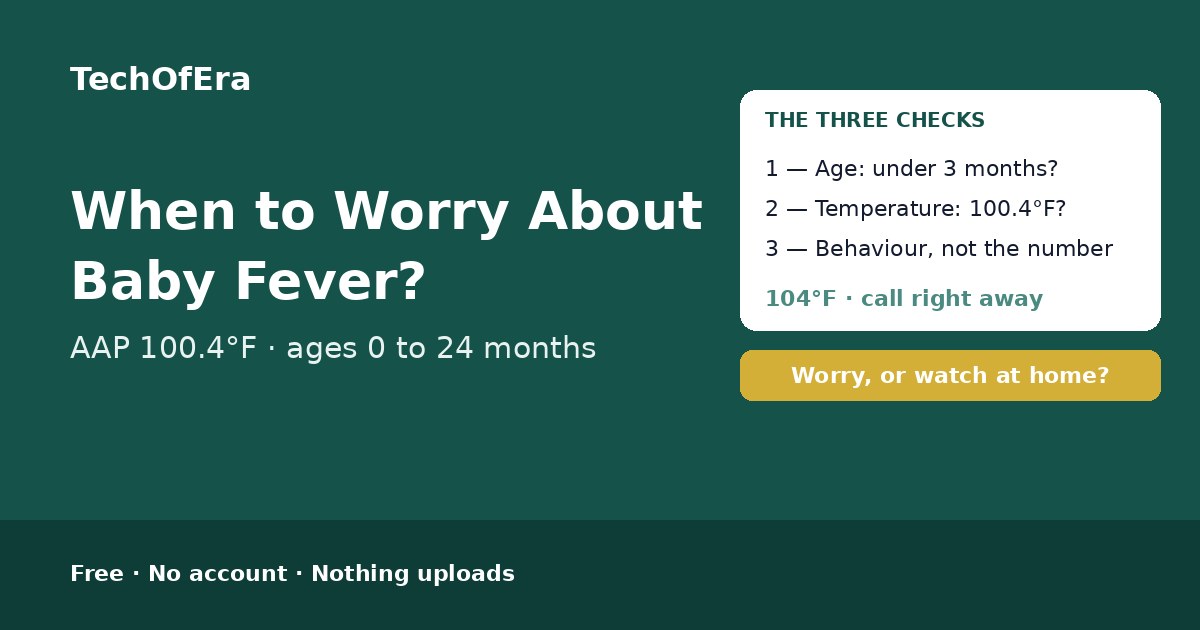
Should you worry about your baby’s fever?

It is 2 a.m., the thermometer says 102.8°F, and you cannot tell whether to call the doctor, wait until morning, or go to A&E. The guides say 100.4°F is a fever and 104°F is a call — but neither tells you what your baby’s number means at your baby’s age, with the way they are acting tonight. Enter the age, the temperature and the warning signs — this checker gives you the verdict in seconds, free, in your browser, nothing uploads.

  • AAP 100.4°F fever line
  • Behaviour matters more than the number
  • Emergency signs named, not buried
  • Free, no account, nothing uploads
Should you worry about your baby's fever?

Check whether your baby’s fever is worrying

Try a preset:
0 of 8 answered

Your result

Answer the questions Your verdict appears here as you answer.
What to do at home

Enter your baby’s temperature above and the home-care steps for your baby’s situation will appear here.

Blockers

Things that do not fit

Things to check

Still to confirm

What to do next

    Your result summary


    Answer the questions above — the verdict updates live.

    Privacy you can verify, not just trust

    Checking whether your baby’s fever is worrying by uploading your baby’s details to a website would be backwards — the check should never be the leak. This one can't: your answers are checked with plain JavaScript on your device, and they never leave the device — the only third-party requests are the site's own analytics, which count page views. Don't take our word for it:

    New cross-origin requests during use: 0
    1. Press F12 to open developer tools, then the Network tab.
    2. Answer a question above. Watch: apart from the site's analytics, nothing new is requested — no uploads, and no data ever leaves your device.
    3. Extra credit: disconnect your internet after this page loads — the checker still works.

    How the baby-fever check works

    The American Academy of Pediatrics says a fever is a rectal temperature of 100.4°F (38°C) or higher, and the NHS says the same. But a number on a thermometer is not a verdict: a 100.4°F fever is an emergency at 1 month and watchable at 14 months, a 103°F baby who is drinking and playing is often less worrying than a 101°F baby who is limp and hard to wake, and a fever that has lasted 3 days means call whatever the number is. This checker combines four clues — your baby’s age, the temperature and how it was measured, how long the fever has lasted, and how your baby is acting and drinking — plus the warning signs, and gives you a verdict for tonight: emergency, call your doctor right away, call today, monitor at home, or no fever — with the home-care steps for your baby’s situation.

    To use it:

    1. Enter your baby’s age in months. The rules change with age — a fever under 2 months is an emergency, at 2–3 months it means call right away, and a moderate fever under 6 months means call today. The checker covers birth to 24 months.
    2. Enter the temperature. Take it with a digital thermometer — rectal is the most accurate for a baby, and the only reading the emergency rules are written for. Enter it in °F or °C.
    3. Say how it was measured. Armpit readings can run about 1°F low, forehead scanners are inconsistent in young babies, and ear thermometers are not recommended under 6 months. If the reading is close to the fever line, confirm it rectally.
    4. Say how long the fever has lasted. A fever lasting more than 24 hours in a child under 2 years means call your doctor, and more than 3 days means call whatever the age.
    5. Say how your baby is acting and drinking. Playing and alert is reassuring. Very drowsy, hard to wake, limp or floppy is an emergency, whatever the thermometer says. Refusing fluids or fewer wet nappies are dehydration signs.
    6. Tick any warning signs you can see. A stiff neck, trouble breathing, a rash that does not fade when pressed with a glass, a seizure, or blue or grey lips are emergency signs. Repeated vomiting or a sunken soft spot mean call right away.

    What makes this checker different

    The pages that rank for this search are guides — the AAP’s HealthyChildren page, WebMD’s fever-in-babies guide, the paediatric practice pages that list when to call, and long articles that give you the thresholds and leave you to do the sums at 2 a.m. There is no free, standalone checker that takes your baby’s exact age, the temperature and how it was measured, how long the fever has lasted, how your baby is acting and drinking, any fever medicine, and the warning signs — and gives you a verdict: emergency, call right away, call today, monitor at home, or no fever — with the home-care steps and every fix named. This page is that answer: eight questions, an instant verdict for your exact baby and your exact reading, the blockers named, and the next steps. It is a self-assessment, so it says plainly what it cannot know: it cannot feel your baby or read your thermometer, and where the number and the baby disagree it trusts the baby instead of guessing.

    When is this the right check?

    At 2 a.m., when the thermometer says 102°F and you cannot tell whether to call the doctor, wait until morning, or go to A&E. When the fever has been going for 2 days and you cannot remember whether the 24-hour or the 3-day line applies to your baby’s age. When someone else took the temperature — grandparents, babysitters, nursery — and you do not know whether it was rectal or armpit, and the reading is close to the fever line. When your baby is sleepier than usual and you cannot tell whether that is the fever or something worse. And whenever the number and the baby disagree — because that is when a guide leaves you guessing and a checker earns its keep.

    Honest limitations

    A self-assessment, not medical advice

    This checker cannot feel your baby or read your thermometer. It cannot check how your baby is acting, whether they are drinking, or what the thermometer actually says. If you are worried about your baby’s fever, behaviour or breathing, call your doctor or health visitor — and in an emergency call 999 or 911.

    Behaviour matters more than the number

    A higher number does not always mean a more serious illness. A baby with a 103°F fever who is drinking and playing is often less worrying than a baby with a 101°F fever who is limp and hard to wake. Watch the baby, not just the thermometer.

    The method can move the number

    Armpit readings run about 1°F low, forehead scanners are inconsistent in young babies, and ear thermometers are not accurate under 6 months. For a baby under 3 months, only a rectal temperature should be used to decide — the checker says so instead of treating every reading as equal.

    Fever medicine lowers the number, not the illness

    Paracetamol and ibuprofen are for comfort, not for the number — and they can mask a fever. Do not give fever medicine to a baby under 3 months before calling the doctor, and never give aspirin to a child. If you are unsure of the right dose, call your doctor — do not guess from a chart on the internet.

    A febrile seizure is frightening, not usually dangerous

    A brief seizure when a fever rises quickly is frightening but usually harmless and does not cause brain damage. Even so, any seizure needs emergency care — call 999 or 911, lay your baby on their side, and note how long it lasts.

    Rules from official sources, dated November 2026

    The rules here are the AAP’s fever guidance (HealthyChildren, updated 2 December 2022) and the NHS fever-in-children guidance, as they read in November 2026. Guidance changes: recheck with your doctor or health visitor if anything about your baby changes.

    Frequently asked questions

    What temperature counts as a fever in a baby?

    A rectal temperature of 100.4°F (38°C) or higher counts as a fever, according to the American Academy of Pediatrics. An armpit temperature of 99°F or higher counts too, because armpit readings run about 1°F low. A baby’s normal temperature ranges from about 97.0 to 99.5°F. How the temperature was taken matters as much as the number: rectal is the most accurate for a baby, forehead scanners give inconsistent readings in young babies, and ear thermometers are not recommended under 6 months. For a baby under 3 months, only a rectal temperature should be used to decide about a fever.

    When should I call the doctor about my baby’s fever?

    Call right away for any fever in a baby under 3 months, for a temperature of 104°F (40°C) or higher at any age, and for a fever with a stiff neck, trouble breathing, an unexplained rash, repeated vomiting or diarrhoea, a seizure, or a baby who is very drowsy, limp or hard to wake. For a baby under 2 months with a fever, go to A&E or the emergency room — do not wait and do not give fever medicine first. Call today if the fever lasts more than 24 hours in a child under 2, or more than 3 days at any age. A mild fever with a baby who is playing, alert and drinking can usually be watched at home, with a re-check every 4 hours.

    How do I take my baby’s temperature accurately?

    Use a digital thermometer, and for a baby under 3 months use it rectally: clean the tip, apply a little petroleum jelly, lay your baby face down on your lap or a firm surface, insert the tip about half an inch, and hold it until it beeps. Rectal is the most accurate method and the only one the emergency rules are written for. Armpit readings can run about 1°F low, so confirm a borderline armpit reading rectally. Forehead scanners are inconsistent in young babies. Ear thermometers are not recommended under 6 months because the ear canal is too small. Feeling the forehead tells you your baby feels warm, but it cannot tell you whether there is a fever.

    Can I give my baby fever medicine?

    Do not give fever medicine to a baby under 3 months before calling the doctor — it can mask the fever and make it harder for doctors to assess your baby. Paracetamol, also called acetaminophen or Tylenol, is for babies 2 to 3 months and older, and only when the doctor says it is OK. Ibuprofen, sold as Motrin, Advil or Nurofen, is for babies 6 months and older. Fever medicine is for comfort, not for the number: a baby who is playing and drinking does not need it, and it lowers the number without treating the illness. Never give aspirin to a child. If you are unsure of the right dose, call your doctor or health visitor — do not guess from a chart on the internet.

    What is a febrile seizure and what should I do?

    A febrile seizure is a brief seizure — shaking, stiffening or staring — when a fever rises quickly, most often in children between 6 months and 5 years. It is frightening to watch, but it is usually harmless and does not cause brain damage. Even so, any seizure needs emergency care, so call 999 in the UK or 911 in the US. While you wait, lay your baby on their side on a flat surface, do not put anything in their mouth, do not restrain them, and note how long the seizure lasts — the doctor will ask. A seizure with a fever is one of the reasons this checker gives an emergency verdict.

    How do I keep my feverish baby comfortable at home?

    Offer fluids often, in small sips — breast milk or formula, and from 6 months oral rehydration solution. Dress your baby lightly and keep the room comfortable, around 16–20°C. A lukewarm sponge can help comfort; never use a cold bath, ice or rubbing alcohol. Re-check the temperature every 4 hours and after any sleep, and write down the readings and anything you have given — the doctor will ask. Watch the wet nappies: fewer wet nappies, a dry mouth, no tears when crying, or a sunken soft spot are dehydration signs, and they mean call your doctor right away.

    Is a high fever dangerous — can it cause brain damage?

    Fevers from infection do not cause brain damage. A higher number does not always mean a more serious illness: a child with a 103°F fever who is drinking and playing is often less worrying than a child with a 101°F fever who is limp and hard to wake. What matters is how your baby looks and acts, how long the fever has lasted, and the warning signs — a stiff neck, trouble breathing, a rash that does not fade, a seizure, or a baby who is hard to wake. That is why this checker weighs behaviour and signs alongside the number, instead of judging by the thermometer alone. If you are worried, call your doctor or health visitor — a parent’s worry is itself a reason to call.

    Does this checker give medical advice?

    No. This checker is a self-assessment: it runs your answers against the American Academy of Pediatrics and NHS fever guidance as they read in November 2026, entirely in your browser, and nothing you enter leaves your device. A web page cannot feel your baby or read your thermometer — it cannot check how your baby is acting, whether they are drinking, or what the thermometer actually says — so it says plainly what still needs checking, and where the number and the baby disagree it trusts the baby instead of guessing. The only third-party requests are the site’s own analytics, which count page views. If you are worried about your baby’s fever, behaviour or breathing, call your doctor or health visitor — and in an emergency call 999 or 911.