How the see-a-doctor-for-a-cough check works
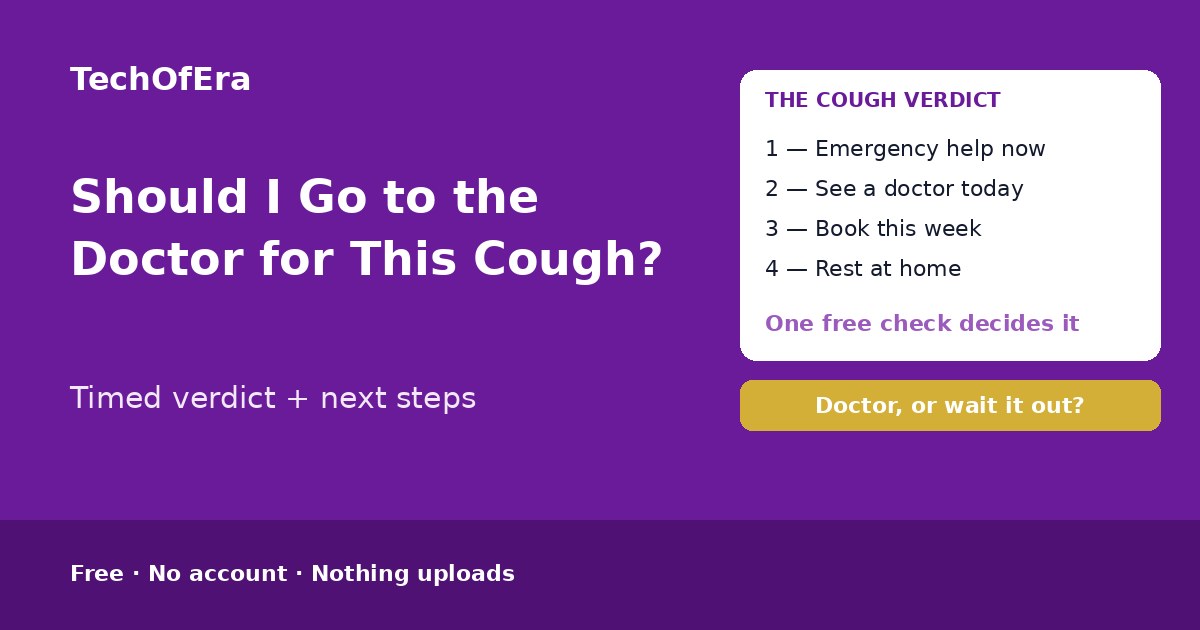
A cough on its own says little. What decides how urgent it is: how long you have had it, whether it is getting better or worse, your breathing, any fever, and the warning signs that travel with it. This checker weighs all of it — duration, trend, fever, breathing, blood, chest pain, who is coughing, and nine warning signs — and gives you a verdict: get emergency help now, see a doctor today, book a doctor's appointment this week, or rest at home and watch it, plus the next steps for each.
To use it:
- Say how long you have had the cough. Less than 3 days, 3–7 days, 1–2 weeks, 2–3 weeks, 3–8 weeks, or more than 8 weeks. Most coughs clear within 3 weeks; past 3–4 weeks, see a GP.
- Say whether it is getting better or worse. Getting better, about the same, getting worse, or keeps coming back. A cough getting worse instead of better needs a doctor — it can mean a secondary infection.
- Say whether you have a fever. No fever, a mild fever under 38.5°C (101.3°F), a high fever of 38.5°C or higher, or a fever that has lasted more than 3 days. A fever over 100.4°F (38°C) with a cough needs a doctor.
- Say how your breathing is. Breathing normally, wheezing or whistling when you breathe out, short of breath when you exert yourself, short of breath even at rest, or too breathless to finish a sentence. Breathlessness with a cough is the sign that matters most.
- Say whether there is any blood. No blood, streaks of blood in the mucus, or coughing up blood. Any blood with a cough means seeing a doctor urgently — and coughing up blood means emergency help now.
- Say whether you have chest pain. No chest pain, a mild ache when you cough, or sharp pain, or pain when you breathe in. Chest pain with a cough needs a clinician.
- Say who is coughing. An adult 18–64 with no long-term condition, a child or teenager 5–17, a child under 5, an adult 65 or older, pregnant, a weakened immune system, or asthma, COPD or heart disease. Children under 5, adults over 65, and people with a weak immune system or a lung condition need a doctor sooner.
- Tick any warning signs. Night sweats, unexplained weight loss, swollen painful glands in the neck, a hoarse voice for more than 3 weeks, a whooping sound or a barking cough, a cough that started after choking, vomiting from coughing 3 or more times, feeling very unwell, confused, drowsy or faint, or lips or skin that look blue or grey. Any one of these changes the verdict — tick nothing if none of them is happening.
The five verdicts, and what each one means
Get emergency help now
Struggling to breathe, coughing up blood, blue or grey lips or skin, or feeling very unwell, confused, drowsy or faint. Call your local emergency number now — 999 in the UK, 911 in the US, 112 across the EU — or go to the nearest emergency department. Do not drive yourself.
See a doctor today
Streaks of blood in the mucus, sharp chest pain, a fever that has lasted more than 3 days, new wheeze, a cough that started after choking, a whooping or barking cough, vomiting from coughing, or a cough getting worse quickly. Contact your GP practice today, or an urgent-care or walk-in clinic — these signs need a clinician within 24 hours.
Book a doctor’s appointment this week
A cough past 3 weeks, night sweats, unexplained weight loss, swollen glands, a hoarse voice over 3 weeks, or a cough that keeps coming back. Book a GP appointment this week and tell them how long the cough has lasted and what else is happening, so the cause can be found.
Rest at home and watch it
A short cough that is getting better, with no warning signs: rest, drink plenty of fluids, and keep an eye on it for the next few days. Most coughs from a cold clear up within 3 weeks. If it gets worse instead of better, lasts past 3 weeks, or any warning sign appears, see a doctor.
Cannot tell yet
Not enough answers to judge: a cold cough a week in and getting better needs no doctor, and a cough with blood and breathlessness needs emergency help, and the checker cannot tell which one yours is. Answer the first questions and the verdict appears.
What makes this checker different
The pages that rank for this search are articles — a Franciscan Health guide, a GoodRx explainer, a Healthline page, an HSHS hospital blog. None of them asks how long you have had the cough, whether it is getting better or worse, how your breathing is, or whether there is blood — and none of them gives you a timed verdict for your cough. The tools that do exist are something else: cough-audio apps that record you coughing, AI symptom checkers that ask about everything, and a baby-only cough checker for ages 0–5. There is no free, standalone checker that takes your cough — duration, trend, fever, breathing, blood, chest pain, who is coughing, and the warning signs — and turns it into a timed verdict with the next steps. This page is that answer: eight questions, an instant verdict, the blockers named, and the next steps. It is a self-assessment, so it says plainly what it cannot know: it cannot listen to your chest, measure your temperature, or tell what is causing your cough.
When is this the right check?
When you have had a cough for two weeks and you are not sure whether to wait it out — because 3 weeks is the line, and the checker tells you which side of it you are on. When the cough is getting worse instead of better — because that can mean a secondary infection, and the checker says so instead of guessing. When there is blood, breathlessness or chest pain and you are not sure how urgent it is — because the checker separates emergency help now from see a doctor today. And when a child, an older adult, or someone with a weak immune system or a lung condition is coughing — because the bar for seeing a doctor is lower for them, and the checker applies it instead of giving the adult answer.
Honest limitations
A self-assessment, not medical advice
This checker cannot listen to your chest, measure your temperature, or tell what is causing your cough. It cannot tell whether a cough needs a clinician. If you are struggling to breathe, coughing up blood, or feel very unwell, get emergency help now — do not wait for a web page.
Without your breathing, the verdict is a guess
Breathlessness is the sign that matters most, and the checker cannot measure it. If you are not sure how your breathing is, the checker treats it as unknown and the verdict drops to low confidence — and if you are short of breath at all, get help sooner rather than later.
“A mild fever” is a judgement, not a measurement
Most people judge a fever by how they feel, and a thermometer can read differently by a degree. If you are not sure whether you have a fever, the checker treats it as unknown — and a fever over 100.4°F (38°C) with a cough needs a doctor, whatever the thermometer says.
The timed verdicts are planning estimates
The timed verdicts on this page — emergency now, today, this week, or rest at home — are the checker's own planning estimates drawn from the cough guidance, not a diagnosis for any one person. Your body, your medicines and your history all change them: if something feels seriously wrong, do not wait for the verdict to catch up.
Other symptoms count too
This checker asks about the cough, the fever, the breathing and the warning signs. It does not ask about ear pain, sinus pain, a very sore throat, or a rash — all of which can change the answer. The verdict is about the cough, not the whole illness.
Rules from official sources, dated November 2026
The rules here are the cough guidance from the NHS, Healthline, GoodRx, Franciscan Health and the Self-Care Forum, as they read in November 2026. Guidance changes: recheck with a clinician if anything about your health, your medicines, or your symptoms changes.