How the too-hot-or-too-cold check works
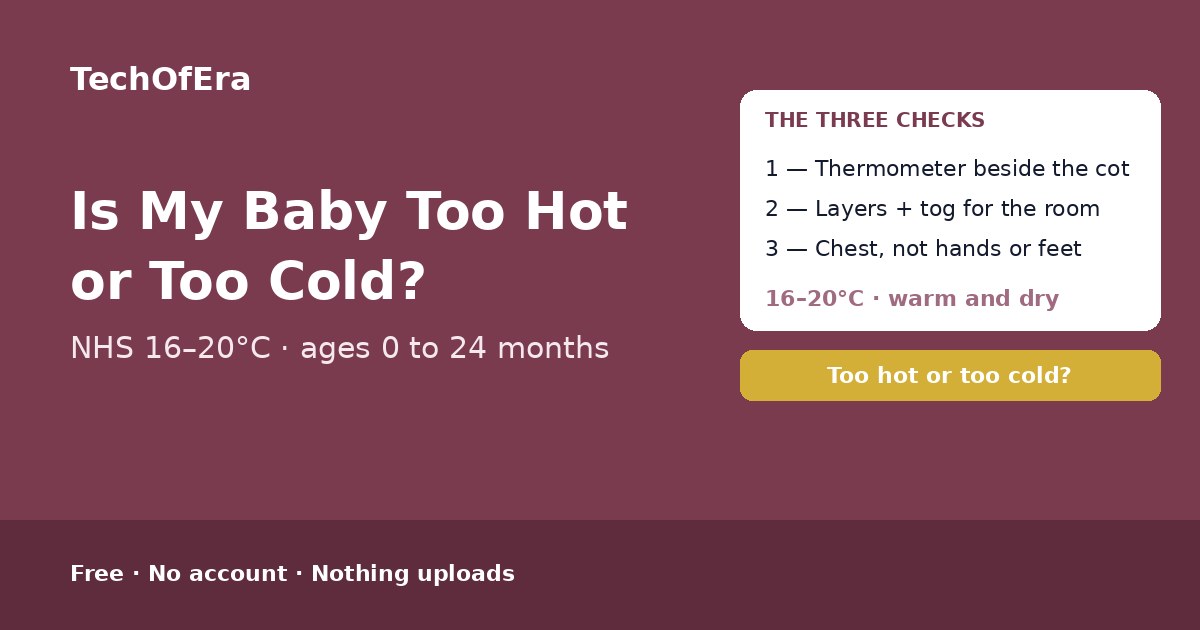
The NHS and the Lullaby Trust say to keep the room where your baby sleeps around 16–20°C, checked with a room thermometer beside the cot. The American Academy of Pediatrics names no single number — clothing, bedding, humidity, airflow and the baby all affect warmth — and says to dress your baby in no more than one layer more than you are wearing in the same room. Overheating raises the risk of sudden infant death, so a cool room with the right layers is safer than a warm one. But a number on a thermostat is not a verdict: a room at 20.5°C is not suddenly dangerous, and a room at 15.5°C does not tell you, by itself, that your baby is cold. This checker combines three clues — the room temperature, the layers and the tog, and how your baby’s chest actually feels — and gives you a verdict for tonight, with the outfit the room calls for.
To use it:
- Enter your baby’s age in months. The rules change with age — a blanket is unsafe at 3 months and acceptable at 15 months, and the tog that fits changes too. The checker covers birth to 24 months.
- Enter the room temperature beside the cot. Read a thermometer beside the cot, at cot height, away from radiators, sunny windows and draughts — not the hallway thermostat, which reads the hallway. Enter it in °C or °F.
- Say what your baby is wearing. The base layer, the sleep sack’s tog, any blanket, and whether there is a hat. Each one adds warmth, and the checker adds them up and compares the total with what the room calls for.
- Feel your baby’s chest or the back of their neck. Slip two fingers onto the chest or the back of the neck — warm and dry is right, hot or sweaty means take a layer off, cool means add one. Do not judge by the hands or feet: they are often cool in a comfortable baby.
- Tick any signs you can see. Sweating, damp hair, flushed cheeks or breathing faster than usual mean too hot. A cool chest or mottled, pale, blotchy skin mean too cold. Tick nothing if your baby seems settled.
What makes this checker different
The pages that rank for this search are guides — the NHS safe sleep pages, the Lullaby Trust’s room-temperature advice, Pampers’ sleep-temperature guide, and long articles that give you a table and leave you to do the sums at 2 a.m. There is no free, standalone checker that takes your baby’s exact age, the room temperature beside the cot, the base layer, the sleep sack’s tog, any blanket and a hat, and the torso check — and gives you a verdict: comfortable, too hot, too cold, or check first because the clues disagree — with the outfit the room calls for and every fix named. This page is that answer: eight questions, an instant verdict for your exact baby and your exact room, the blockers named, and the next steps. It is a self-assessment, so it says plainly what it cannot know: it cannot feel your baby or read your thermometer, and where the layers and the torso disagree it says so instead of guessing.
When is this the right check?
At bedtime, every night in a heatwave or a cold snap — because the room that was 18°C at 7 p.m. can be 23°C by 2 a.m. once the heating has been on, and the other way round in a cold house. When your baby is stirring and you cannot tell whether they are too hot, too cold, or just awake. When you buy a new sleep sack and the tog on the label means nothing to you. When someone else dresses your baby for the night — grandparents, babysitters, nursery — because a heavy blanket added by a well-meaning grandparent is the most common way a comfortable cot stops being comfortable. And whenever the torso and the thermometer disagree — because that is when a guide leaves you guessing and a checker earns its keep.
Honest limitations
A self-assessment, not medical advice
This checker cannot feel your baby or read your thermometer. It cannot check the temperature beside the cot or how warm your baby’s chest actually is. If you are worried about your baby’s temperature, sleep or breathing, talk to your paediatrician.
A fever is not a layering problem
A baby who still feels hot after you remove layers, or whose temperature is 38°C (100.4°F) or more, has a fever — not too many clothes. Call your paediatrician instead of taking more layers off.
The tog is a guide, not a guarantee
A tog measures insulation, not warmth on its own. The room, the base layer, the humidity, the airflow and your baby all count — which is why this checker asks for the torso check as well as the tog.
The rules are for the first year — then they soften
The NHS and AAP guidance was written for babies under 12 months. After the first birthday a light blanket is generally acceptable, and a toddler’s room still wants to be around 16–20°C. Where the guidance is thinner after 12 months, this checker says so.
Cold hands and feet are normal
A baby’s hands and feet are often cool because their circulation is still maturing. The NHS says not to worry about it. The check that counts is the chest or the back of the neck.
Rules from official sources, dated November 2026
The rules here are the NHS / Lullaby Trust room-temperature guidance and the AAP’s 2022 safe sleep policy, as they read in November 2026. Guidance changes: recheck with your paediatrician if anything about your baby changes.