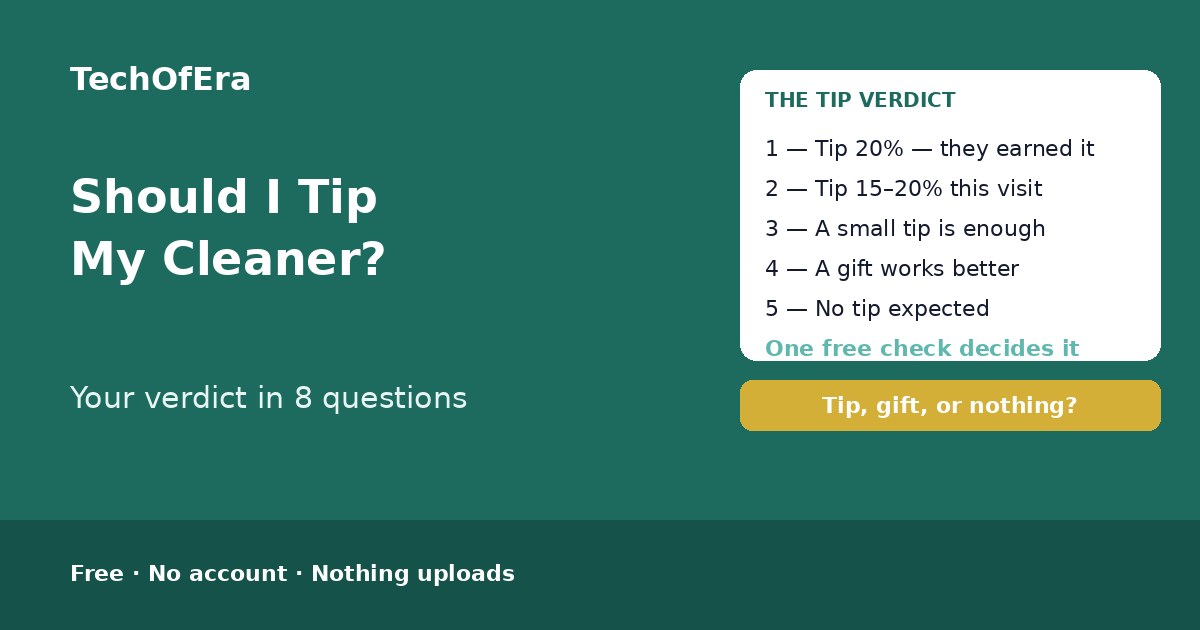
How the tip check works
Tipping a cleaner is one of those questions where the answer genuinely changes with the country, the cleaner and the job. In the US, the usual benchmark is 15–20% of the cleaning cost — Care.com's cleaning expert puts it at 15–20%, Angi says the same, and the Association of Residential Cleaning Services International puts the accepted amount at 10–15%, with 20% not uncommon. In the UK, it is a different world: tipping is not baked into the culture, most regular clients tip nothing between visits, and the Christmas gift of one session is the main gesture. This checker weighs all eight questions — who cleans, how often, which country, what one visit costs, how good the work was, whether anything extra was done, how long they have cleaned for you, and whether a tip is already included — and gives you a verdict with the exact amount: tip 20%, tip 15–20%, a small tip is enough, a gift works better than cash, or no tip expected.
To use it:
- Say who cleans your home. An independent, self-employed cleaner, an agency with the same cleaner each visit, an agency where different cleaners rotate, or a one-off deep-clean company. An independent cleaner keeps the whole tip; with an agency, cash handed to the cleaner is the way to make sure it reaches them.
- Say how often they come. Weekly, every two weeks, monthly, or a one-off visit. For recurring service, most clients tip monthly, after harder visits, or at the holidays instead of every clean.
- Say which country you are in. United States, United Kingdom, Canada, Australia, or Germany or another European country. The norms differ sharply: the US expects 15–20% per visit, the UK expects nothing per visit.
- Enter what one visit costs. The price of one cleaning visit, in your local currency. The tip is a percentage of that figure, so the checker needs it to work out the amount — a standard US clean runs $75–$175 a visit, a deep clean $200–$400.
- Say how good the work was. Excellent and above and beyond, good and solid, OK with a few things missed, or poor. A tip is a thank-you for good work — poor work means no tip, and saying what was missed matters more than the money.
- Say whether they did anything extra. A deep clean or extra rooms, a tough job with pets, stains or a big mess, nothing extra, or a first visit still settling in. Extra effort is when a higher tip makes sense.
- Say how long they have cleaned for you. A first visit, a few months, or a year or more. A cleaner who has worked for you for a year or more usually gets a holiday gift of one session.
- Say whether a tip or service charge is already included. No, yes, or that they are not allowed to accept tips. Some agencies build a tip into their rates — if so, no extra tip is expected, and offering one can be awkward or refused.
The five verdicts, and what each one means
Tip 20% — they earned it
Excellent work, a deep clean or a tough job: that is when the guidance says to go to the top of the range. On a $150 visit, 20% is $30; on a £100 deep clean, it is £20. Hand it over in cash, directly to the person who did the work, so it reaches them — especially with an agency, where a tip added to the bill may not.
Tip 15–20% this visit
Good work, done as expected, is what the 15–20% benchmark is for — the range Care.com, Angi and the cleaning-services association all point to. On a $150 visit that is $22.50–$30. Cash, handed directly to the cleaner, is the safest way to make sure it reaches them.
A small tip is enough
The work was only OK, or it was a good one-off job in the UK where per-visit tipping is not the norm. In the US that means 10% — $15 on a $150 visit. In the UK it means a small cash gesture of £5–£10, which the UK guides call appropriate and generous without being unusual.
A gift works better than cash
You have had the same cleaner for a year or more, and in the UK that relationship is where the Christmas gift is the norm — not a tip after every visit. The usual gift is the equivalent of one cleaning session, in cash or as a gift card, with a short thank-you note. Per-visit tipping is not expected and its absence is not impolite.
No tip expected
Poor work, or a tip or service charge already included in what you pay, or a cleaner who is not allowed to accept tips. A tip is a thank-you for good work, not a fee for a job that missed the mark — and adding a tip on top of an included service charge would double-pay it. The honest thank-you here is feedback: say what was good, and if the work was poor, say what was missed so it can be put right.
Which situation gets which tip
The reference table the checker works from — your situation on the left, the tip it points to on the right:
| Your situation | Recommended tip | Why |
|---|---|---|
| US, good regular clean | 15–20% of the visit cost | The usual benchmark: Care.com, Angi, ARCSI |
| US, excellent work or deep clean | 20% of the visit cost | Extra effort earns the top of the range |
| US, one-off or move-out clean | 15–20%, up to 25% for a hard job | One-off jobs are tipped right after the visit |
| US, holidays | One session, or around 25% | The holidays are the most common time to tip |
| US, work was only OK | 10% of the visit cost | A small tip is enough for work that missed things |
| UK, regular cleaner for a year or more | A Christmas gift of one session | The UK norm: a gift, not a per-visit tip |
| UK, one-off deep clean done well | 10–15% of the bill | A reasonable, appreciated gesture for a big job |
| UK, particularly good regular visit | £5–£10 in cash | A small gesture, generous without being unusual |
| UK, standard regular visit | No per-visit tip expected | Most UK clients tip nothing between visits |
| Agency cleaner | Same amount, in cash, directly to them | A tip added to the bill may not reach the cleaner |
| Tip or service charge already included | No extra tip | Adding one would double-pay it |
| Poor work | No tip — give feedback instead | A tip is a thank-you for good work, not a fee |
Your step-by-step plan
Whatever the verdict, this is the plan the checker is aiming for — the steps it builds from your answers:
- Check the bill first. Before you think about a tip, check whether a tip or service charge is already included in what you pay, or whether the cleaner is allowed to accept tips. If either is true, no extra tip is expected.
- Judge the work honestly. Excellent, good, OK or poor — a tip is a thank-you for good work. If things were missed, say what they were before you decide on the amount.
- Work out the amount from the visit cost. 15–20% for good work in the US, 20% for excellent work or a deep clean, 10% for work that was only OK, and £5–£10 for a particularly good regular visit in the UK. Enter the cost and the checker does the maths.
- Hand it over in cash, directly to the cleaner. Cash in a labelled envelope, or handed over at the end of the visit, is the easiest way to make sure the right person gets it — especially with an agency, where a tip added to the bill may not reach them in full.
- Remember the holidays. The Christmas gift of one session's cost is the gesture that matters most for a regular cleaner — in the US and the UK alike. It is the one time of year when a bonus feels not just welcome, but common.
- Say what stood out. Specific praise is worth as much as the money: name the room, the job, or the extra effort. And if the work was poor, respectful feedback and a chance to put it right beat a tip every time.
What makes this checker different
The pages that rank for this search are articles — a Care.com guide, an Angi guide, a Thumbtack guide, and UK guides from WeCasa, Instant Cost and eMobile Cleaning. They all answer the same question in words: 15–20% in the US, nothing expected per visit in the UK. None of them asks who your cleaner is, how often they come, how good the work was, or what one visit costs — and none of them works out the amount for you. This page is the answer the articles do not give: eight questions, an instant verdict, the exact tip amount in your currency, the holiday thank-you worked out too, and the blockers named. It is a self-assessment, so it says plainly what it cannot know: it cannot see your home or your cleaner.
This checker also answers a different question from the How Much Should I Tip My Hairdresser? Calculator — that one is about tipping at the salon, this one is about tipping the person who cleans your home. It is also different from the Should I Tip My Christmas Delivery Driver? Checker, which is about a one-off seasonal tip for a delivery driver, not an ongoing cleaning relationship. And if you are still deciding whether to hire someone at all, the Should I Hire a House Cleaner? Checker covers that decision.
When is this the right check?
When the cleaner has just left and you are standing there wondering whether to hand something over — and how much. When you have just had a deep clean or a move-out clean and the bill is bigger than usual. When the holidays are coming and you want to know what a fair Christmas thank-you looks like. When you have moved from the US to the UK, or the other way round, and the tipping rules you grew up with no longer apply. And when the agency's bill mentions a service charge and you are not sure whether that is already the tip.
Honest limitations
A self-assessment, not etiquette advice
This checker cannot see your home or your cleaner. Tipping is a personal choice and the norms differ by country — in the US 15–20% is the usual benchmark, in the UK per-visit tipping is not expected. The percentages here are the checker's own judgement drawn from the guidance, not a rule for any one household.
The US and UK norms genuinely differ
Care.com and Angi put the US benchmark at 15–20%; the UK guides say most regular clients tip nothing between visits. The checker follows the country you pick, but a household that has always tipped weekly in the UK, or never tipped in the US, is not doing anything wrong — the norms are averages, not rules.
“Good” and “excellent” are judgements, not measurements
Most people judge the work by eye, and "good" and "excellent" can look alike. If you are not sure which one yours is, the checker treats good as the standard 15–20% and excellent as 20% — and says so in the answer, rather than pretending it measured the clean.
The amounts depend on the cost you enter
The tip is a percentage of the visit cost, so the amounts are only as good as the figure you enter. If the cost changes — a bigger house, an extra room — enter the new figure and the amounts update.
One cleaner at a time
This checker looks at one cleaner at a time. If a crew comes, split the tip so each cleaner gets a fair amount — the checker does not split it for you. Run it once per cleaner if different people clean different parts of your home.
Rules from official sources, dated November 2026
The rules here are the tipping guidance from Care.com, Angi, Thumbtack, the Association of Residential Cleaning Services International, Better Homes & Gardens, WeCasa, Instant Cost and eMobile Cleaning, as they read in November 2026. Guidance changes: recheck if anything about your cleaner, your country, or your arrangement changes.