How the hairdresser tip calculator works
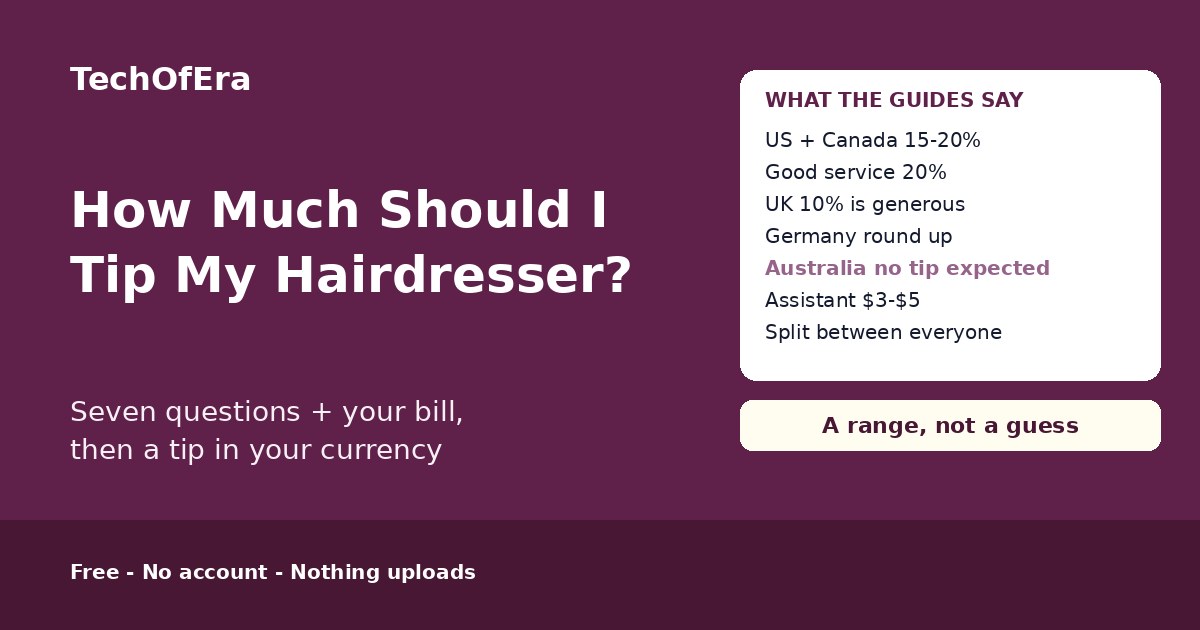
There is no single right tip for a hairdresser — and in some countries the right tip is nothing at all. The published guides agree on the American range: 15% to 20% of the service price (Emily Post Institute), with 20% the most common amount for good service and 25% generous for exceptional work (Reader's Digest). In Canada it is the same. In the United Kingdom, 10% is generous and tipping is appreciated but not required. In Germany, the custom is to round the bill up, or add 5% to 10% for good service. In Australia, tipping a hairdresser is not expected at all. This calculator starts from the range for your country and how good the visit was, then splits the tip between everyone who worked on your hair — and says plainly when the honest answer is no tip. The figures are etiquette estimates, not prices. This is a year-round salon calculator: it covers every hair appointment, not the once-a-year festive tipping in our Christmas tip tools.
To use it:
- Say what service you had. A cut is the standard case. Colour, extensions and bridal styling are long appointments: 20% to 25% is good etiquette in the US for the time and talent involved. A barber cut follows the same 15% to 20% guideline, but because many cuts are lower in price, clients often round up to at least $5 — and this calculator applies that floor for you.
- Enter your bill. The price of the service itself, before tax and before any discount. The guides are clear: tip on the full service price even when you use a coupon or a gift card, and only on the service — not on salon products you buy at checkout.
- Say where you are. The norm changes by country, and the same visit is a different answer in each one: 15% to 20% in the United States and Canada, 10% in the United Kingdom, a round-up in Germany, and no tip expected in Australia. The tip is shown in your currency.
- Say how good the visit was. Quality sets the percentage. Poor is around 10% in the US, okay is 15%, good is 20%, excellent is 25%. If you were unhappy, the guides say to leave something at the lower end — and to say what went wrong, so the stylist can fix it.
- Say who worked on your hair. Tip each person who worked on you. The shampoo assistant gets $3 to $5 in the US, handed to them directly. A separate colourist shares the tip with your stylist. The salon owner is traditionally not tipped — but modern guidance says tip if you liked the work, and the calculator keeps the range unchanged either way.
- Say how many people split the bill, and whether to round up. If two of you share the appointment, the tip and the total are divided between you. Rounding the tip or the total up to a whole amount is the usual way to pay in cash — pick it and the range already includes it.
What makes this calculator different
The pages that rank for this search are guides — the Cosmetology and Spa Academy, Reader's Digest, a salon blog — listing the same 15% to 20% in a table, with a few paragraphs of advice. The calculators that do exist are American-only percentage tools: enter a dollar amount, get 15%, 18%, 20% or 25% back. None of them covers five countries with their own norms and currencies, none splits the tip between your stylist, your colourist and your shampoo assistant, none applies the barber $5 floor, none divides the bill between the people paying, and none says plainly when the answer is no tip at all. This page is that answer: seven questions, one tip range in your currency, the split worked out, and the etiquette behind every adjustment named in the result. It is a self-assessment, so it says plainly what it cannot know: it cannot know your salon's policy, your finances, or what your stylist actually did — and the figures are etiquette estimates, not prices.
When is this the right calculation?
When the card reader flips around at the desk and you have three seconds to choose a percentage. When you had colour and a cut from two different people and you are not sure who gets what. When someone else washed your hair and you are wondering whether they get a tip too. When the owner did your hair and you are not sure whether owners get tipped. When you are on holiday in Germany or Australia and the American rule does not apply. And when the visit was disappointing and you are wondering whether you still tip — you do, at the lower end, and you say what went wrong.
Honest limitations
A self-assessment, not financial advice
This calculator cannot know your finances. It gives a tip range from the published etiquette guides — it cannot tell you what you can afford, and it is not financial advice.
The figures are estimates, not prices
The ranges come from the guides — the Emily Post Institute, Reader's Digest, Suddl and the salon guides — as they read in November 2026. They are etiquette estimates, not prices, and the guides disagree with each other at the edges. Pick the figure inside the range that feels right for your visit.
Currency conversion is approximate
The range is worked out in US dollars and converted at a fixed approximate rate — 1 US dollar is about £0.79, €0.92, C$1.36 or A$1.52. Rates move daily, so check the live rate before you pay, and round to a figure that looks natural in your currency.
Tipping norms differ
The guides are mostly American, and tipping norms differ by country, by salon and by culture. Some salons include a service charge; some owners refuse tips; in some places a tip is simply not part of the custom. The range is a starting point, not a rule for every salon.
The split is a fair share, not a rule
The assistant's $3 to $5 and the half-and-half split with a colourist come from the guides, but no salon publishes an official split. If you know who did most of the work, weight the tip their way — the calculator shows the even split as a starting point.
Facts from the guides, dated November 2026
The facts here are the Emily Post Institute, Reader's Digest, Suddl and the salon guides, as they read in November 2026. Guides change and polls are re-run: recheck the numbers if anything about your salon changes.