How the porch-light check works
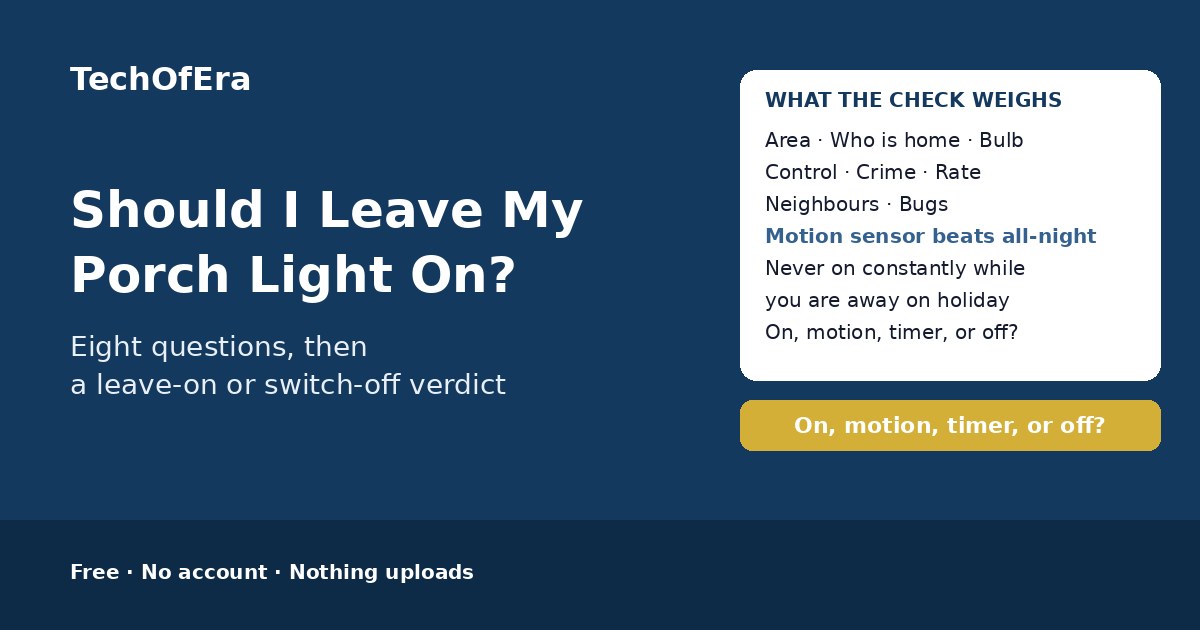
The guides that rank for this question agree on the routine and disagree on the details — one says leave it on, another says turn it off at bedtime, a third says a motion sensor beats both. None of them scores your situation. What decides it is eight things: where you live, who is home tonight, what bulb is in the fixture, how the light is controlled, how much crime happens nearby, what you pay per kilowatt-hour, whether the light shines into a neighbour's window, and whether bugs swarm it. A motion sensor is the best single upgrade in most cases, because it startles anyone approaching, costs almost nothing to run, and never becomes a predictable pattern. But while you are awake or expecting someone late, the light earns its keep. Use this simple rule: leave it on while you are up, turn it off at bedtime, and never leave it on constantly while you are away.
To use it:
- Say where you live. In a town or city, a lit porch is normal and a dark one can look empty. In the suburbs, the neighbours' lights set the pattern — a house that is dark while every other porch is lit stands out. In the countryside, a constant light can make you less safe: it ruins your night vision beyond the glow, so you cannot see anyone approaching, while it lights up the porch for them.
- Say who is home tonight. While you are awake, the light signals that someone is home and helps people reach the door safely. If someone is coming home late, leave it on until they are in. If you are out tonight and back late, leave it on until you are home, then switch it off. If you are going to bed, turn it off like any other room light. If you are away on holiday, never leave it on constantly — use a timer or smart bulb so the times vary.
- Say what bulb is in the fixture. A 9 W LED left on 10 hours a night uses about 33 kWh a year — roughly $6 at $0.17 per kWh, the US average. A 60 W incandescent doing the same uses about 219 kWh, roughly $37. A halogen floodlight sits between them, and a CFL is close to an LED. The bulb decides whether the cost matters at all — with an LED, the money argument against leaving it on almost disappears, and the decision turns on security and neighbours instead.
- Say how the light is controlled now. A plain wall switch means the light is on or off by hand — and a forgotten light stays on all night. A dusk-to-dawn sensor switches it on at sunset and off at sunrise, which is the same as leaving it on all night. A timer follows a schedule. A motion sensor keeps it off until someone walks up. A smart bulb or switch does all of it from your phone, and lets you vary the times while you are away.
- Say how much crime happens nearby. Where break-ins are common, a light left on all night does not stop burglars — and a light that never changes can signal that nobody is home. A motion light is better: it snaps on when someone approaches, which startles them and tells you something moved. Where break-ins are rare, the light buys you almost nothing, and the decision turns on cost, bugs and neighbours. A porch light alone is never security — pair it with a camera, a door sensor or an alarm if crime is a real worry.
- Say what you pay per kilowatt-hour. The rate is printed on your electricity bill. At the US average of about $0.17 per kWh, a 9 W LED left on all night costs about $6 a year and a 60 W incandescent about $37. At over $0.25 per kWh, the incandescent costs over $50 a year — and the LED swap pays for itself in weeks. A motion sensor cuts either figure to a few cents, because the light only fires for minutes a night.
- Say whether the light shines into a neighbour's window. A porch light that shines into a bedroom is a neighbour problem, not a security feature. Angle the fixture down, fit a shield, and use a warm-white bulb at 2700–3000K — it cuts glare and preserves night vision. A motion sensor helps too: the light is only on when someone is actually there.
- Say whether bugs swarm the porch light. Cool-white light pulls in far more bugs than warm-white light, so a warm-white LED at 2700K is the better porch bulb. A motion sensor limits the time the bugs can gather, because the light is only on for minutes a night. If bugs swarm badly and crime is low where you live, turning the light off at bedtime is the simplest fix.
What makes this checker different
The pages that rank for this search are guides — a home site walking through the pros and cons, a security company on when to turn it on and off, a magazine quoting security experts, a lighting retailer on the cost. None of them scores your situation: none takes where you live, who is home tonight, your bulb, your control, the crime nearby, your electricity rate, your neighbours and the bugs — and none gives you a verdict — leave it on, fit a motion sensor, use a timer, or turn it off — with the yearly running cost for the bulb you actually have. There is no free, standalone checker that takes a porch light's bulb and control and returns a leave-on-or-switch-off verdict with the holiday rule, the rural rule and the neighbour rule applied. This page is that answer: eight questions, and an instant verdict for your exact porch. It is a self-assessment, so it says plainly what it cannot know: it cannot see your street, your neighbours, your electricity bill, or how much crime happens where you live, and where a light left on all night would signal an empty home, it tells you to use a timer instead of giving you a maybe.
When is this the right check?
When you have just moved in and the neighbours all do something different — because the pattern on your street is what a burglar reads, and the check tells you which pattern fits your house. When you are going away on holiday — because a light left on constantly while you are away signals an empty home, and the timer setup takes five minutes. When the electricity bill arrives and you wonder what the porch light costs — because the answer is $6 a year for an LED and $37 for an incandescent, and the check works out your figure. When the bugs arrive in summer — because a warm-white LED and a motion sensor fix the swarm without giving up the light. And when a neighbour mentions the glare — because angling the fixture down and fitting a shield is a five-minute job, and turning it off at bedtime costs nothing.
Honest limitations
A self-assessment, not professional advice
This checker cannot see your street, your neighbours, your electricity bill, or how much crime happens where you live. It scores the answers you give against what the porch-light guides say — it cannot tell you what your home actually needs, and it is not professional advice.
Crime levels are your judgement, not data
This checker asks how much crime happens nearby, but it cannot check the police figures for your street. Your sense of the area, your neighbours' experience and the local crime map all count — and if crime is a real worry, a porch light alone is never the answer.
The cost is an estimate, not your bill
The yearly cost assumes 10 hours a night, every night, at the rate you pick. Real nights run 8 hours in summer and 14 in winter, and your rate changes with your tariff. Check your bill for the real rate, and treat the figure as a comparison — LED against incandescent, all-night against motion sensor — not a promise.
Motion sensors need aiming
A motion sensor pointed at the street fires at every passing car, and one pointed too low misses the path. This checker says to fit one, but it cannot aim it for you — point it at the path to the door, set the shortest on-time that still lets you reach the door, and test it after dark.
Local rules vary
Some neighbourhoods, landlords and local rules limit outdoor lighting — brightness, hours, or light spilling onto a neighbour's property. This checker does not know your local rules: check them before you fit a brighter fixture or a floodlight.
Facts from the porch-light guides, dated November 2026
The facts here are the porch-light guides that rank for this question — Bob Vila, SafeWise, Homes & Gardens, Thermo Direct, Guardian Storage and SmartChoiceLiving — as they read in November 2026. Guides change and rates move: recheck the numbers if anything about your bulb or your bill changes.