How to decide whether to leave your Christmas lights on all night
The short answer is on the safety groups’ advice. The US Consumer Product Safety Commission is blunt about it: turn off lights on trees and other decorations when you go to bed or leave the house, because lights can short and start a fire — and that applies to LEDs, indoor trees and outdoor displays alike. The Electrical Safety Foundation says the same thing in different words: turn decorations off when you leave home and when you are sleeping. The numbers behind that advice are small but real. The National Fire Protection Association reports that from 2020 to 2024, US fire departments responded to an average of 143 home fires a year that started with Christmas trees, and electrical distribution or lighting equipment was involved in two in five of them. From 2016 to 2020, an average of 790 home fires a year began with decorative lights. None of that means your display is dangerous. It means the failures that do happen are electrical, and an electrical fault is far less dangerous when somebody is awake to smell it, see the breaker trip, or notice a string go dark. The hours between midnight and 6 a.m. are the only stretch of the day when nobody in the house would notice anything. Turning the display off for those hours removes the risk from exactly the window where it would do the most damage — and it costs you nothing you would have seen anyway, because you are asleep.
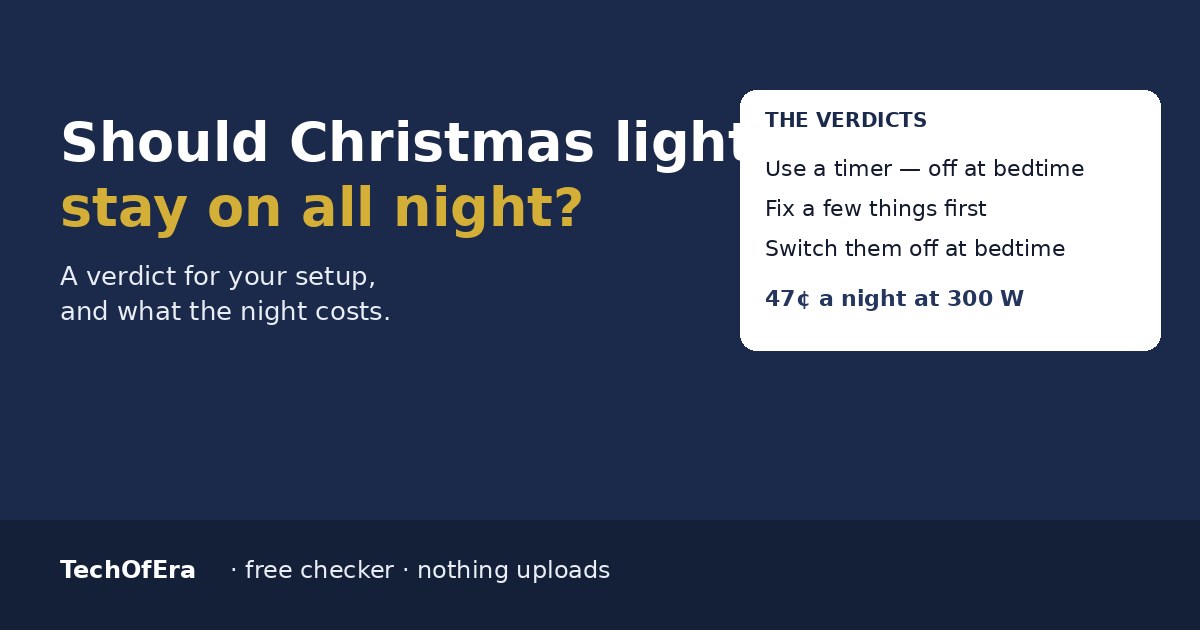
LEDs lower the risk; they do not remove it. LED strings run cool and draw a fraction of the power of incandescent sets. A 50-bulb LED C9 string uses bulbs of about 0.6 watt each; a traditional C9 bulb is 7 watts, and LEDs use up to 90% less energy overall. That is a real safety improvement, and for a new display it is the only bulb worth buying. But the bulb is the least likely part of a display to fail. Problems almost always start in the boring parts: the plugs, the cords and the connections — and even LED lights can develop electrical faults that create fire hazards when unattended. So the rule does not change with the bulb type: LED or incandescent, indoors or out, off at bedtime. The other half of the answer is money. A 300-watt display left on for 9 hours uses 2.7 kWh — about 47 cents a night at the US average rate of 17.23 cents per kWh in 2025 (EIA), or about $14 over 30 nights. A small LED display under 100 watts costs only a few cents a night, while a large display over 500 watts costs about $1.24 a night. A timer saves both the risk and the money: six hours a night is enough to enjoy the display, and it stops the string running hot all night while nobody is watching. This checker scores all of it at once — type, tree, timer, hours, outlet, load, neighbours and what has already happened — so you can see which risk is actually driving the verdict, and what the night would cost you.
To use it:
- Answer the ten questions honestly. The bulb type, where the lights are, the condition of the string, who is awake while they are on, how they switch off, how long they stay on, what kind of outlet they use, how many watts the display uses, whether they bother the neighbours, and whether anything has already happened. If you are not sure about the type, the condition or the wattage, say so — the checker scores the unknown as a risk and lists it as something to confirm, rather than guessing.
- Enter your electricity rate. The US average was 17.23 cents per kWh in 2025 (EIA), and the checker starts there — but your rate is on your bill, and entering it makes the overnight cost estimate exact. The rate never leaves your device.
- Read the score and what fails first. The verdict is a score out of 100, and the thing most likely to fail first is named in plain words — usually a fault nobody notices until morning. A setup can score well on nine questions and still be unsafe because of one bad one — a damaged string, or lights that have already sparked, is enough on its own.
- Fix the blockers first. Anything in the blockers list means do not leave the lights on all night: a damaged string, lights that have already sparked, smoked or shocked you, or a tripped breaker on an old set. If the lights sparked, smoked or shocked you, stop checking and unplug them now — and do not plug them in again to test them.
- Work down the cautions. Every caution is a ten-minute fix or a decision: fit a timer, swap an incandescent set for LEDs, fit a plug-in GFCI/RCD adapter, or angle the lights away from the neighbours’ windows. Each fix moves the score up — re-run the checker after the fixes to see the new verdict.
- Know the warning signs. Buzzing, warm sockets, a burning smell, a tripped breaker, or a tingle when you touch the lights mean unplug them now and do not use them again — not even for one more evening, and not even if they still light up.
Conditions and what to do at a glance
The table below is built from the same rules as the checker, so it can never disagree with your verdict. The biggest risk decides, not the number of small ones.
| Condition | Verdict | What to know |
|---|
What makes this checker different
The pages that rank for this search are guides — thorough explanations of why the CPSC says to switch lights off at bedtime, how LEDs differ from incandescent bulbs, and what all night costs on the bill — but they leave you to judge your own setup: to weigh an old incandescent set on a dry tree against a standard outlet against no timer against a 500-watt display against lights shining into the neighbours’ windows, and to decide which of those matters most. This page is the answer for your setup: ten questions in, a score out of 100, the single thing most likely to fail first named in plain words, an estimated overnight cost from your own rate, and a verdict that says use a timer, fix a few things, or switch them off at bedtime — with the fixes in the order that matters, and the emergency case handled as an emergency, not a low score. It is a self-assessment, so it says plainly what it cannot know: a web page cannot see your wire, sockets or plug, so anything you mark “Not sure” stays on the list until you confirm it. This checker is the overnight decision — different from its two closest neighbours on this site. Are My Old Christmas Lights Safe to Use? is about the age and condition of the string itself, and Can I Put Christmas Lights Outside in the Rain? is about whether an outdoor set survives wet weather. This one is about the hours between midnight and 6 a.m.: who is awake, whether a timer switches the lights off, and what the night costs.
When is this the right check?
Whenever the box of lights comes out of storage and you wonder whether to leave them on overnight: the day you pull them from the attic, the day you buy a second-hand set, or the night you are tempted to leave the display on “just this once”. Also whenever the setup changes — a new timer or GFCI goes in, a new string joins the display, or the tree moves from the corner to the window. And whenever something has already happened: a tripped breaker, dark sections, flicker, a burning smell, sparks, or a tingle when you touch the lights — the last three mean unplug them now, not a checklist. Re-run it after the first week of the season, and again if the neighbours mention the lights.
Honest limitations
A self-assessment, not an inspection
This checker works only from the answers you enter. It cannot inspect your light string — no web page can see your wire, sockets or plug, or know how the set was stored. If an answer is wrong, the verdict is wrong. When in doubt, switch the lights off at bedtime — a new LED string costs less than a fire.
The score is a guide, not a guarantee
A high score means the risks you described are handled — not that nothing can happen. A string that tested fine yesterday can fail today, and a fault at 3 a.m. is the one nobody notices. Re-check after the first week, and test before you leave them on.
The cost is an estimate, not your bill
The overnight cost is estimated from the wattage band and hours you pick and the rate you enter. Real displays draw a little more or less than their band, and your rate may be a time-of-use tariff that changes overnight. Check your bill for the exact rate, and treat the figure as an estimate.
A timer is the fix, not a guarantee
A timer removes the risky hours — it does not fix a damaged string, a bad outlet or a tripped breaker. If anything in the blockers list applies, a timer is not enough: unplug the lights and fix the fault first.
“It still lights up” proves nothing
A failing string often still lights up. Flicker, buzzing, warmth, a burning smell and a tripped breaker are the signs that matter — not whether the bulbs glow. Never use “it lights up” as a safety test.
Warning signs override the verdict
A burning smell, buzzing, warm sockets, a tripped breaker or a tingle on touch mean unplug the lights and do not use them again, whatever the checker said. If you got a shock, get an electrician to check the outlet as well as the lights.