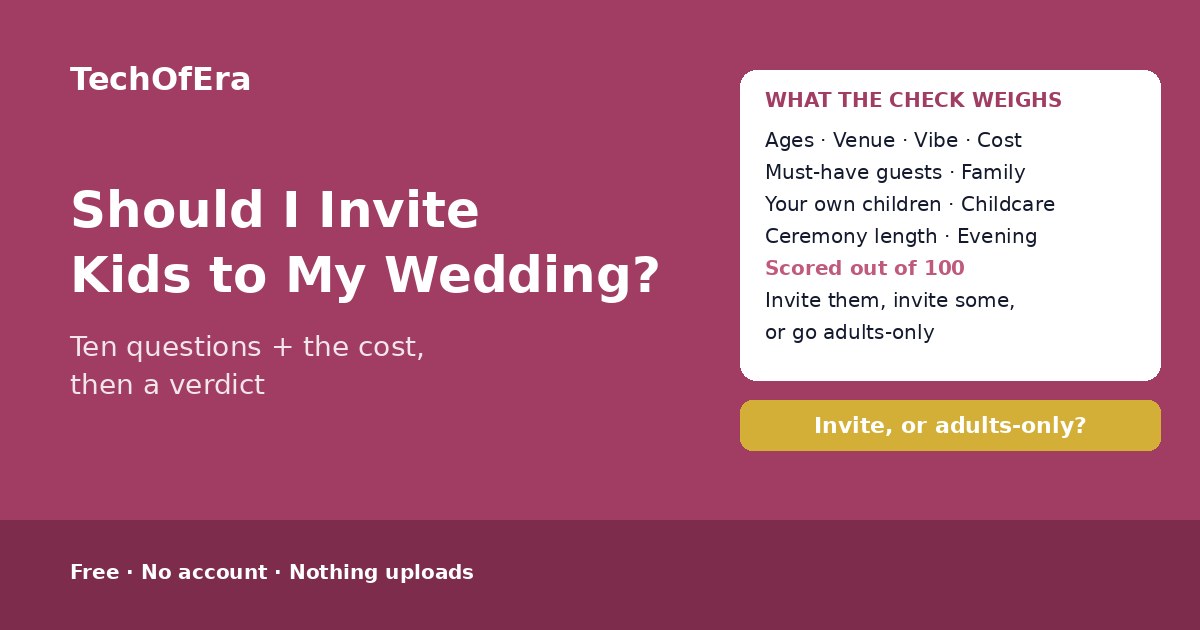
How the kids-at-the-wedding check works
Few wedding decisions divide opinion like whether children should be on the guest list. For some couples, kids bring energy, humour and a little unpredictability that makes the day feel even more joyful. For others, an adults-only celebration feels calmer, more formal and easier to manage. Neither choice is wrong — the guides that rank for this question all say so. What decides it is not a rule, but ten things, scored out of 100: the age of the youngest child, the venue, the vibe you want, the extra cost, whether must-have guests would stay home without their children, what your family expects, whether any of the children are yours or in the wedding party, whether childcare is arranged, and how long and how late the day runs. A score of 65 or more means invite them; 45 to 64 means invite some of them; under 45 means go adults-only. Two things override the score: if any of the children are your own, the answer is at least invite them, and if several must-have guests would stay home, the answer is at least invite some.
To use it:
- Say how old the youngest child is. Babies under 1 are the quietest guests of all — fed or asleep, they are satisfied — while children from 6 months to 5 years are loud, fidgety and hard to keep still through a ceremony. Children 6 and older can sit at a dedicated kids’ table, and teenagers need no entertainment at all.
- Say what kind of venue it is. A formal ballroom, a hotel, a garden, a barn, a restaurant, a backyard and a destination wedding all point in different directions — a formal room has nowhere for a restless child to go, while a barn takes children in its stride.
- Say what vibe you want. A formal evening and a family party are different weddings. If the evening is the wedding you are dreaming of, the children are the trade.
- Say how tight the budget is, and how many children would be invited at what cost per child. Every child still needs a seat, a meal and a place setting. The Knot’s 2026 Real Weddings Study puts the average all-in cost at $292 per guest — a child’s plate is usually less, so ask your caterer for a kids’ menu price.
- Say whether must-have guests would stay home without their children. Some parents will decide not to attend because childcare is difficult or because they are uncomfortable leaving their children. If that includes people you cannot imagine the day without, the decision is half made.
- Say what your family expect, and whether any of the children are yours or in the wedding party. Your own children are not really a choice — they are part of the day — and the same goes for a flower girl or page boy.
- Say whether childcare is arranged, and how long and how late the day runs. On-site childcare is the compromise that makes inviting children work at a formal wedding, and a short ceremony and an early finish suit children far better than a long formal ceremony and dancing past midnight.
What makes this checker different
The pages that rank for this search are guides — a wedding planner listing the pros and cons, a photographer explaining what each age is like, a venue laying out the middle-ground options. None of them scores your situation: none takes the ages of your children, your venue, the vibe you want, the extra cost, whether must-have guests would stay home, what your family expect, whether any of the children are yours or in the wedding party, whether childcare is arranged, and how long and how late the day runs — and none prices the extra cost from your own numbers, or gives you a verdict — invite them, invite some of them, or go adults-only — with the next steps for the verdict you got. There is no free, standalone checker that does all of that. This page is that answer: ten questions, two figures, and an instant verdict for your exact wedding. It is a self-assessment, so it says plainly what it cannot know: it cannot know your family, your guests, or what your venue will actually allow, and where your own children are involved it tells you the adults-only rule cannot apply to them instead of giving you a maybe.
When is this the right check?
When the guest list is the argument — one of you wants the children there and the other does not, and neither of you can say why beyond a feeling. When the venue is booked and the numbers are real: the children would add a four-figure sum to the catering, and the budget is tight. When a must-have guest has small children and you do not know whether they would come without them — because that is the fact that decides the whole thing, and guessing is how weddings lose their favourite people. When your own children are in the wedding and someone suggests the reception should be adults-only anyway. And when the invitations are about to go out and the wording has to be decided — because the verdict comes with the words to use, whether the answer is invite them, invite some, or adults-only.
Honest limitations
A self-assessment, not wedding advice
This checker cannot know your family, your guests, or what your venue will actually allow. It scores the answers you give against what the wedding guides and the wedding studies say — it cannot tell you how your family will react, and it is not wedding advice.
The score is a guide, not a prediction
A score of 90 does not mean the children will behave, and a score of 30 does not mean they will ruin the day. The score weighs the ages, the venue, the vibe, the cost and the guests together — but only you know the children involved, and only the day shows how it goes.
The cost is your number, not a quote
The extra cost is children times the cost per child you enter. A child’s plate is usually cheaper than an adult’s, but the real figure is whatever your caterer charges — ask for a kids’ menu price before you treat the total as final.
Attendance is a guess, not a guarantee
About 75 to 85% of wedding guests usually attend, and excluding children moves that number down — but it is an average, not a promise. Talk to the must-have guests before you decide: ask whether they could find childcare, and how hard it would be. Do not guess.
The middle ground needs plain wording
Inviting some children and not others is the most common answer — and the one most likely to be misunderstood. Address invitations to the adults by name, say who is included, and tell the parents who matter most in person. Clarity is kinder than ambiguity.
Facts from the guides and studies, dated November 2026
The facts here are the wedding guides that rank for this question and The Knot’s 2026 Real Weddings Study, as they read in November 2026. Guides change and studies are re-run: recheck the numbers if anything about your wedding changes.