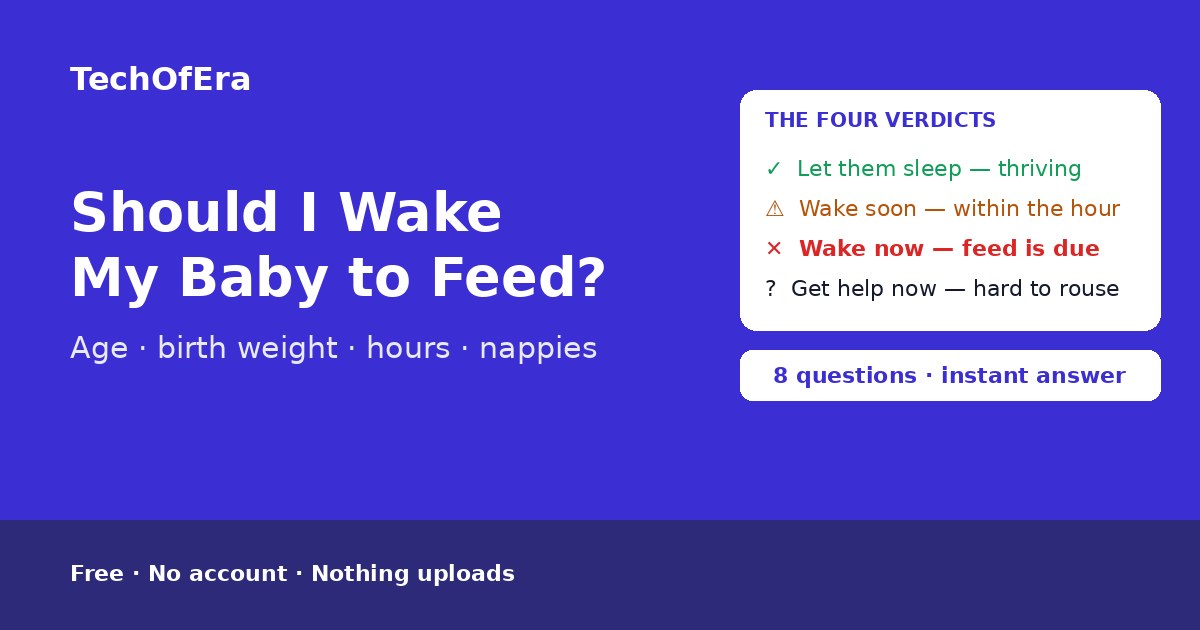
How to decide whether to wake your baby to feed
Waking a sleeping baby feels wrong — they look so peaceful, and you are tired too. But in the first weeks, a long sleep stretch is feeds missed, and a newborn who misses feeds does not always wake up hungry to make up for it: very young babies, and babies who are premature or unwell, can simply sleep through hunger. The rule the AAP, the CDC and the NHS all describe is the same: feed on demand once birth weight is regained and weight gain is steady, and wake to feed before that — every 2 to 4 hours, counting from the start of the last feed. The question parents actually ask at 3am is not what the rule is — it is whether this sleep stretch, in this baby, is safe to let run. This checker asks exactly what decides it.
To use it:
- Check the age first. Under 2 weeks is the strictest window: most newborns should not go more than 4 hours without a feed. At 2 to 6 weeks the ceiling is still about 4 hours, and after about 6 weeks it loosens for a thriving baby.
- Check birth weight. Babies lose weight after birth and usually regain it by about 2 weeks. Until the weight is back, waking to feed is part of the plan — a baby still below birth weight should not be left to sleep through feeds.
- Count the hours from the start of the last feed, not the end. Breastfed newborns usually nurse every 2 to 3 hours, formula-fed babies every 3 to 4 hours. The AAP advises waking a formula-fed baby who sleeps longer than 4 to 5 hours in the first month and starts missing feeds.
- Check growth and nappies — the questions that decide whether a long stretch is safe. A baby who is gaining steadily and has 6 or more heavy wet nappies a day after the first week is thriving, and a thriving baby can sleep. A baby who is gaining slowly, losing weight, or has fewer than 6 wet nappies a day cannot.
- Try to wake gently before deciding. Patting, stroking, undressing or changing the nappy usually wakes a sleepy newborn — and a drowsy feed still counts. If your baby will not wake at all, that is not a schedule question any more: get emergency help.
- Know the red flags. A baby who is hard to rouse, feeds less than 8 times in 24 hours, or is losing weight needs a doctor — whatever the clock says.
Feeding situations and what to do at a glance
The table below is built from the same rules as the checker, so it can never disagree with your verdict. Age, birth weight, hours, growth and nappies decide together.
| Feeding situation | Verdict | What to know |
|---|
What makes this checker different
The pages that rank for this search are guides — thorough explanations of the 4-hour rule, the 8-to-12-feeds-a-day picture, and when to wake a sleepy newborn — but they leave you to work out what that means for the sleep stretch you are looking at right now: whether 4½ hours counts as too long at 10 days old, whether birth weight matters more than the clock, whether a formula-fed baby gets longer than a breastfed one, and whether few wet nappies change the answer. They also rarely put the red flags in one place — a baby who is hard to rouse, or who is losing weight — that change the answer from “let them sleep” to “get help now”. This page is that answer: eight questions, an instant verdict, the reason named, and the red flags stated plainly instead of buried in the text — with nothing to install, no account, and nothing uploaded. It is a self-assessment, so it says plainly what it cannot know: a web page cannot weigh your baby, watch a feed, or tell how deeply they are sleeping, so anything you mark “Not sure” stays on the list until you confirm it.
When is this the right check?
Whenever your baby sleeps longer than usual and you are not sure whether to let it run: the 4-hour stretch at 10 days old, the 5-hour stretch at 5 weeks, the first night your baby sleeps through and you wake up wondering if you should have woken them. Also whenever the picture changes — your baby was premature, has jaundice, is gaining slowly, or has fewer wet nappies than usual. And whenever you are not sure what counts: whether the hours are counted from the start or the end of the feed, whether breast milk and formula have different intervals, or when you can stop waking at night altogether. If the answer is “wake now”, the checker tells you exactly how to wake gently — and what to have ready if you need to call.
Honest limitations
A self-assessment, not a diagnosis
This checker works only from the answers you enter. It cannot examine your baby — no web page can weigh them, watch a feed, or tell how deeply they are sleeping. If an answer is wrong, the verdict is wrong. When in doubt, call your paediatrician or health visitor.
The 4-hour rule is a rule of thumb
The AAP, CDC and NHS describe the same picture — feed every 2 to 4 hours in the first weeks, then let a thriving baby wake on their own — but it is a clinical picture, not a test. Only a weigh-in and a clinician’s look can confirm your baby is thriving.
Red flags override everything
A baby who is hard to rouse, or will not wake at all, or who is losing weight, is not a wait-and-see question — they need medical help now, whatever else the checker says.
Hours are counted from the start of the feed
The intervals in the guidance — every 2 to 3 hours for breastfed newborns, every 3 to 4 for formula-fed — are measured from the start of one feed to the start of the next. Counting from the end of a feed makes every interval look shorter than it is.
Night feeds protect milk supply
The body makes more prolactin, the hormone that builds milk supply, at night — so night feeds matter for breastfeeding even after your baby could sleep through. If you are breastfeeding and your baby starts sleeping long stretches, talk to your paediatrician or lactation consultant about supply.
Rules from AAP, CDC and NHS guidance
The rules here follow AAP HealthyChildren.org guidance on how often and how much babies eat, CDC guidance on feeding newborns, and NHS guidance on breastfeeding and waking a sleepy baby, as they read in November 2026. Guidance can be revised, so re-check if a new edition appears.