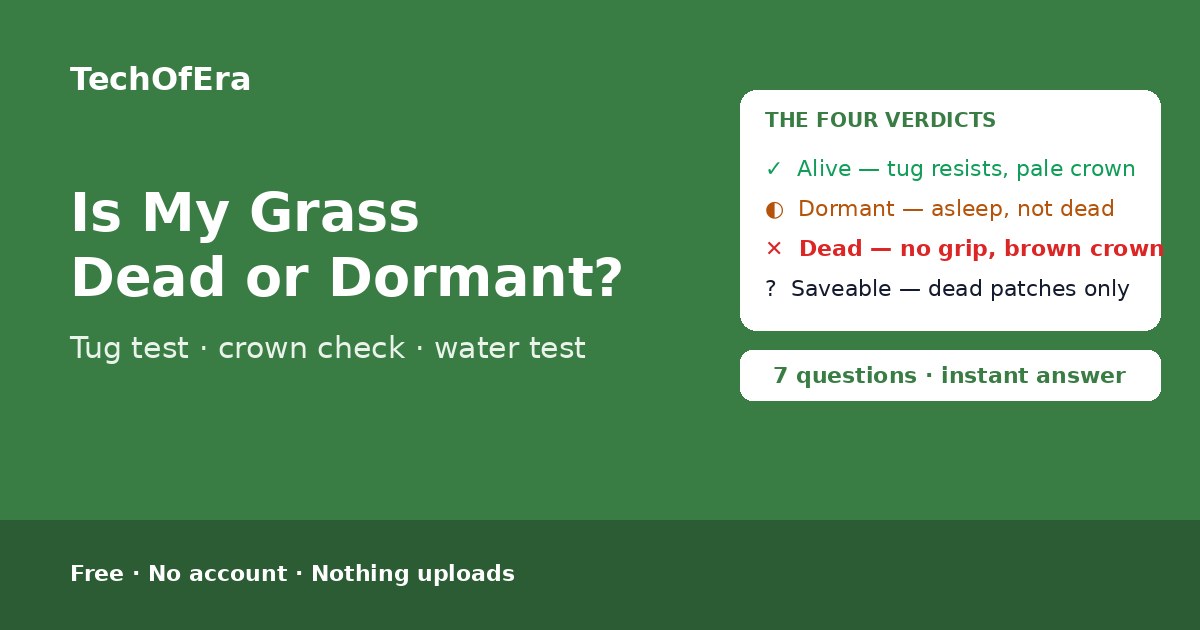
How to tell whether your grass is dead or dormant
That brown lawn you have been staring at all summer may not be gone; it may just be dormant. Dormancy is a survival strategy: the grass stops producing chlorophyll, turns straw-brown, and redirects its remaining energy to protecting the crown and root system — the parts that actually matter for recovery. It looks lifeless. It isn't. Death is different — when the crown and roots die, the plant has lost its ability to absorb water and nutrients, and unlike dormancy, that state is permanent. The question homeowners actually ask is not what dormancy is — it is whether this lawn, the one in front of them, is still alive. This checker asks exactly what decides it.
To use it:
- Do the tug test first. Go to a brown area of your lawn, grab a small handful of grass and pull firmly upward. If the grass resists and holds firm, the roots are intact and alive — that is the best possible outcome. If it lifts out easily with little resistance, with roots that look brown, mushy or virtually nonexistent, that area is dead. Try it in a few spots, because dead patches are often local. If the turf peels back like a loose carpet, grubs have probably eaten the roots from below.
- Check the crown. Part the blades with your fingers and look at the base of the grass plant right at the soil surface. The crown is the pale nub where blades grow up and roots grow down — the growing point of the grass. A crown that is firm and green or creamy white is alive. A crown that is completely brown, mushy, shrivelled or dried out is dead. This is the single most reliable test, because brown blades tell you nothing on their own.
- Check the roots. Dig up a small plug and look: healthy roots are firm, white and fibrous, holding the soil together. Roots that are brown, short, broken or missing have died. Turf that lifts with almost no roots is either dead or grub-damaged — either way, it will not recover on its own.
- Run the water test. Pick a small brown patch about a metre square and water it deeply every second day for two weeks, without feeding it. Dormant grass will start to put out fresh green leaves, often from the crown, within a couple of weeks if the temperature is right. Dead grass stays brown and nothing changes. This is the test that settles the argument when the tug test and the crown check disagree.
- Read the pattern. Dormancy is uniform: the whole lawn, or whole sun-baked areas, fades to an even straw colour together. Trouble is irregular: sharp circles, streaks or scattered patches while the rest stays green point to grubs, disease, insects or spills — not dormancy. If your brown is patchy rather than lawn-wide, start by finding the cause.
- Match the grass type to the season. Cool-season grasses — Kentucky bluegrass, tall fescue and perennial ryegrass — go dormant in summer heat and drought and return in autumn, typically September to October. Warm-season grasses — Bermuda, zoysia and St. Augustine — go dormant in winter cold and return in spring, around April to May. Brown in the grass type's own dormant season is expected; brown at the wrong time of year is a warning sign. If you are not sure which grass you have, watch when it greens up: grass that greens in April is cool-season, and grass that waits until May is warm-season.
- Do not judge by the blades alone. Brown blades tell you nothing on their own — a dormant lawn looks identical to a dead one from the window. What matters is the crown: as long as the crown is alive, the grass can come back. And new green shoots after watering are the strongest proof of life there is.
Lawn situations and what to do at a glance
The table below is built from the same rules as the checker, so it can never disagree with your verdict. Tug, crown, roots, water test, pattern and season decide together.
| Lawn situation | Verdict | What to know |
|---|
What makes this checker different
The pages that rank for this search are guides — thorough explanations of dormancy, the tug test, and the crown check — but they leave you to work out what that means for the lawn you are looking at right now: whether a lawn that resists the tug but has brown patches is dormant or damaged, whether a crown that is pale but roots that are brown counts as alive, and whether a warm-season lawn brown in July is dormant or dying. The photo-diagnosis tools that rank alongside them want a photo, an account, and usually a subscription or credits — and their answer is a guess from pixels. This page is the answer without the upload: seven questions, an instant verdict, the reason named, and the dead signs stated plainly instead of buried in the text — with nothing to install, no account, and nothing uploaded. It is a self-assessment, so it says plainly what it cannot know: a web page cannot see your lawn, so anything you mark “Not sure” stays on the list until you do the test yourself.
When is this the right check?
Whenever you catch yourself staring at a brown lawn and wondering whether to dig it up: the lawn that turned straw-coloured in a July heatwave, the one that never greened up in spring while every lawn on the block did, the patch that stayed brown after the rest recovered. Also whenever the pattern changes — a lawn that was green recently and has suddenly gone brown in patches, or one that browned out during a dry stretch and has not come back after the rain. And whenever you are not sure what counts: a tug that resists versus one that lifts away, a crown that is pale versus one that is brown, a patch that greens up versus one that stays brown. If the answer is “dead”, the checker tells you what killed it, so the new grass does not go the same way.
Honest limitations
A self-assessment, not a diagnosis
This checker works only from the answers you enter. It cannot see your lawn — no web page can tug a handful of grass, part the blades to look at the crown, or water a test patch for two weeks. If an answer is wrong, the verdict is wrong. When in doubt, do the tests again, or ask a local nursery or your county extension office.
The water test fails in cold weather
Warm-season grasses need warm soil to respond to the water test, so a patch can stay brown in midwinter even though the crowns are alive. Wait for the soil to warm up in spring before judging by it — until then, trust the tug test and the crown check.
Patchy brown usually has a cause
Dormancy is uniform; patches are not. Sharp-edged brown patches, rings or streaks in an otherwise green lawn point to grubs, disease, a chemical spill or dog urine. Find the cause before you repair — reseeding over an untreated grub problem wastes the seed.
Dormancy has a time limit
Kentucky bluegrass can survive roughly four to six weeks dormant — often longer — and bounce back when rain and cooler weather return. Past that point without water, drought can turn dormancy into death. A lawn brown for longer than six weeks deserves the water test before you decide.
Do not drown a fungal patch
Do not pour extra water on a brown patch without identifying it first. If the cause is fungal rather than dry, more water makes it worse. Check the pattern and the crown before you reach for the hose.
Rules from lawn-care guides and extension services
The rules here follow the tug test, the crown check, the root check and the water test taught by lawn-care guides and the University of Minnesota Extension, as they read in November 2026. Guidance can be revised, so re-check if a new edition appears.