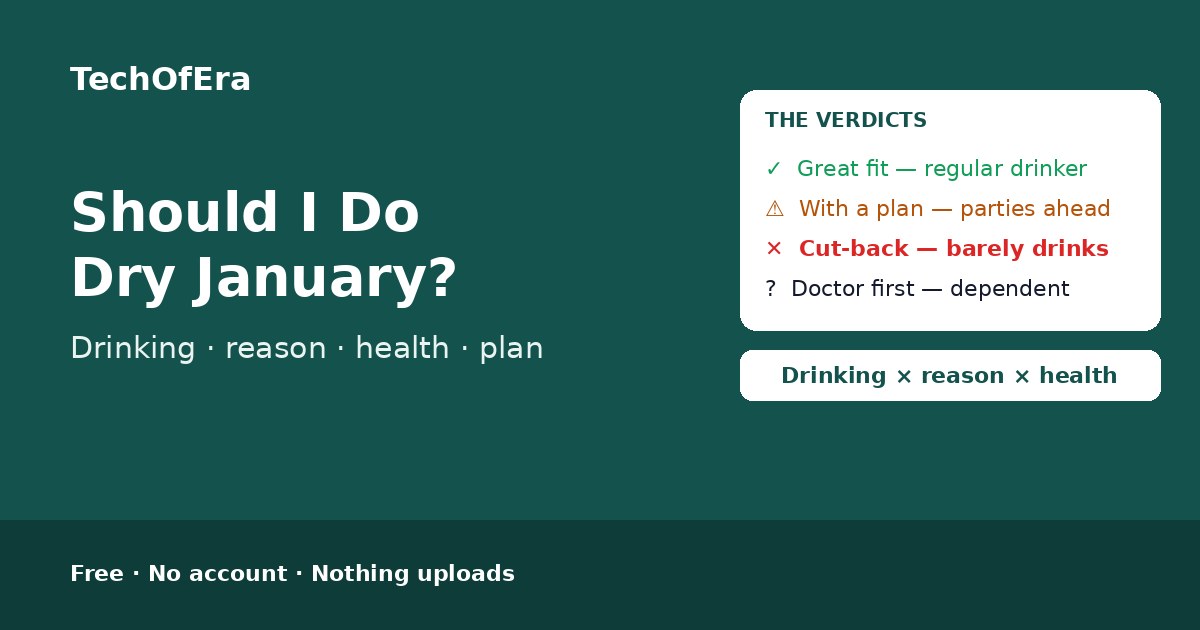
Should you do Dry January — or is a gentler cut-back better?

Dry January started in 2013 with Alcohol Change UK, and the evidence says a dry month moves numbers your doctor can measure — in one study, regular drinkers who stopped for a month lowered their insulin resistance by about a quarter. But it is not for everyone: if you barely drink, it changes almost nothing, and if you are dependent, stopping suddenly can be dangerous. Answer nine quick questions and get a personal verdict — plus the money you would save and a week-by-week plan. Entirely in your browser.

  • Personal verdict — great fit, with a plan, cut-back, or doctor first
  • Money saved and calories avoided, from your own answers
  • Week-by-week plan for the whole month
  • Free, no account, nothing uploads
Should you do Dry January — or is a gentler cut-back better?

Check whether Dry January is for you

Try a preset:
8 of 9 answered

Your result

Pick how often you drink Your verdict appears here once you pick how often you drink above.
What this means for January

Pick how often you drink above and what this means for January will appear here.

Blockers

Cautions

Still to confirm

Things to check

Your week-by-week plan

    What to do next

      Your result summary


      Pick how often you drink above — the verdict updates live.

      Privacy you can verify, not just trust

      Checking a health question by uploading details of your drinking to a website would be backwards — the check should never be the leak. This one can't: your answers are checked with plain JavaScript on your device, and they never leave the device — the only third-party requests are the site's own analytics, which count page views. Don't take our word for it:

      New cross-origin requests during use: 0
      1. Press F12 to open developer tools, then the Network tab.
      2. Pick how often you drink above. Watch: apart from the site's analytics, nothing new is requested — no uploads, and no data ever leaves your device.
      3. Extra credit: disconnect your internet after this page loads — the checker still works.

      How to decide whether Dry January is for you

      Dry January is a month without alcohol, from 1 January to 31 January. It started in 2013 with the UK charity Alcohol Change UK, and it has grown from about 4,000 official sign-ups in its first year to about 175,000 in 2023. The question it answers is not “is alcohol bad for you” — it is “what is alcohol doing in your life, and what changes if you take a month off?” This checker asks exactly what decides that.

      To use it:

      1. Count how often you drink. Count the drinking days in a normal week — most people drink on the same days each week. Drinking every day and drinking once a month are different answers, and this is the question the whole verdict turns on.
      2. Count how much per session. One drink is a beer, a glass of wine or a shot. Count honestly: the money saved and the calories avoided are worked out from this and how often you drink.
      3. Put in your weekly spend. Include drinks at home and drinks out — pubs and bars add up fast. The checker works out the money saved from the spend you enter, times 31/7 weeks in January, in the currency you pick. It does not guess an average, because spending varies too much.
      4. Be honest about the health flags. A liver condition, a medicine that clashes with alcohol, pregnancy, or getting shaky or ill when you do not drink — any of these changes the verdict to “talk to your doctor first”. Stopping suddenly can be dangerous if you are dependent, so this is the question that matters most.
      5. Weigh the social pressure. Most slips happen at a party or a pub night, not at home. If you host, or you work in hospitality, alcohol is in front of you most days — the month needs a plan for every shift and every guest, not just willpower.
      6. Use your past attempts. Not finishing last time is information, not failure: something tripped you up, and this time the plan has to cover that moment. If you finished before, you know you can do it — and you know what the hard days feel like.

      Drinking patterns and what to do at a glance

      The table below is built from the same rules as the checker, so it can never disagree with your verdict. How often you drink, how much per session, your reason and your health flags decide, together.

      PatternVerdictWhat to know

      What makes this checker different

      The pages that rank for this search are guides — thorough explanations of what Dry January is, the health benefits, and the general advice to try it — but they leave you to do the work yourself: to judge whether you drink enough for it to matter, to work out what you would save, and to decide what to do about the parties, the pub nights and the moment that tripped you up last time. The quizzes that do exist are personality quizzes that match you with a meme, or the four-question CAGE screening test — neither answers the question as it is actually asked: “Should I do Dry January?” This page is that answer: how often you drink, how much per session, your reason, your health flags and your social pressure scored together, and a verdict for your exact situation — yes, a great fit; worth trying with a plan; a gentler cut-back instead; or talk to your doctor first — with the money saved, the calories avoided and a week-by-week plan. It is a self-assessment, so it says plainly what it cannot know: a web page cannot know your body or whether you are dependent on alcohol, so anything you mark as a health flag stays on the list until a clinician confirms it.

      When is this the right check?

      Whenever you are wondering whether to sign up for Dry January: the drinker who has a glass of wine most evenings and wants to know if a month off is worth it, the weekend drinker deciding between a full dry month and a gentler cut-back, the person whose friends are all doing it and wants to know if it is worth it for them too, the heavier drinker who wants the health gains but is not sure it is safe to stop, or the person who tried last year and did not finish and wants a plan for the moment that tripped them up. Also whenever the decision turns on something specific — how much money you would actually save, how many calories you would avoid, whether the parties in your diary make it unrealistic, or whether a liver condition or a medicine changes the answer.

      Honest limitations

      A self-assessment, not medical advice

      This checker works only from the answers you enter. It cannot diagnose you — no web page can know your body, your medical history or whether you are dependent on alcohol. If an answer is wrong, the verdict is wrong. When in doubt, talk to your GP.

      The fit score and savings are estimates

      The 0–100 fit score, the money saved, the calories avoided and the units avoided are this checker’s own estimates, built from the answers you enter — a standard drink counted as roughly 150 calories and roughly 2 UK units, and your weekly spend times 31/7 weeks. They are not measurements of your body or your bank account.

      Dependence is a medical question

      Getting shaky or ill when you do not drink, or needing a drink first thing in the morning, are signs of physical dependence — and stopping suddenly can be dangerous. This checker flags it and tells you to talk to your doctor first, but it cannot assess you: only a clinician can.

      A slip does not ruin the month

      One drink does not cancel Dry January — the research says participants still drank less six months later, even if they did not finish. The useful response is to carry on the next day, not to give up.

      February matters too

      A dry month is a reset, not a cure. The research says most participants drink less afterwards, but the month works best when you plan February too — alcohol-free weekdays, a weekly limit, or another dry month later in the year.

      Rules from public-health sources

      The rules here follow Alcohol Change UK, the BMJ Open month-off study, the UK low-risk drinking guidelines and NHS guidance, as they read in November 2026. Guidance can be revised, so re-check if a new edition appears.

      Frequently asked questions

      Should I do Dry January?

      It depends on how much you drink and why you are considering it. If you drink most days and want a reset, better sleep or a check on your relationship with alcohol, Dry January is a great fit — and in the BMJ Open month-off study, regular drinkers who stopped for a month lowered their insulin resistance by about a quarter and their blood pressure by about 6.6%. If you barely drink, a full dry month changes almost nothing and a gentler cut-back fits better. And if you get shaky or ill when you do not drink, do not stop suddenly — talk to your doctor first. This checker asks how often and how much you drink, your reason, your health flags and your social pressure, and works out which of those answers fits you.

      Is Dry January worth it?

      For most people who drink regularly, yes. The clearest evidence comes from a 2018 BMJ Open study of 94 moderate-to-heavy drinkers who stopped for a month, compared with 47 who kept drinking: the abstainers' insulin resistance fell by about 26%, their systolic blood pressure by 6.6% and their weight by 1.5%, with no matching change in the drinking group. A 2016 study of 857 UK participants found people drank less on average six months later, whether or not they finished the month, and very few drank more afterwards. The gains are biggest for heavier drinkers — and they need medical advice to get there safely. This checker works out your own gains from the drinking pattern and weekly spend you enter: the money saved and the calories avoided are the checker's own estimates, and the page says so.

      Who should not stop drinking suddenly?

      People who are physically dependent on alcohol should not stop drinking suddenly. The NHS says withdrawal can be dangerous — shaking, sweating, nausea, anxiety, and seizures in severe cases — and people who are dependent should speak to a GP or a local alcohol service first, so a safe way to cut down can be planned. Signs of dependence include getting shaky or ill when you do not drink, or needing a drink first thing in the morning. The same caution applies if you have a liver condition or take a medicine that clashes with alcohol: talk to a clinician or pharmacist first. This checker scores any of those answers as 'talk to your doctor first — do not stop suddenly', and says so before anything else.

      How much money will I save doing Dry January?

      It depends entirely on what you spend now — so this checker does not guess an average, it works it out from the weekly spend you enter, times 31/7 weeks in January. As a guide, £25 to £50 a week becomes about £166 saved in January, and £50 to £100 a week becomes about £332 (the checker's own estimates, from the midpoints of the bands you pick). If you spend more than £100 a week, the figure is shown as 'at least' that amount. Pick your currency — pounds, dollars or euros — and the figure is shown in it.

      How many calories will I avoid in Dry January?

      This checker counts a standard drink as roughly 150 calories — a pint of beer is about 180, a 175 ml glass of wine about 130, a spirit with a mixer about 100 — and multiplies it by the drinks a week your answers imply, times 31/7 weeks in January. That is the checker's own estimate, and the page says so: the real figure depends on what you drink. As a guide, 12 drinks a week becomes about 7,970 calories avoided in January. The checker also estimates the alcohol units avoided, counting a standard drink as roughly 2 UK units.

      What happens if I have a drink during Dry January?

      Nothing is ruined. One drink does not cancel the month — the research says participants still drank less six months later, even if they did not finish the month. The useful response is to carry on the next day, not to turn one drink into a reason to give up. If you slipped at a party or a pub night, that is the moment to plan for next time: decide your line in advance, order an alcohol-free drink first, and have an exit plan for the evening. This checker's week-by-week plan covers the first social test in week 2, because that is when most slips happen.

      Does this checker diagnose me or upload anything?

      No to both. This checker is a self-assessment: it works only from the answers you enter, runs entirely in your browser, and nothing you enter leaves your device. It cannot diagnose you — a web page has no way to know your body, your medical history or whether you are dependent on alcohol — so every answer you are unsure about is reported as something to confirm, and the result says so plainly. It is not medical advice: if you get shaky or ill when you do not drink, do not stop suddenly — speak to a GP or a local alcohol service first. The only third-party requests are the site's own analytics, which count page views. You can verify it yourself with the network-request counter in the privacy section below the checker.