How the crate-training check works
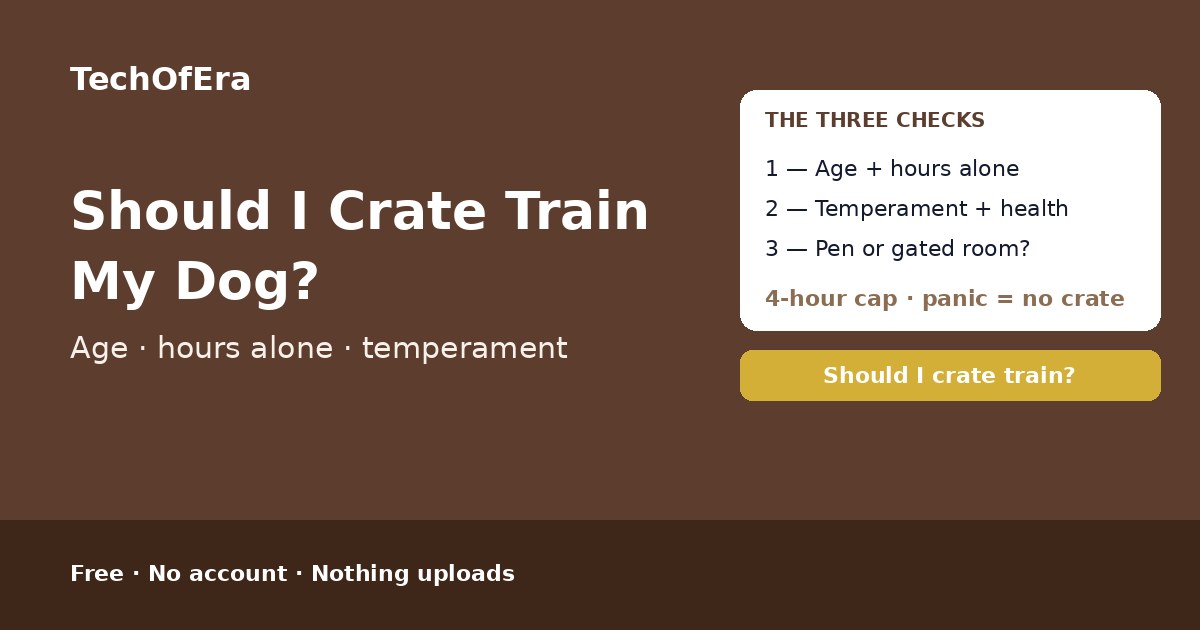
The American Kennel Club, Cornell University College of Veterinary Medicine and the RSPCA, Dogs Trust and Blue Cross agree on the shape of the answer, even if they phrase it differently: a crate is a short-term tool, not a place a dog lives. A puppy manages roughly its age in months plus one, in hours — so a 3-month-old puppy manages about 4 hours — and puppies under six months should not stay in a crate for more than three or four hours at a time. An adult dog should not routinely be crated, or left alone at all, for more than about four hours at a stretch. And a dog that panics behind a closed door should never be crated, whatever the other answers say. This checker adds up the reasons a crate helps — a young dog, a dog still having accidents, a dog that destroys things alone, a dog that settles in small spaces, a dog that travels, a dog recovering from surgery, a household with no pen as an alternative — and weighs them against the limits: the hours alone, the overnight hours, and your dog’s health and nerves. The verdict is for your dog, not for dogs in general.
To use it:
- Say how old your dog is. Age sets the safe stretch in a crate: puppies manage roughly their age in months plus one, in hours, and seniors need more frequent toilet breaks.
- Say how long your dog is alone at a stretch. The longest stretch on a typical day decides whether a crate can cover it — an adult should not routinely be crated for more than about 4 hours at a stretch, and a crate cannot cover a whole working day on its own.
- Say whether your dog would sleep in the crate overnight. Overnight adds about 8 hours to the daily total — a dog that sleeps in a crate should spend the day free, and a dog crated in the day should sleep free at night.
- Say whether your dog is house-trained, and how they behave unsupervised. House-training is the strongest single reason to crate train, and a dog that chews or eats things alone is the dog a crate keeps safe.
- Say how your dog reacts to small spaces. This is the question that decides everything: a dog that panics behind a closed door should not be crated at all, and a nervous dog needs a slow, door-open introduction.
- Say how your dog’s health is, whether you travel, and whether you have a pen or gated room. Arthritis, breathing problems and recovery from surgery all change the answer, and a pen is the best alternative for the long stretches a crate cannot cover.
What makes this checker different
The pages that rank for this search are guides — the American Kennel Club’s crate-training guide, Care.com’s myths and benefits article, Paw.com’s reasons to crate train, and a vet’s benefits article — and every one of them gives the same general answer to a general question: yes, with conditions, for most dogs. None of them asks about your dog. There is no free, standalone checker that takes your dog’s age, the hours they are alone, whether they would sleep in the crate, their house-training, their behaviour unsupervised, their reaction to small spaces, their health, your travel and whether you have a pen — and gives you a verdict: yes, yes with conditions, optional, or skip the crate — with the longest safe stretch, the daily total cap and a first-week plan. This page is that answer: nine questions, an instant verdict for your exact dog and your exact household, the blockers named, and the next steps. It is a self-assessment, so it says plainly what it cannot know: it cannot meet your dog, and where your dog’s own reaction disagrees with the numbers it says so instead of guessing.
When is this the right check?
Before you buy a crate — because the crate, the pen and the gated room are three different answers, and the wrong one costs money and a stressed dog. When a new puppy comes home, and the house-training question is really a crate question. When a rescue dog arrives and you do not yet know how they react to small spaces. When your working hours change and the old arrangement no longer fits inside the safe stretch. When someone else looks after your dog — a dog walker, a family member, a neighbour — because a long day in a crate is the most common way a routine week turns into a stressed dog. And whenever your dog starts pacing, howling or scratching at the crate door — because that is when a guide leaves you guessing and a checker earns its keep.
Honest limitations
A self-assessment, not veterinary or training advice
This checker cannot meet your dog. It cannot see whether your dog panics in a crate or how stiff their joints are. If you are worried about your dog, talk to your vet or a qualified trainer.
Your dog’s reaction beats the numbers
A dog that panics behind a closed door should not be crated, whatever the score says. The fit score is guidance for an average dog of that age — your dog’s own reaction is the verdict that counts.
The hour limits are guidance, not a guarantee
No dog reads a clock. A calm adult can manage longer than four hours on a rare day, and a nervous puppy can struggle with two. The limits are where vets and welfare groups say to start paying attention — not a promise that inside them is safe and outside them is not.
Overnight is an estimate
The checker counts an overnight crate sleep as about 8 hours. Some dogs sleep ten, some wake after six — and a puppy that needs a 2 a.m. toilet break is not sleeping through at all. Adjust the total for your own dog.
Breed and size are not the question here
Unlike the cold-weather checkers, this one does not ask for breed or size: the crate rules turn on age, hours, temperament and health, and a Chihuahua and a Great Dane with the same answers get the same verdict. Crate size still matters — big enough to stand, turn and lie down, small enough not to soil one corner and sleep in another.
Rules from official sources, dated November 2026
The rules here are the American Kennel Club, Cornell University College of Veterinary Medicine, Humane World for Animals and RSPCA / Dogs Trust guidance, as they read in November 2026. Guidance changes: recheck with your vet or trainer if anything about your dog changes.