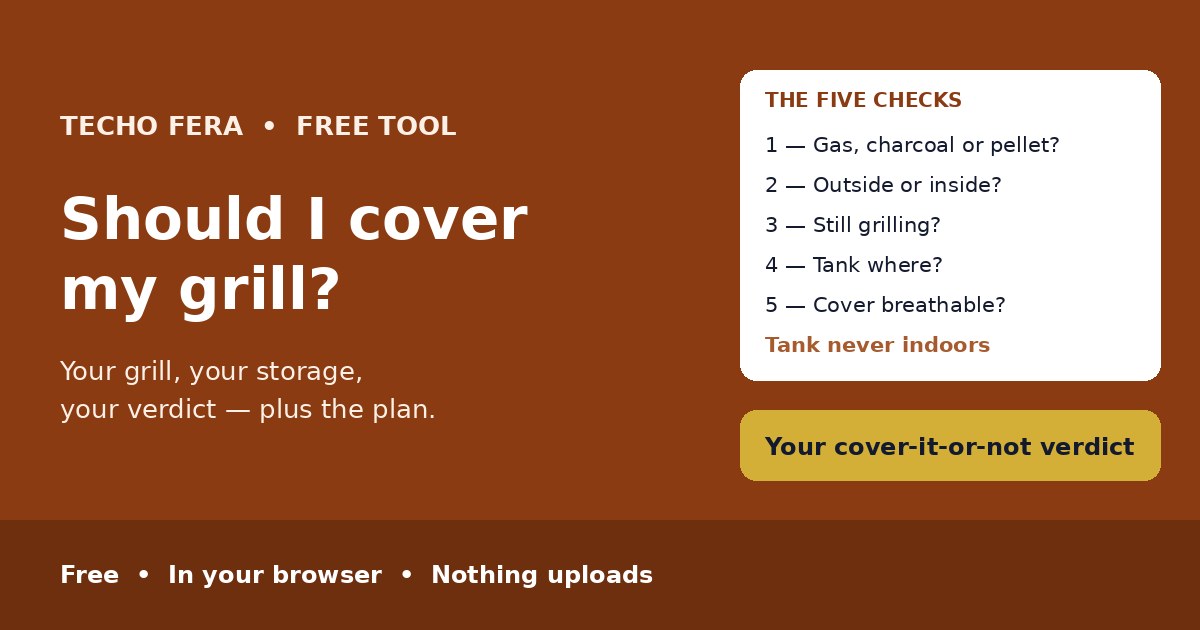
Should you cover your grill for winter?

Every guide says the same thing — cover it — but the right answer depends on your grill. A grill in a garage needs no cover at all; a grill you still cook on needs one only between cooks; a dirty grill must be cleaned before any cover goes on; and a propane tank stored indoors is the one thing that must change today. Answer twelve questions and this checker gives you the verdict for your grill, with a step-by-step plan. Free, in your browser, nothing uploads.

  • Weber: cover keeps it cleaner
  • Tank never indoors
  • Clean before covering
  • Free, no account, nothing uploads
Should I cover my grill for winter? Check your grill in seconds.

Check whether to cover your grill for winter

Try a preset:
0 of 12 answered

Your result

Answer the questions Your verdict appears here as you answer.
Recommended action

Answer the questions above and the recommended action will appear here.

Your winter plan

    Blockers

    Things that do not fit

    Things to check

    Still to confirm

    What to do next

      Your result summary


      Answer the questions above — the verdict updates live.

      Privacy you can verify, not just trust

      Checking whether to cover your grill by uploading your home details to a website would be backwards — the check should never be the leak. This one can't: your answers are checked in your browser, and they never leave the device — the only third-party requests are the site's own analytics, which count page views. Don't take our word for it:

      New cross-origin requests during use: 0
      1. Press F12 to open developer tools, then the Network tab.
      2. Answer a question above. Watch: apart from the site's analytics, nothing new is requested — no uploads, and no data ever leaves your device.
      3. Extra credit: disconnect your internet after this page loads — the checker still works.

      How the grill winter cover check works

      Metal rusts when moisture meets oxygen, and a grill left bare all winter sits wet for months — snow melts on it, rain soaks it, and the steel rusts. But the right answer is not the same for every grill. A grill in a garage needs no cover at all. A grill you still cook on needs one only between cooks. A dirty grill must be cleaned before any cover goes on, or the cover traps grease, mice and mold. And a propane tank stored indoors is the one thing that must change today, whatever else you do. This checker asks twelve questions — where you are, what kind of grill it is, where it is stored, whether you are still grilling, what the winter is like where you are, what cover you have, whether it is clean, where the propane tank is, what the grill is made of, whether it already has rust, whether it is already put away, and how long it will sit unused — and turns the answers into a verdict and a step-by-step plan, in the order you should do the job.

      To use it:

      1. Say what kind of grill it is. A pellet grill's hopper must stay dry, and a gas grill has a propane tank to deal with — the answer changes with the type.
      2. Say where it will be stored. Outside in the open, under a porch overhang, or in a garage or shed. A grill that lives indoors needs no cover at all — but its propane tank still stays outside.
      3. Say whether you are still grilling. A grill you still cook on needs no winterising — just a cover between cooks, and grates brushed after every cook.
      4. Say what the winter is like where you are. Heavy snow and hard freezes mean a cover is essential; a mild winter under a roof means it is optional; coastal salt air speeds up rust.
      5. Say what cover you have. A fitted, breathable cover is what survives a winter. Thin vinyl turns rigid and cracks below 32°F, and a tarp can freeze to the grill.
      6. Say whether it is clean, where the tank is, what it is made of, whether it already has rust, and whether it is already put away. A cover goes on a clean, dry grill, never a greasy one; a tank must never be stored indoors; cast iron needs oil, not just a cover; rust already there needs scrubbing.
      7. Read the verdict — and the plan. The verdict tells you whether to cover it, clean it first, store it inside, or keep grilling. The plan lists the steps in order, so you can walk outside and do them one by one.

      What makes this checker different

      The pages that rank for this search are how-to guides — a home-improvement site, a food site, a grill shop, a small outdoor-kitchen blog. Every one of them gives you the same answer — cover it — and leaves you to judge your own grill. None of them asks whether you are still grilling, where the propane tank is, or what cover you have — and none of them tells you what to do when the answer is "I don't know". This page is that answer: twelve questions, a verdict that changes with the grill type, the storage, the cover and the tank, and a plan that stops at the step you cannot do and tells you what to do instead. It is a planning aid, so it says plainly what it cannot know: it cannot see your grill, and where your answers are uncertain it says so instead of guessing.

      When is this the right check?

      When autumn arrives and you are not sure whether to bother — because the answer depends on the grill, not the season. When you have just moved into a house and do not know where the tank is — because a tank in the garage is the one thing that must change today. When you bought a pellet grill and are not sure whether the hopper needs protecting — because wet pellets swell and jam the auger. And when you are still grilling through the winter — because the checker tells you the cover goes on between cooks, not over the season.

      Honest limitations

      A planning aid, not grilling advice

      This checker cannot see your grill, your cover or your forecast. It cannot tell you whether a specific burner is rusted through, or whether your tank valve leaks. If you smell gas, do not light the grill: turn the tank valve off, move away, and call your gas supplier or the fire department.

      The tank is the danger, not the grill

      A grill with no tank connected is safe indoors. A tank in a garage is not. Propane is heavier than air, so a leak pools low and waits for a spark — a furnace, a dryer, a light switch. That is why the tank stays outside, upright, away from vents, whatever the weather.

      A cover can trap moisture too

      A waterproof cover with no vents keeps rain out and locks moisture in. Ground moisture and melting snow rise into the fabric and settle on the steel — the cover that was meant to stop rust starts it. That is why the cover must breathe, and why it comes off on dry, sunny days.

      Thin vinyl fails in the cold

      Cheap covers rely on thin vinyl or PVC coatings. Below 32°F that soft plastic turns as rigid as a potato chip, then cracks when the wind moves it or snow loads it. A heavy-duty breathable polyester cover (600D or better) stays flexible in the cold and survives the winter.

      Rust already there stays there

      A cover slows rust down — it does not reverse it. Rust spots already showing need scrubbing with a wire brush and a coat of oil on the bare metal, and if a burner or a firebox is rusted through, no cover will save it. Check in spring before the first cook.

      Rules from the grill makers and the pitmasters, dated November 2026

      The rules here are the published guidance as they read in November 2026: Weber's guidance on leaving a grill outside and never storing a propane tank indoors, the Family Handyman winterising guide, pitmaster Christie Vanover's advice on keeping a grill covered and dry, and the cover-material guidance from grill-cover makers. Guidance changes: recheck with those sources if anything about your plans changes.

      Frequently asked questions

      Should I cover my grill for winter?

      If the grill sits outside and the season is over, yes — a cover keeps it dry, and dry steel rusts far slower than wet steel. If the grill lives in a garage or shed it needs no cover at all, and if you are still grilling through the winter you only need to cover it between cooks. Two things matter more than the cover itself: the grill must be clean and dry before the cover goes on, and a propane tank must never be stored indoors. This checker works out the exact verdict from your grill type, storage, cover, tank and climate.

      Can I leave my grill outside in winter?

      Yes. Weber says its grills do not need to come inside for winter, though bringing one inside will not hurt it. If you leave it outdoors, a cover keeps the outside cleaner — make sure the grill is clean and dry before the cover goes on, and on a dry, sunny day pull the cover off for a bit to let trapped moisture escape. If the grill is a gas grill, close the tank valve; if it goes into a garage or shed, disconnect the tank and leave it outside, upright.

      Should I cover my grill if I still grill in winter?

      Cover it between cooks. A grill does not need to be put away for winter, and Weber says its grills do not need to come inside. Brush snow off the cover before you lift it, so it does not fall into the grill, and brush the grates after every cook while they are still warm. Keep the propane tank outside and upright — propane contracts in the cold and loses pressure, so expect weaker flames on the coldest days. That is normal, and it is never a reason to bring the tank indoors.

      Can I store my propane tank in the garage?

      No — never store a propane tank indoors, not in a garage, a basement or a shed. A small gas leak in an enclosed space can cause a huge explosion. If the grill stays outside, the tank can stay connected with the valve shut off. If the grill goes into a garage or shed, disconnect the tank and leave it outside, upright, away from dryer and furnace vents and children's play areas.

      What kind of grill cover is best for winter?

      A heavy-duty breathable polyester cover (600D or better) with vents and a drawstring or tie-downs, fitted to your grill if you can. Thin vinyl and PVC covers turn rigid and crack below 32°F, and a waterproof cover with no vents traps condensation underneath — ground moisture and melting snow rise into the fabric and settle on the steel. A tarp is worse than no cover in deep cold: it goes brittle, cracks and can freeze to the grill.

      Should I clean my grill before covering it for winter?

      Yes — a cover goes on a clean, dry grill, never a greasy one. Weber warns that leftover grease and food bits attract mice, feed mold and trap the moisture that leads to rust. Brush the grates and burners, scrape grease and food bits off the inside, and empty the drip pan or ash catcher. Then coat the burners and other metal parts with a light coat of cooking oil, and wrap the burner unit in a plastic bag to keep spiders and insects from nesting in the gas tubes.

      Do I need to cover a pellet grill or a kamado for winter?

      For a pellet grill, the cover is not optional: water and ice in the hopper ruin the pellets and can jam the auger, so keep the hopper covered and dry or empty it for the winter. For a kamado, keep the ceramic and the felt seals dry — a soaked felt seal swells and the lid can stick or crack in a freeze. Both types still need the same cleaning first: brush the grates, empty the ash, and oil the metal parts.

      Does this checker give grilling advice?

      No. This checker is a planning aid: it runs your answers against the published guidance as it reads in November 2026, entirely in your browser, and nothing you enter leaves your device. A web page cannot see your grill, your cover or your forecast, so it says plainly what still needs checking — above all, where the propane tank is, whether the grill is clean, and what cover you have.