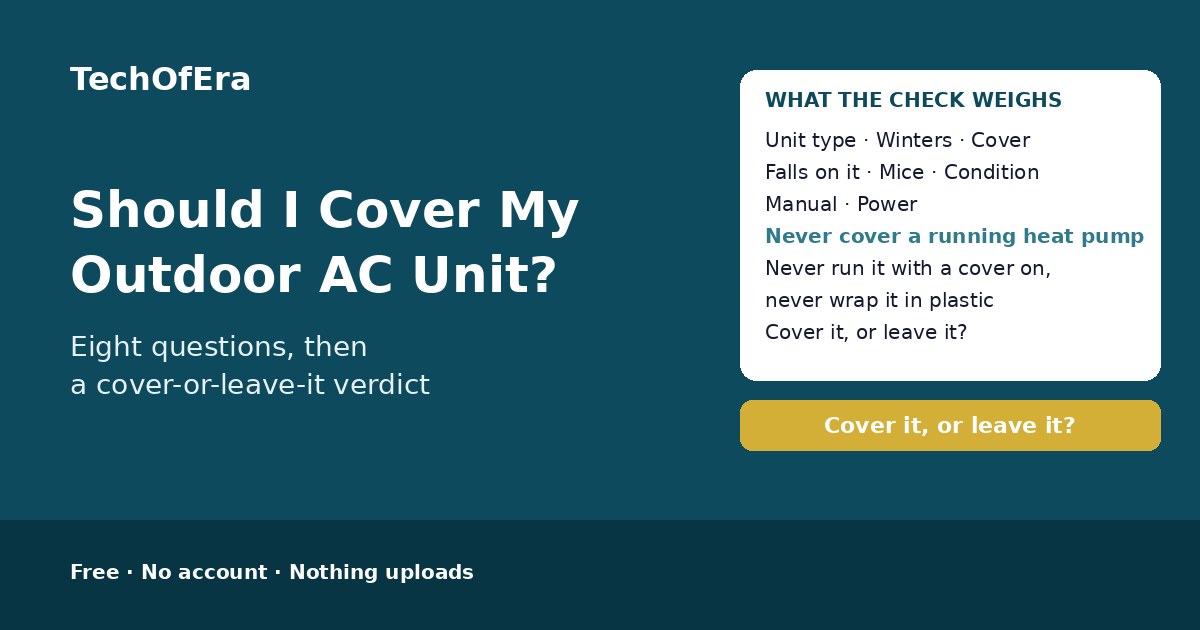
How the cover-or-leave-it check works
The guides that rank for this question agree on the routine and disagree on the details — one says never cover anything, another says a top-only shield is sensible, a third says a full wrap is fine. None of them scores your situation. What decides it is eight things: what kind of outdoor unit it is, how hard your winters are, what cover you have, what falls on it, whether mice are about, what state it is in, what the manual says, and whether the power stays on. The first question matters most: if the outdoor unit heats your home, it is a heat pump, and the answer is never cover it. If it is an AC-only condenser that sits idle all winter, the answer is usually a top-only cover at most — or nothing at all in a mild winter. Use this simple rule: never cover a running heat pump, never run an AC with a cover on, and never wrap a unit in plastic.
To use it:
- Say what kind of outdoor unit it is. An AC-only condenser sits idle until spring. A heat pump looks almost the same but heats your home in winter, so it has to breathe and shed ice all season. Check the nameplate on the cabinet — the label often says “heat pump” — or the thermostat: an “Em Heat” or “Aux Heat” setting means it is a heat pump. Or watch it on a cold day: if the outdoor fan runs while the heat is on, or the unit puffs steam during a defrost cycle, it is a heat pump. A window unit is a different job again: it is best taken out of the window for winter.
- Say how hard your winters are. In a mild winter, where it rarely drops below freezing, an AC-only condenser needs no cover at all — it was built to sit outside, and Lennox says modern air conditioners typically do not require winterizing. In a cold winter, with regular frosts and some snow, a top-only cover earns its keep where ice or leaves fall on the unit. In a harsh winter, with long deep freezes and heavy snow, the top-only cover still earns its keep — but the sides must stay open, because a full wrap traps moisture for months.
- Say what cover you have. Choose a fitted, breathable top-only cover, or a piece of plywood weighted down with a brick, over the top grille only. A full vinyl wrap or a tarp pulled tight holds damp air against the coil all winter, which is exactly what causes rust and corrosion, and it gives mice a warm place to nest. Lennox says full covers, especially plastic or vinyl, can do more harm than good. If all you have is a full wrap, get a top-only cover before winter, not after the damage.
- Say what falls on the unit. The real danger to an outdoor condenser is not soft snow sitting on top of it — it is falling ice. If the unit sits directly beneath a roofline or gutters, a direct hit from heavy ice can crush the grille, bend the fan blades and damage the motor housing. That is the one case where a top shield is clearly worth it. Under trees, leaves pile up and hold water against the coil. In open sky, with nothing above it, there is nothing to shield against.
- Say whether mice are about. A full wrap is a warm, sheltered nest, and mice chew wires. If you have seen droppings, nests or chewed wires, or mice are common where you live, a top-only cover is the best you can do — it leaves the sides open, so mice have nowhere to hide — and you check the wiring in spring for chew marks. Keep the area around the unit clear of stored boxes and brush.
- Say what state the unit is in. Nothing goes under a cover dirty or damaged. Leaves and dirt in the coil hold moisture against it all winter, and a cover on a dirty unit only seals the damp in. Clear the coil and the base, rinse the fins gently from the inside out with a hose — never a pressure washer — and let it dry. Bent fins block airflow, rust spreads under a cover, and chewed wires are a fire risk: get a technician to look at damage before the unit sits idle for months.
- Say what the manual says. The manual is the tiebreaker. Lennox cautions that covering an outdoor unit may affect its warranty, depending on the manufacturer, so check the manual for your exact model before covering it. If the manual says do not cover it, do not cover it — clear the leaves and debris from the coil instead. If the manual allows a top-only cover, keep to what it allows and nothing more.
- Say whether the power stays on. Goodman says high-voltage power should always be disconnected whenever a cover or anything obstructing airflow is introduced, so pull the disconnect beside the unit while the cover is on. But restore power at least 24 to 48 hours before the first cooling run in spring, so the crankcase heater can warm the compressor oil before it starts. Never turn off a heat pump — it must stay powered through winter, because it is your heating system.
What makes this checker different
The pages that rank for this search are guides — an HVAC company walking through the whole winterizing job, a manufacturer on why full covers backfire, a home site on what the unit is built to handle, a local contractor on covers and breakers. None of them scores your situation: none takes your unit type, your winters, your cover, what falls on it, your mice, your unit's state, your manual and your power — and none gives you a verdict — top-only, leave it uncovered, do not cover it at all, or take the window unit out — with the plan for the verdict you got. There is no free, standalone checker that takes an outdoor unit's type and winter and returns a cover-or-leave-it verdict with the heat-pump rule, the full-wrap trap and the power rule applied. This page is that answer: eight questions, and an instant verdict for your exact unit. It is a self-assessment, so it says plainly what it cannot know: it cannot see your condenser, feel its coil, or read its nameplate, and where a cover would trap moisture or a heat pump would be harmed, it tells you to do something else instead of giving you a maybe.
When is this the right check?
When the first frost is a few weeks away and the outdoor unit is still uncovered — because the dry fall day is the moment to clear the coil, check the manual and fit a top-only cover, and by the time the frost arrives it is too late. When you are not sure whether the outdoor box is an AC or a heat pump — because that one answer decides most of it, and covering a heat pump is the mistake that breaks the unit. When all you have is a full vinyl wrap from the hardware store — because a tight wrap traps moisture and shelters mice, and you need a top-only cover before the damage starts. When the unit sits under a roof edge without a gutter — because falling ice is the real danger, not snow, and a top board takes the hit. And when spring comes — because the cover has to come off before the first cooling run, and the power has to go back on 24 to 48 hours before it.
Honest limitations
A self-assessment, not professional advice
This checker cannot see your condenser, feel its coil, or read its nameplate. It scores the answers you give against what the manufacturers and the HVAC guides say — it cannot tell you what your unit actually needs, and it is not professional advice.
The manual is the tiebreaker
Lennox, Amana, Goodman, Trane and Carrier do not all say the same thing, and your model's manual wins over any general guide — including this one. If the manual says do not cover it, do not cover it, whatever this checker says about a top-only cover.
Heat pumps and mini-splits vary
Some heat pumps have a factory wind baffle or a snow guard fitted by the installer, and some mini-splits have a drain pan heater. This checker treats every heating unit the same — never cover it — and it cannot tell you about the accessories fitted to your own unit.
Covers are not all equal
A fitted, vented, breathable top-only cover and a cheap thin one are not the same thing. This checker asks what kind of cover you have, but it cannot measure the cover's quality — a thin cover that pools water is barely better than no cover at all.
Winters move year to year
“Mild”, “cold” and “harsh” are the winters you usually get, not the winter you are about to get. A mild winter with one bad ice storm can still crush a fan grille, and a harsh winter with no roof drip may need nothing at all. The forecast tells you this year's.
Facts from the manufacturers and the HVAC guides, dated November 2026
The facts here are Lennox, Amana, Goodman, Trane and Carrier guidance, NYSERDA, and the HVAC guides that rank for this question — HGTV, Liberty Home Guard, Golden Rule, Brooks HVAC and others — as they read in November 2026. Guides change and winters move: recheck the numbers if anything about your unit changes.