How the robot vacuum check works
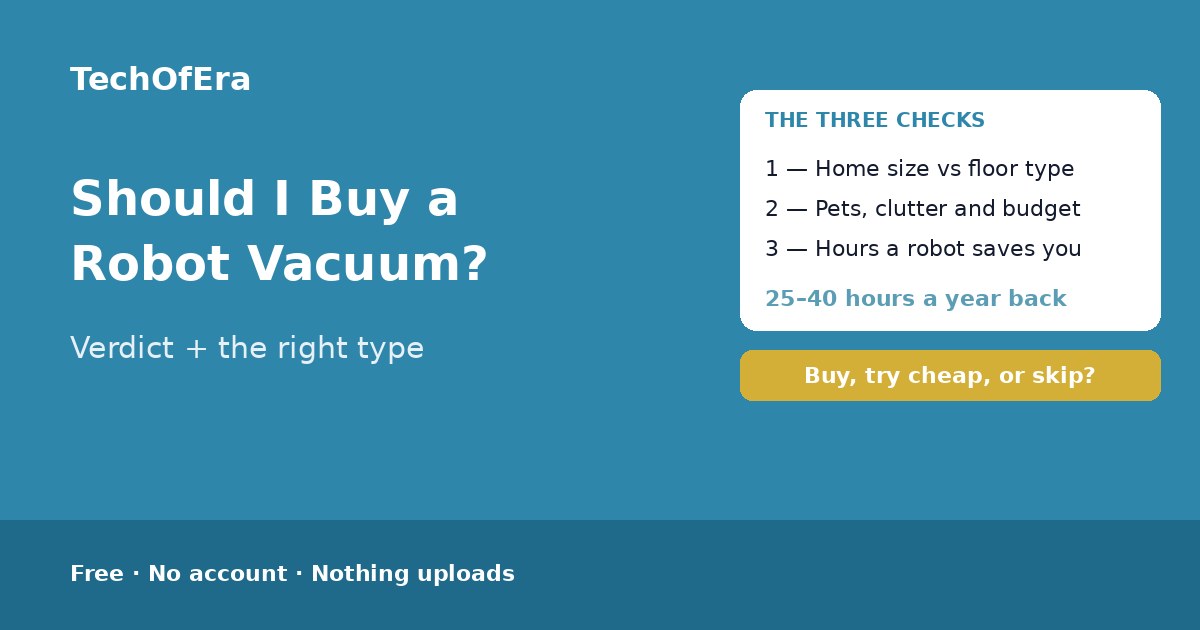
A robot vacuum is a maintenance machine, not a deep cleaner. It picks up dust, crumbs and loose hair on hard floors and low- to medium-pile carpet, but it does not replace a traditional vacuum for stairs, upholstery, thick carpets, corners or large spills. The honest value is frequency: a household that vacuums 30–45 minutes a week manually drops to a monthly manual pass with a daily robot, getting back roughly 25–40 hours a year. This checker combines six clues — how big your home is, what your floors are, whether you have pets or small children, how clear the floors are, what you can spend, and how long vacuuming takes you now — plus what else is true, and gives you a fit score out of 100, a verdict, the type to buy, and the hours a robot would save you each year.
To use it:
- Say how big your home is. Count the rooms the robot would clean: a studio under 50 m² is small, a house over 100 m² is a job for a mapping robot that cleans room by room and comes back to recharge.
- Say what your floors are. Hard floors and low-pile carpet suit a robot; thick, high-pile or shag carpet does not — the wheels get stuck, the brushes can damage the rug, and the shag hides the sensors.
- Say whether you have pets or small children. Pets and kids are the biggest reason to buy: daily runs keep hair and crumbs off the floor before they work in. Heavy shedding needs an anti-tangle brush and strong suction, and a self-empty base.
- Say how clear your floors are, and what you can spend. A robot needs mostly clear floors — cables, toys and clothes on the floor most days will leave it stuck. And the budget decides the type: the jump from no robot to a $300–$450 LiDAR robot buys almost all the value, while under $200 buys a basic model with no map.
- Say how long vacuuming takes you now. Time it for a week — that number is what the hours-saved figure is built from, and it is the honest measure of whether a robot is worth buying.
- Tick what else is true. Limited mobility, allergies, wanting a mop, or noise sensitivity shape which type to buy — a self-empty base for mobility, a HEPA filter for allergies, a mop combo for hard floors, a schedule that runs while you are out for noise.
What makes this checker different
The pages that rank for this search are guides — a brand guide that tells you a robot is worth it if it fits your floor type and budget, and a property site that lists the pros and cons and names three models to buy. Neither one asks how big your home is, what your floors are, whether you have pets, or how long vacuuming takes you now, and neither one tells you whether to buy or which type fits your home. One UK site runs a robot vacuum ROI calculator, but it answers a different question — how long until the robot pays for itself, in pounds, from the value you put on your own time — not whether you should buy one, and not which type. There is no free, standalone checker that takes your home size, floors, pets, clutter, budget and vacuuming time and gives you a fit score, a buy-or-skip verdict, the type to buy and the hours it would save you. This page is that answer: six questions, an instant verdict for your exact home, the blockers named, and the next steps. It is a self-assessment, so it says plainly what it cannot know: it cannot see your floors, and where shag carpet or a tiny place you can vacuum by hand is involved it says skip instead of selling you a robot.
When is this the right check?
When you are standing in a shop — or on a sale page — wondering whether the robot in front of you is worth the money, and the answer depends on your home, not the box. When the house has pets and the hair never stops, and you want to know whether a robot would actually stay ahead of it or just tangle and give up. When you have a small flat and a nagging feeling the robot would be an expensive way to avoid a five-minute chore. And when someone in the house finds pushing a vacuum hard — because that is where a robot earns its keep most, and this checker weighs it.
Honest limitations
A self-assessment, not a showroom
This checker cannot see your floors, test a robot in your home, or know how much hair your pets actually shed. It cannot check whether your rugs are shag or low-pile, how cluttered your floors really are, or what a robot would do in your rooms. Try a model from a shop with a good returns policy before you commit.
The score is a guide, not a diagnosis
A score of 92 does not mean a robot will change your life, and a score of 58 does not mean your home is wrong for one. The score weighs the home size, the floors, the pets, the clutter, the budget and your vacuuming time together — but only living with a robot for a month can say whether it earns its keep.
The hours saved are an estimate, not a promise
The hours figure assumes the robot covers about three quarters of your manual vacuuming, with a monthly manual pass still needed — and it assumes you actually run it daily. If it spends its life stuck under the sofa, or you forget to schedule it, the saving is smaller.
The yearly cost is a range, not a quote
The cost figures are five-year all-in ranges from the 2026 buying guidance — machine, electricity, filters, brushes and bags — for a typical home. Your cost depends on the model, how often you replace parts, and your electricity tariff, which is why this checker quotes a range, not a number for your bill.
A robot maintains, it does not replace
Every verdict on this page assumes you keep your current vacuum for the monthly deep clean, the stairs and the upholstery. If you sell the upright the day the robot arrives, the carpets will slowly get dirtier and the stairs will never get done — that is not a robot problem, it is an expectations problem.
Rules from the 2026 buying guidance, dated November 2026
The rules here are the 2026 buying guidance as it reads in November 2026: the 25–40 hours a year for a 30–45 minute weekly routine, the $300–$450 mapping tier that buys almost all the value, and the five-year all-in costs of roughly $80–$100 a year for a budget robot, $120–$220 for mid-tier and $270–$330 for a flagship. Guidance and prices change: recheck before you buy.