How the brine check works
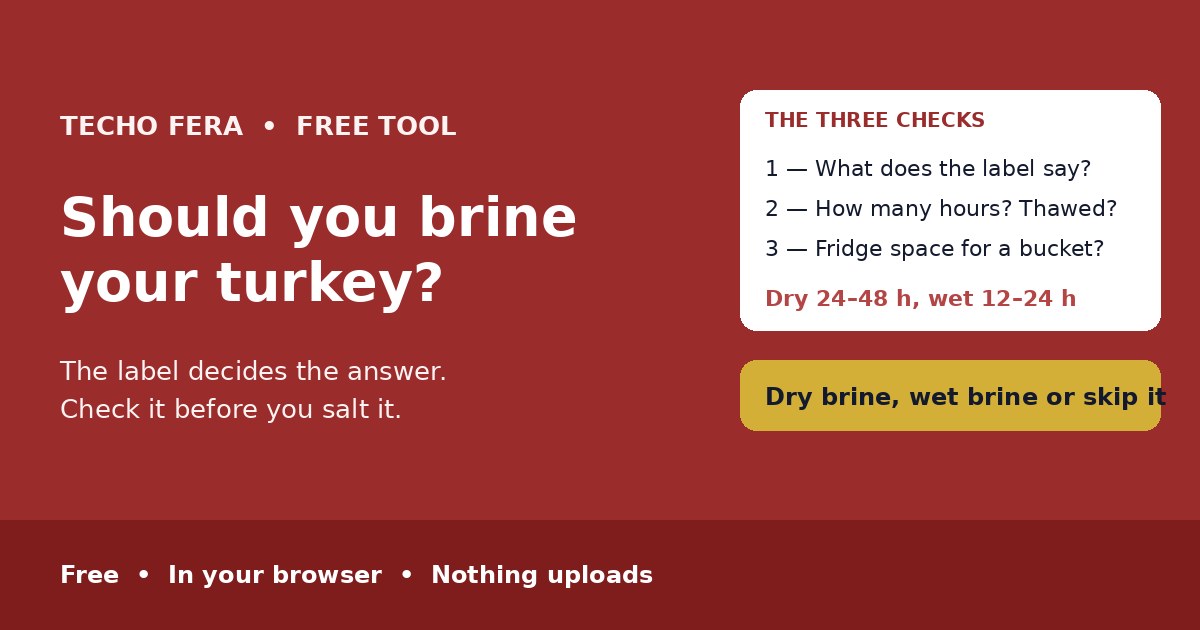
Brining is salt, applied in advance: either rubbed on as a dry brine for 24 to 48 hours, or dissolved in water as a wet brine for 12 to 24 hours, so the meat stays juicier and seasoned all the way through. But the right answer depends on your bird, not on the recipe: a Butterball is already salted, a frozen bird cannot be brined at all, a bird roasting today has no time for either brine, and a wet brine needs a container big enough to hold the bird fully submerged. This checker asks seven questions — the turkey's weight, what the label says, whether it is thawed, how many hours until you roast it, how much fridge space you have, what matters most to you, and which salt you own — and gives one verdict: dry brine it, wet brine it, or skip the brine, with the exact salt, water and hours for your bird.
To use it:
- Weigh the turkey. Enter the weight in pounds — 4 to 30 lb. The weight sets the salt and the water: a dry brine is 1 tablespoon of kosher salt per 5 lb, and a wet brine is about 1 gallon of water per 10 lb. The checker shows the kilogram equivalent next to it.
- Read the label. Pick what the label says: a plain bird with no added solution, a self-basting or pre-brined bird such as a Butterball, a kosher bird, an enhanced bird ("contains up to …% of a solution"), or not sure. This is the question that decides the answer — an already-salted bird must never be brined again.
- Say whether it is thawed. Fully thawed, partly frozen, still frozen solid, or not sure. A turkey has to be fully thawed before it goes into a brine, and thawing takes about 24 hours per 4 to 5 lb in the fridge — a 14 lb bird needs about 3 to 4 days.
- Say how many hours until you roast it. Under 12 hours, 12 to 24, 24 to 48, 48 to 72, or more than 72. A wet brine needs at least 12 hours and a dry brine at least 24 — and the USDA says never to brine longer than 2 days.
- Say how much fridge space you have. A big container fits, just the bird on a shelf, no fridge room but a cooler with ice, or no fridge room at all. A wet brine needs the container; a dry brine only needs the bird itself on a tray.
- Say what matters most. The juiciest meat, the crispiest skin, the least fuss, or the best gravy. A wet brine gives slightly juicier meat; a dry brine gives crisper skin, less fuss and richer drippings.
- Say which salt you own. Diamond Crystal kosher salt, Morton kosher salt, table salt, fine sea salt, or not sure. Salt works by weight, not by volume — a tablespoon of Diamond Crystal is 8 g, Morton 16 g and table salt 18 g — so the checker converts the amount for the salt you own.
Wet brine vs dry brine at a glance
| Turkey | Dry brine salt | Wet brine water + salt | Time |
|---|---|---|---|
| 8 lb (3.6 kg) | 1½ tbsp Diamond Crystal kosher salt | 2 gallons water + 1½ cups table salt | Dry 24–48 h · Wet 12–24 h |
| 12 lb (5.4 kg) | 2½ tbsp Diamond Crystal kosher salt | 2 gallons water + 1½ cups table salt | Dry 24–48 h · Wet 12–24 h |
| 14 lb (6.4 kg) | 2¾ tbsp Diamond Crystal kosher salt | 2 gallons water + 1½ cups table salt | Dry 24–48 h · Wet 12–24 h |
| 16 lb (7.3 kg) | 3¼ tbsp Diamond Crystal kosher salt | 2 gallons water + 1½ cups table salt | Dry 24–48 h · Wet 12–24 h |
| 20 lb (9.1 kg) | 4 tbsp Diamond Crystal kosher salt | 3 gallons water + 2¼ cups table salt | Dry 24–48 h · Wet 12–24 h |
| 24 lb (10.9 kg) | 4¾ tbsp Diamond Crystal kosher salt | 3 gallons water + 2¼ cups table salt | Dry 24–48 h · Wet 12–24 h |
The amounts are the checker's own estimates from the USDA ratios — 1 tablespoon of kosher salt per 5 lb for a dry brine, 3/4 cup of table salt per gallon of water for a wet brine, about 1 gallon of water per 10 lb — for the weight in the left column. Weigh your salt if you can: the checker converts the volume for Morton kosher salt, table salt and fine sea salt, because a spoon of one brand is not a spoon of another.
What makes this checker different
The pages that rank for this search are cooking guides — and every one of them gives you the same static answer: a recipe, with one salt amount and one time. None of them asks what your label says, how much your bird weighs, how many hours you have, how much fridge space you have, or which salt is in your cupboard — and none of them tells you to skip the brine when the bird is already salted. The brine calculators that do exist work out salt and water from a weight, but they do not decide whether to brine at all: they will happily size a brine for a Butterball. There is no free, standalone checker that takes a label, a weight, a thaw state, a clock, a fridge and a salt and gives you one verdict — dry brine, wet brine or skip it — with the exact plan for your bird. This page is that answer: seven questions, an instant verdict for your exact turkey, the blockers named, and the next steps. It is general information, so it says plainly what it cannot know: it cannot see your fridge, your salt or your turkey, and where the guidance is thinner — what the label really says, whether the bird is really thawed — it tells you to check instead of guessing.
Not the same question as the other turkey tools
Four other turkey tools on this site answer four different questions, and this checker says so rather than pretending to be them. Is My Turkey Done? checks whether a raw turkey is cooked — the first cook, after the brine. When Should I Thaw My Turkey? plans the thaw before cooking — and before brining, since a frozen bird cannot be brined. Can I Freeze Cooked Turkey? decides whether cooked turkey can go in the freezer at all. And Can You Reheat Turkey? decides whether leftover turkey can be heated up again. This checker starts where those stop: the turkey is still raw, still in the fridge, and you want to know whether to salt it before it goes in the oven — and how.
When is this the right check?
When you have bought the turkey and you are standing in the kitchen wondering whether to brine it — because the answer changes with the label, and a Butterball wants no brine at all. When the bird is still in the freezer and you are counting the days — because a 14 lb bird needs about 3 to 4 days just to thaw, and the brine needs a day on top of that. When you have one shelf free and no room for a bucket of salt water — because that rules out a wet brine and leaves the dry brine, which only needs the bird itself on a tray. And when you have opened three recipes and they disagree about the salt — because one says 1/2 cup a gallon and another says 1 cup, and the difference is which brand of salt they measured: weigh it, and the checker does the conversion for you.
Honest limitations
General information, not food-safety advice
This checker cannot see your fridge, your salt or your turkey. It cannot tell you what the label really says, whether the bird is really thawed, or whether it stays at 40 °F (4 °C) or below the whole time it brines — only you can. If you cannot confirm the label or the thaw, the honest answer is to skip the brine and cook the bird to 165 °F (74 °C).
The salt amounts are the checker's own estimates
The USDA ratios are the anchor — 3/4 cup of table salt per gallon for a wet brine, 1 tablespoon of kosher salt per 5 lb for a dry brine — but the amounts for your bird's exact weight, and the conversions between salt brands, are this checker's own arithmetic from those ratios and the King Arthur Baking weights. Weigh your salt if you can: a spoon of one brand is not a spoon of another.
The water is an estimate too
About 1 gallon of water per 10 lb is the rule of thumb, and a whole turkey needs at least 2 gallons to be submerged — America's Test Kitchen's table is 2 gallons for a 12 to 17 lb bird and 3 gallons for 18 to 24 lb. Your pot may need more or less: the bird has to be fully covered, whatever the number says.
The thaw time is a rule of thumb
About 24 hours per 4 to 5 lb in the fridge is the USDA figure, and the checker works from the middle of it. A wide, flat bird thaws faster than a deep, round one of the same weight — check the middle with your hand, not the clock.
Not sure means the cautious answer
If you are not sure what the label says, or whether the bird is thawed, the checker does not guess — it tells you to check the label or skip the brine. That is deliberate: the safe mistake is to roast an unbrined turkey that would have been fine brined.
Rules from the USDA, Food Network, The Kitchn and America's Test Kitchen, dated November 2026
The rules here are the brining rules as they read in November 2026: the USDA FSIS "Poultry: Basting, Brining, and Marinating" page (wet brine 3/4 cup table salt per gallon; dry brine 1 tbsp kosher salt per 5 lb; never brine longer than 2 days; keep it at 40 °F or below; skip kosher, self-basting and pre-brined birds), the Food Network wet vs dry brine guide (wet 12 to 24 hours, dry 24 to 72 hours), The Kitchn dry-brine guide (1 tbsp kosher salt per 5 lb, baking powder for crisp skin), America's Test Kitchen (1 tsp Diamond Crystal kosher salt per pound, 24 to 48 hours; wet brine 1/2 cup table salt per gallon), and the King Arthur Baking salt weights. Guidance changes: recheck with your local food-safety authority if anything changes.