Is your posture bad — or just tired?

Most people only know their posture “isn’t great” — not what is actually wrong with it. The wall test takes 30 seconds, and this checker adds your habits, symptoms and desk setup to it, then scores four patterns — forward head, rounded shoulders, lower back and desk setup — with the exact fixes the NHS describes.

  • Wall test + 13 questions
  • Four pattern scores, not one number
  • NHS-based fixes, named per pattern
  • Free, no account, nothing uploads
Is your posture bad — or just tired?

Check whether your posture is bad

Try a preset:
0 of 13 answered

The wall test — do it now, against any wall

Habits and symptoms — your typical day, not your best day

Your desk — only if you work at one

Your result

Answer the questions Your verdict appears here as you answer.
Your weakest pattern

Do the wall test above and your weakest pattern will appear here.

Red flags

Things that do not fit

Things to check

Still to confirm

What to do next

    Your result summary


    Answer the questions above — the verdict updates live.

    Privacy you can verify, not just trust

    Checking your posture by uploading your health details to a website would be backwards — the check should never be the leak. This one can't: your answers are checked with plain JavaScript on your device, and they never leave the device — the only third-party requests are the site's own analytics, which count page views. Don't take our word for it:

    New cross-origin requests during use: 0
    1. Press F12 to open developer tools, then the Network tab.
    2. Answer a question above. Watch: apart from the site's analytics, nothing new is requested — no uploads, and no data ever leaves your device.
    3. Extra credit: disconnect your internet after this page loads — the checker still works.

    How the posture check works

    Good posture, as the NHS describes it, is the position of your body when you sit or stand with minimal effort and without strain: viewed from behind, the spine should run in a straight line; viewed from the side, it should have natural curves, with the head above the shoulders and the shoulders over the hips. Poor posture looks like a poking chin, rounded shoulders, a pelvis tilted forwards, or a bottom sticking out. Most people have only a vague sense that their posture “isn’t great” without knowing specifically what needs work — and different patterns need different fixes. Forward head posture needs different exercises than an exaggerated lower back curve, and rounded shoulders need different stretches than tight hip flexors. This checker finds which pattern is yours: the wall test shows what your body actually does, the habit questions show what drives it, and the desk questions show what your setup is doing to you.

    To use it:

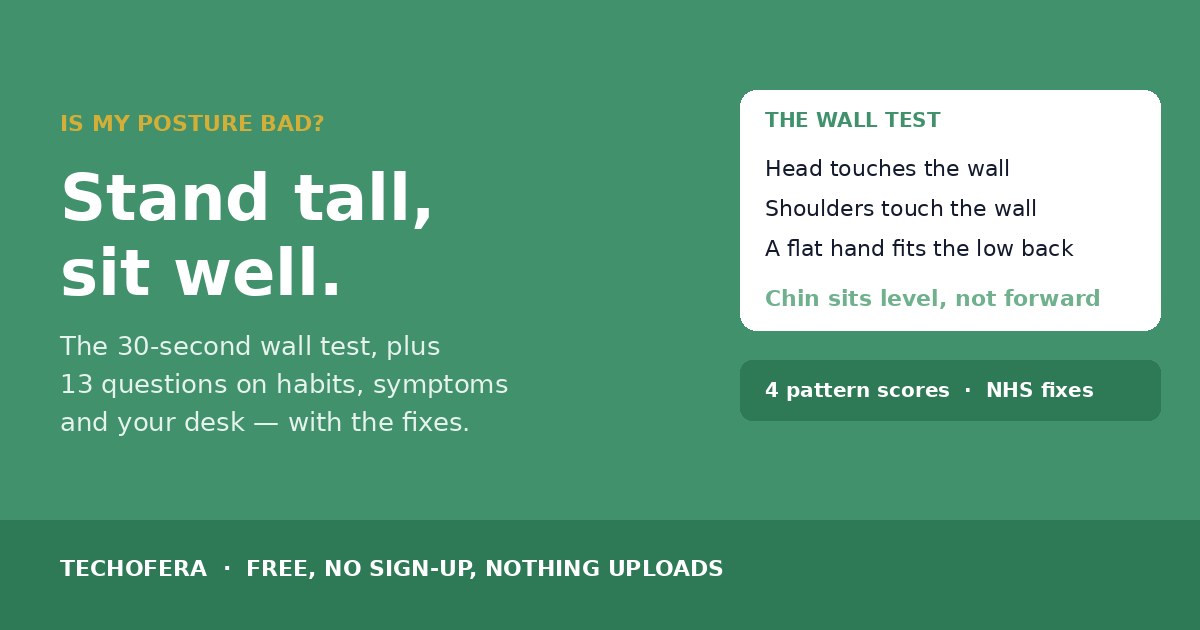
    1. Do the wall test. Stand with your back to a wall, heels a few inches from the base. Let your buttocks and shoulder blades rest against it. Check whether the back of your head touches naturally, whether your shoulders touch, and whether a flat hand fits behind your lower back. Then check in a mirror whether your chin pokes forward when you stand normally.
    2. Answer the habit and symptom questions. Think about your typical day, not your best day: how many hours you sit, how often you look down at your phone, and how often you get neck pain, back pain or headaches after screen work. Answer the numbness question honestly — it is the red flag that changes the verdict.
    3. Answer the desk questions. Screen at eye level, feet flat on the floor, chair supporting your lower back — or “I do not work at a desk” if that is you. The desk pattern only scores the questions that apply to you.
    4. Read your four pattern scores. Each pattern scores 0–100%: under 25% is good, 25–39% is fair, 40–59% needs work, 60% or more needs attention. Fix the worst pattern first — its fix is named in the results, with the exact exercise the NHS describes.
    5. Re-check in 4–6 weeks. Posture changes slowly. Re-do the wall test and run the checker again to see whether the scores are moving — that is the honest way to know the fixes are working.

    What makes this checker different

    The pages that rank for this search are guides — the wall test written out as steps, checklists you print and tick, and quizzes that ask four questions and return one percentage. There is no free, standalone checker that combines the guided wall test with your sitting and screen habits, your symptoms and your desk setup, and scores four separate patterns — forward head, rounded shoulders, lower back and desk setup — each with its own named fix. The only interactive rival is a four-question quiz that returns a single percentage and no per-pattern fixes. This page is the fuller answer: thirteen questions, four pattern scores, a red-flag check for numbness, and the next steps. It is a self-assessment, so it says plainly what it cannot know: it cannot see your body, and it never claims your posture caused your pain — because the research has not proven that link.

    When is this the right check?

    When you catch yourself slouching at your desk and want to know what exactly is wrong, not just that something is. When your neck or back aches after a long day and you want to know whether your habits, your screen or your chair is the likeliest contributor. When you start a new desk job, a new chair or a new monitor — because the setup questions catch a bad desk before it becomes a habit. When you have been working on your posture for a month and want to know whether it is actually improving. And whenever you are unsure whether a symptom needs a clinician — because the numbness question is the red flag that says so plainly.

    Honest limitations

    A self-assessment, not medical advice

    This checker cannot see your body. It cannot measure your spine, your desk or how you sit. If you have pain, numbness, tingling, weakness or a sudden change in how you stand, see your GP or a physiotherapist.

    There is no “perfect posture”

    GP-reviewed guidance is clear: there is no such thing as perfect posture. The aim is to avoid staying in positions that feel uncomfortable — and to move often — not to hold one rigid pose all day.

    Posture has not been proven to cause back pain

    Reviews of the research have found no consensus that a particular spine posture causes low back pain. This checker scores habits and patterns; it never claims your posture caused your pain.

    Movement matters as much as position

    No single sitting posture is proven to prevent back pain, so regular movement matters as much as any one position. Get up and move at least every 30 minutes, whatever your score.

    The wall test shows patterns, not causes

    A home test shows patterns, not causes. It can tell you that your head sits forward; it cannot tell you why. If you have pain or numbness, or a big difference between your left and right sides, see a doctor before you start exercising.

    Rules from official sources, dated November 2026

    The rules here are the NHS posture guidance, the MedlinePlus guide to good posture and the OSHA computer workstation guidance, as they read in November 2026. Guidance changes: recheck with your GP or physiotherapist if anything about your body changes.

    Frequently asked questions

    How do I know if my posture is bad?

    Do the wall test: stand with your back to a wall, heels a few inches from the base. The back of your head, your shoulder blades and your buttocks should touch the wall naturally, and the space behind your lower back should fit a flat hand. If your head does not reach the wall, or your shoulders hang forward, your posture needs work. This checker adds your habits, symptoms and desk setup to the wall test and scores four patterns — forward head, rounded shoulders, lower back and desk setup — so you get a verdict instead of a vague feeling.

    What is the wall test for posture?

    Stand with your back to a wall, heels a few inches from the base, and let your buttocks and shoulder blades rest against it. Check whether the back of your head touches naturally — if not, you likely have forward head posture. Check whether your shoulders touch — if not, they are rounded forward. Then check the space behind your lower back: it should fit a flat hand. More than a hand means an exaggerated arch; no room at all means a flat back. Re-do the test every 4–6 weeks while you work on the fixes.

    Can bad posture cause back pain?

    The honest answer is that nobody has proven it: reviews of the research have found no consensus that a particular spine posture causes low back pain. What is clear is that staying in one position for a long time is linked to aches — so regular movement matters as much as any one position. Bad posture can cause pain in the neck, back, shoulders, legs and feet, and headaches too, according to GP-reviewed guidance. This checker scores your habits and patterns; it never claims your posture caused your pain.

    How do I fix forward head posture?

    Chin tucks, as the NHS describes them: sitting straight-backed, pull your chin in while keeping your neck and back straight, hold for 5–10 seconds, repeat 10 times, a few times a day. Raise your screen so the top of it is at or below eye level, and bring your phone up to eye level instead of looking down at it. Stop any exercise that makes pain worse, as the NHS advises.

    How should I sit at a desk?

    Sit back in the chair so your lower back is supported, sit upright as if a string is attached to the top of your head, and let your shoulders relax down and slightly back. Do not cross your legs or lean to one side. Keep your feet flat on the floor with your thighs supported, your screen directly in front of you with the top at or below eye level, and your keyboard about 100–150 mm in front of you so your wrists rest between typing. Get up and move at least every 30 minutes.

    How long does it take to improve posture?

    There is no fixed timeline — posture changes slowly, over weeks of consistent small fixes, not days. Re-do the wall test and re-run this checker every 4–6 weeks to see whether the pattern scores are moving. If nothing changes after a couple of months of steady effort, or if pain persists, a physiotherapist can check what the checker cannot see.

    Does this checker diagnose anything?

    No. This checker is a self-assessment: it runs your answers against NHS posture guidance as it reads in November 2026, entirely in your browser, and nothing you enter leaves your device. A web page cannot see your body — it cannot measure your spine, your desk or how you sit — so it says plainly what still needs checking. The only third-party requests are the site's own analytics, which count page views. If you have pain, numbness, tingling, weakness or a sudden change in how you stand, see your GP or a physiotherapist.