How the log burner safety check works
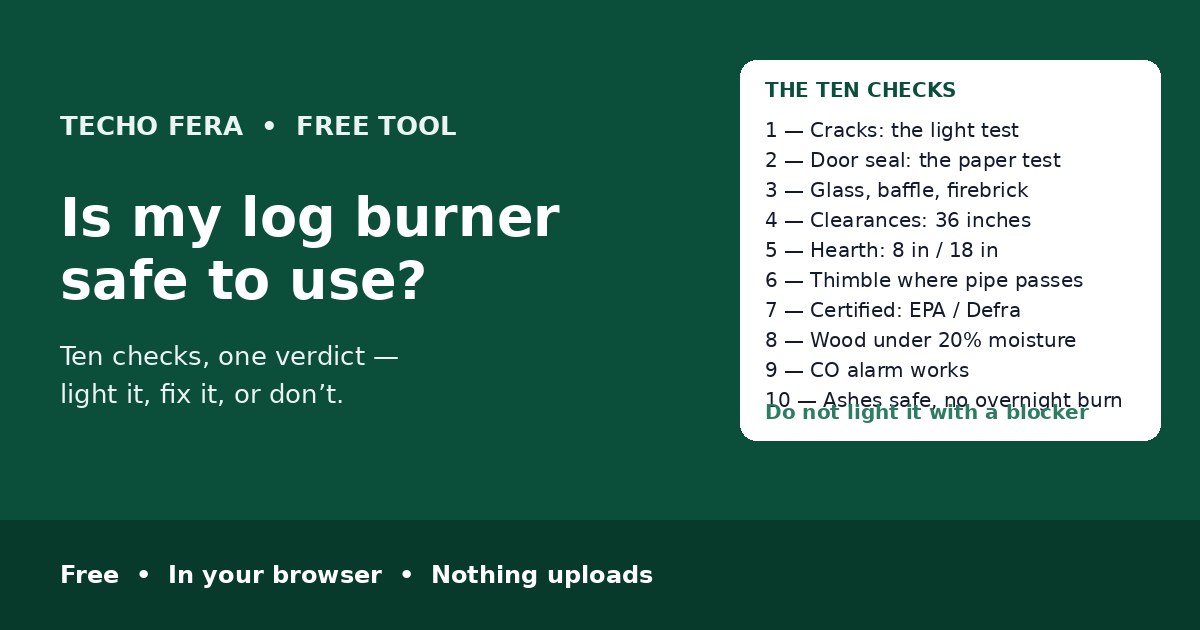
Whether a log burner still lights is not the question — whether it is safe to light is. The checks that matter are the ones a stove professional runs on a first visit: the light test for cracks in the firebox, the paper test for the door seal, the glass and baffle, the clearances to anything that can burn, the floor protection, the thimble where the pipe passes through a wall or ceiling, the certification label, the dryness of the wood, the carbon monoxide alarm, and how the ashes are handled. This checker scores your stove on those ten checks and turns the score into a verdict: safe to light, fix these first, or do not light it yet. A crack in the firebox, a stovepipe through wood with no thimble, or no working CO alarm are blockers — they mean do not light it, whatever the rest of the score says. Everything else is scored by weight: clearances and the thimble matter more than the certification label, because a fire starts where the heat meets something that can burn.
To use it:
- Say where you live and what kind of stove it is. The certification rules differ — the US uses EPA certification, the UK uses Defra Smoke Exempt and HETAS — and a freestanding stove and an insert have different clearance and floor-protection rules.
- Do the light test. Put a bright light inside the firebox in a dark room and look from outside. Any light leaking through the steel or cast iron means a crack — and a crack means do not light it until a professional has looked at it.
- Do the paper test. Close a sheet of paper in the door and pull. If it slides out easily, the gasket is worn and needs replacing before the next fire.
- Measure the clearances. A stove with no safety label needs 36 inches to anything that can burn; with a label, follow the label. Single-wall pipe needs 18 inches, double-wall pipe 6 inches. Check the hearth reaches 8 inches past the sides and back and 18 inches in front of the door.
- Check the thimble, the wood and the alarms. Where the pipe passes through a wall or ceiling there must be a thimble. The wood must be seasoned and under 20% moisture — a moisture meter is the only way to know. Press the test button on the CO alarm and the smoke alarm.
- Read the verdict — and the per-check list. The verdict tells you whether to light it; the per-check list tells you what to fix, in order, and what still needs confirming.
What makes this checker different
The pages that rank for this search are guides and videos — an insurer's safety tips, a manufacturer's blog, a news article about a doctor's warning, a YouTube video walking through seven checks. Every one of them tells you what to look for and leaves you to judge your own stove. The checklists that exist are paper forms: a thatched-property risk form, a fire district's PDF checklist. None of them scores your stove, none of them tells you which fault matters most, and none of them gives you a verdict. This page is that answer: ten checks, a score, a light-it-or-don't verdict, and a fix list in order — with the chimney covered separately by the Is My Chimney Safe to Use? Checker, so the two tools do not overlap.
When is this the right check?
Before the first fire of the season — because a stove that sat all summer can have a cracked firebrick, a perished gasket or a dead CO alarm you have not noticed. When you move into a house with a log burner you did not install — because you do not know who fitted it, whether it is certified, or whether the pipe has a thimble. When the stove is old — because age shows up first in the seal, the baffle and the firebox. And after any change — a new flue, a moved stove, a different wood supply — because the checks that passed last year may not pass now.
Honest limitations
A planning aid, not a professional inspection
This checker cannot see your stove, your flue or your alarms. It cannot tell you whether a crack is hairline or structural, or whether a flue liner is sound. If anything is uncertain, get a stove professional or a HETAS-registered installer to look at it.
The stove is only half the system
This checker scores the stove, not the flue. Creosote in the chimney, a blocked cap or a damaged liner can make a safe stove dangerous — and the chimney should be swept at least once a year. Check the flue with the Is My Chimney Safe to Use? Checker.
Rules differ by country
Certification, smoke control areas and fines are country-specific: EPA certification in the US, Defra Smoke Exempt and HETAS in the UK. This checker asks where you live and adjusts, but local building codes and insurance rules can add requirements — check them before you install or move a stove.
An uncertified old stove is not automatically unsafe
A stove too old to have a certification label can still be sound — age alone is not a fault. What matters is the firebox, the seal, the clearances and the alarms. If the checks pass, an old stove can be safe; if they do not, a new stove would fail the same way.
Smoke is a warning, not a nuisance
If smoke leaks into the room when you light the stove, stop. It can mean a blocked flue, a failed seal or a cold chimney — and it can carry carbon monoxide with it. Open a window, let the fire go out, and get the stove and flue checked before lighting it again.
Rules from the Alliance for Green Heat, Travelers, Defra and others, dated November 2026
The rules here are the published stove-safety rules as they read in November 2026: the Alliance for Green Heat on the nine signs of a hazardous stove, Travelers Insurance on alarms and certification, Defra on Ready to Burn wood and smoke control areas, HETAS on installation certificates, and the La Pine Fire District on its safety checklist. Guidance changes: recheck with those sources if anything about your plans changes.