How the firewood dryness check works
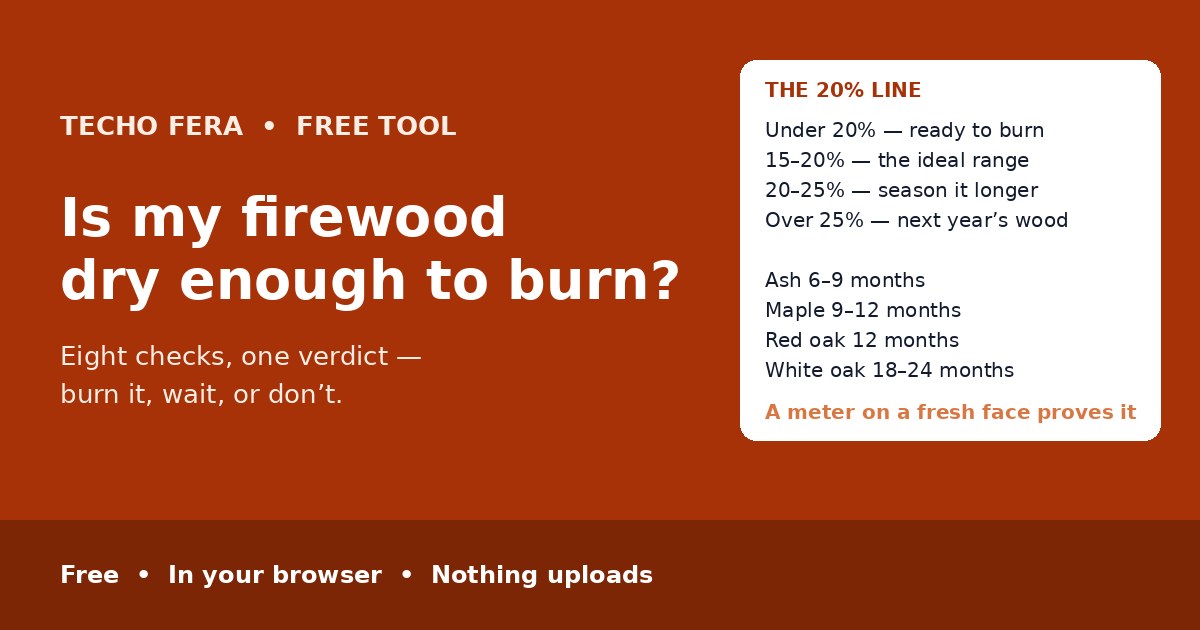
Whether firewood looks dry is not the question — whether it is dry enough to burn is. The line is a number: under 20% moisture, measured on a freshly split face, and 15% to 20% is the ideal range. This checker works from the eight things that actually decide that number: the species and how long it has seasoned, how it is stored, a moisture-meter reading if you have one, and the five signs — the cracks at the cut ends, the bark, the weight and the sound. If you give it a meter reading, the reading decides the verdict. If you do not, the calendar and the signs decide it together, and the checker says plainly that a meter is the only way to be sure. Either way you get a seasoning-time estimate: how many more months the wood needs, for its species, if it is not ready yet.
To use it:
- Say what species it is and how long it has seasoned. Ash seasons in 6 to 9 months, white oak in 18 to 24 — the species decides the calendar. Count from when it was cut and split, not from when the tree was felled.
- Say how it is stored. Split, stacked off the ground, top covered, sides open is the only storage that actually dries wood. A pile on the ground, or unsplit rounds, dries very little even after many months — and the checker counts that against the calendar.
- Give a meter reading if you have one. Split a piece and press the pins into the freshly exposed face — the outside dries first, so a reading on bark or an old end can look several points drier than the core really is. Test three to five pieces from different parts of the stack and go by the wettest one.
- Check the five signs. Deep cracks radiating from the centre of the cut ends, a faded grey colour, bark that is loose or falling off, wood that feels light for its size, and a sharp hollow clack — not a dull thud — when two pieces are knocked together. No single sign proves the wood is ready; use them together.
- Read the verdict — and the seasoning estimate. Burn it now, nearly there, or too wet — with how many more months it needs, and what to fix first.
Typical seasoning times and moisture targets
The months below are estimates for wood split into 4-to-6-inch pieces and stacked in a single row with airflow on both sides. A tight, uncovered pile of round logs takes noticeably longer than any of these figures.
| Species | Typical seasoning | Moisture target |
|---|---|---|
| Ash | 6–9 months | Under 20% |
| Pine or spruce (softwood) | 6–9 months | Under 20% |
| Maple | 9–12 months | Under 20% |
| Birch | About 12 months | Under 20% |
| Beech | 12–18 months | Under 20% |
| Red oak | About 12 months | Under 20% |
| White oak | 18–24 months | Under 20% |
| Another hardwood | At least 12 months | Under 20% |
Ideal burning range for every species: 15% to 20% moisture. Under about 10% the wood is very dry — it catches fast, burns through fuel quickly and throws more sparks.
What makes this checker different
The pages that rank for this search are guides — a seasoning guide, a university extension page, a kiln-dried seller's blog, a backyard blog. Every one of them tells you the 20% line and the five signs and leaves you to judge your own woodpile. The one interactive page that exists takes a single number — your meter reading — and returns a one-line verdict, and nothing else. None of them asks what species it is, how long it has seasoned, or how it is stored. None of them works without a meter, and none of them tells you how much longer to season the wood if it is not ready. This page is that answer: eight checks, a meter reading or the five signs, a burn-it-now verdict, and a seasoning estimate in months — with the stove itself covered separately by the Is My Log Burner Safe to Use? Checker, so the two tools do not overlap. This checker scores the wood, not the appliance.
When is this the right check?
Before you buy a load — because the word "seasoned" on a bag or an invoice is not a measurement: one university test of bagged wood labelled seasoned came back at 66% moisture, barely drier than the tree it came out of. Ask when it was split, split a random piece and test it before the load is unloaded. Before the first fire of the season — because wood that sat all summer in a pile on the ground may not have dried at all. When the fire smokes, hisses or will not catch — because wet wood is the first suspect, before the stove or the flue. And when you cut your own — because the calendar starts when the wood is split and stacked, not when the tree comes down.
Honest limitations
A planning aid, not a laboratory test
This checker cannot measure your wood. It runs your answers against the published firewood rules as they read in November 2026, entirely in your browser. The seasoning months are estimates, and only a moisture meter on a freshly split face gives a number.
The signs sort wood; they do not prove it
Cracks, bark, weight and sound are clues, not a measurement. A piece can look dry on the outside and still be wet in the core — which is why the meter test is always on a fresh face, and why this checker says so when you have no reading.
The wood is only half the system
This checker scores the wood, not the stove or the flue. A safe stove burning wet wood still smoulders and coats the flue in creosote, and dry wood in an unsafe stove is still unsafe. Check the stove with the Is My Log Burner Safe to Use? Checker, and the flue with the Is My Chimney Safe to Use? Checker.
Rules differ by country
In the UK, wood sold as Ready to Burn is certified under 20% moisture, and burning wet wood can bring a fine of up to £1,000. In the US, the EPA Burn Wise guidance gives the same 20% line. Local rules on smoke, fuel and storage can add requirements — check them before you buy or burn.
Very dry wood has its own risks
Wood under about 10% moisture ignites almost instantly, burns through fuel faster than intended, and can push a stove hotter than it is rated for, with more sparks. The sweet spot is 15% to 20% — dry enough to burn cleanly, not so dry that it races away.
Rules from the EPA Burn Wise guidance, the US Department of Energy, university extensions and others, dated November 2026
The rules here are the published firewood rules as they read in November 2026: the EPA Burn Wise guidance on the 20% line and seasoning times, the US Department of Energy on 20% or less by weight, the University of New Hampshire Extension and the University of Tennessee Extension on the signs and the storage rules, and Woodworking Advisor on species seasoning times. Guidance changes: recheck with those sources if anything about your plans changes.