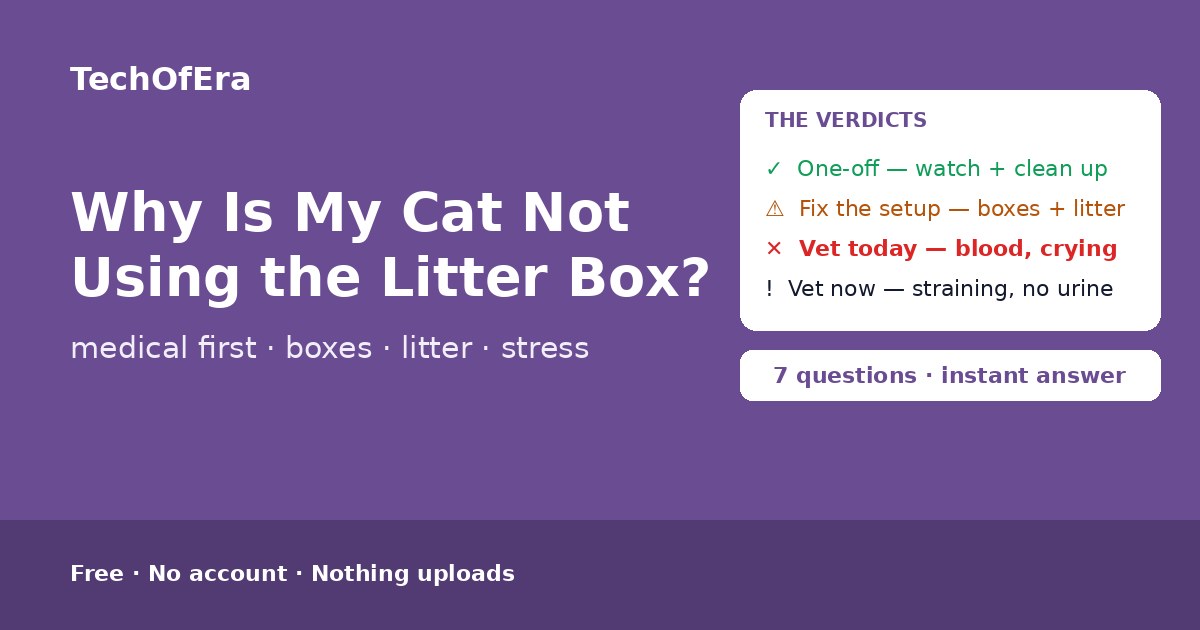
Why is my cat not using the litter box — and what do I fix first?

A cat that stops using the box is telling you something — and it is almost never spite. Inappropriate elimination is 59% of feline behaviour-clinic cases, and the cause is usually a medical problem or a setup problem. Answer seven questions and get an instant verdict: fix the setup, call the vet today, or go now. Entirely in your browser.

  • Instant verdict — fix the setup, vet today, or vet now
  • Medical causes ruled out first — blockage flagged at once
  • The one-box-per-cat-plus-one rule, applied to your home
  • Free, no account, nothing uploads
The verdicts of the litter box checker: fix the setup, call the vet today, or vet now

Work out why your cat avoids the box

The box rule at a glance
  1. 1 cat2 boxes
  2. 2 cats3 boxes
  3. 3 cats4 boxes

One box per cat, plus one extra — in separate spots, not lined up together. Too few boxes is one of the most common causes.

Try a preset:
0 of 7 answered

Your result

Answer the questions Your verdict appears here as you answer.
What this combination means

Answer the questions above and what this combination means will appear here.

Blockers

Cautions

Still to confirm

Things to check

What to do next

    Your result summary


    Answer the questions above — the verdict updates live.

    Privacy you can verify, not just trust

    Checking a health question by uploading details of your cat to a website would be backwards — the check should never be the leak. This one can't: your answers are checked with plain JavaScript on your device, and they never leave the device — the only third-party requests are the site's own analytics, which count page views. Don't take our word for it:

    New cross-origin requests during use: 0
    1. Press F12 to open developer tools, then the Network tab.
    2. Answer a question above. Watch: apart from the site's analytics, nothing new is requested — no uploads, and no data ever leaves your device.
    3. Extra credit: disconnect your internet after this page loads — the checker still works.

    How to work out why your cat stopped using the litter box

    Your cat is not being spiteful. Cats do not punish their owners by peeing on the bed — when a cat stops using the box, something is wrong with the cat, the box, or the house. Vets work through it in a fixed order: rule out a medical problem first, then check the number of boxes, the box and the litter, the location, and finally what changed at home. This checker asks exactly what decides it.

    To use it:

    1. Start with what the cat does instead. Peeing outside the box, pooing outside it, straining in the box, or not going at all each point to a different cause. Small frequent urine spots, straining, crying, or blood point to a medical problem first.
    2. Note when it started. A sudden stop after normal use is the pattern that most often means a medical problem — a urinary infection, crystals, constipation, or pain. A gradual change usually points to the setup or to stress.
    3. Check for warning signs. Straining to pee with little or no urine is an emergency, especially in a male cat — a urinary blockage can become fatal in 1 to 2 days without treatment. Blood in the urine or stool, and crying while trying to go, need a vet the same day.
    4. Count the boxes. The standard rule is one box per cat, plus one extra, in separate spots — not lined up together. One box for several cats is almost always too few, and one cat can silently guard the path to the only box.
    5. Look at the box and the litter. Most cats prefer a large uncovered box they can turn around in, fine unscented clumping litter, and a box scooped at least once a day. A dirty box is the single most common environmental cause — a cat's nose is far more sensitive than yours.
    6. Think about what changed. A new pet, a move, a new baby or housemate, or a box moved next to something noisy are all common triggers. Cats that feel unsettled often start eliminating on soft things, like beds and laundry — and the fix is a quiet safe room with its own box, not punishment.

    Litter box situations and what to do at a glance

    The table below is built from the same rules as the checker, so it can never disagree with your verdict. What the cat does, when it started, and whether there are warning signs decide together with the boxes, the litter and what changed.

    Litter box situationVerdictWhat to know

    What makes this checker different

    The pages that rank for this search are guides — thorough explanations of the medical causes, the box rule, and the fixes — but they leave you to work out what that means for your cat: whether a sudden change with no warning signs can wait, whether one box for two cats is really the problem, whether a new kitten or a scented litter is enough to explain it, and whether straining in a male cat is an emergency or a wait-until-morning. This page is that answer: seven questions, an instant verdict, the reason named, and the red flags stated plainly instead of buried in the text — with nothing to install, no account, and nothing uploaded. It is a self-assessment, so it says plainly what it cannot know: a web page cannot examine the cat, feel its belly, or know its history, so anything you mark “Not sure” stays on the list until you confirm it.

    When is this the right check?

    Whenever your cat stops using the box: the pee on the bed this morning, the poo beside the box that was not there yesterday, the cat that keeps trying to go and produces almost nothing, the new kitten that never really learned the box, the senior cat that suddenly goes on the rug. Also whenever you are about to call the vet and want to know what to say: the checker gives you what the cat does, when it started, and whether there is straining, crying or blood — which is exactly what the vet will ask first.

    Honest limitations

    A self-assessment, not a diagnosis

    This checker works only from the answers you enter. It cannot diagnose your cat — no web page can examine the cat, feel its belly, or know its history. If an answer is wrong, the verdict is wrong. When in doubt, call your vet.

    Medical causes come first

    A urinary blockage can become fatal in 1 to 2 days without treatment, and a male cat straining to urinate is an emergency until a vet says otherwise. No setup fix replaces a vet check when there are warning signs — straining, crying, or blood.

    The box rule is a starting point

    One box per cat plus one extra is the standard rule, but some cats want more — a cat that guards, a house with stairs, or a cat that refuses to share. If the rule is met and the cat still avoids the box, call the vet.

    Stress is real — but not an excuse to skip the vet

    A new pet or a move can genuinely make a cat avoid the box. But stress and illness often arrive together, and a stressed cat can also be a sick cat. Rule out the medical causes first, then fix the stress.

    Never give human medicine

    Never give a cat human painkillers or any medicine meant for people. Paracetamol (acetaminophen) is fatal to cats even in small doses, and ibuprofen and aspirin are dangerous too. If your cat is in pain, call the vet.

    Rules from veterinary sources

    The rules here follow Cornell University College of Veterinary Medicine, the American Association of Feline Practitioners and VCA Animal Hospitals guidance as they read in November 2026. Guidance can be revised, so re-check if a new edition appears.

    Frequently asked questions

    Why is my cat not using the litter box all of a sudden?

    A sudden stop after normal use is the pattern that most often means a medical problem — a urinary infection, crystals, constipation, or pain — so medical causes are ruled out first. If the cat is straining to pee and passing little or no urine, crying while trying to go, or passing blood, call a vet the same day; a male cat straining to urinate needs an emergency vet now, because a urinary blockage can become fatal in 1 to 2 days. If there are no warning signs, the usual causes are the setup: a dirty box, too few boxes, the wrong litter, or something that changed at home.

    How many litter boxes should I have for my cat?

    The standard rule is one litter box per cat, plus one extra — so two boxes for one cat, three for two cats, four for three. Put them in separate spots, not lined up together, and one on each floor if the house has stairs. Too few boxes is one of the most common causes of litter box avoidance: cats do not like to share a dirty box, and in a multi-cat house one cat may silently guard the path to the only box.

    What kind of litter box and litter do cats prefer?

    Most cats prefer a large, uncovered box they can turn around in, with a low entry, and fine, unscented clumping litter — the soft, sand-like kind. Covered boxes can make some cats feel trapped, and senior or arthritic cats can find high sides painful to climb. Scented litter, crystal litter, coarse pellet litter, and an abrupt brand switch are all common triggers for avoiding the box. Scoop at least once a day, ideally twice, and wash the box with a mild unscented cleaner.

    Is my cat not using the litter box because it is stressed?

    Stress is a real cause — a new pet, a move, a new baby or housemate, or a box moved next to something noisy can all make a cat avoid the box — but it is never a reason to skip the medical check. Rule out a medical problem first, especially if the change was sudden or comes with straining, crying or blood. If the vet gives the all-clear, fix the stress: give the cat a quiet safe room with its own box, food and water, keep the routine and the box where they were, and add a box near where the cat spends its time.

    What should I do if my cat is straining to pee?

    Go to an emergency vet now. A cat straining to urinate and passing little or no urine can have a urinary blockage, which can become fatal in 1 to 2 days without treatment — and male cats are particularly at risk, because the male urethra is narrower. Do not wait for an appointment, do not wait to see if it passes, and do not try to help the cat pass urine yourself. Call ahead on the way so the clinic is ready for you.

    How do I clean up where my cat went outside the box?

    Clean the spot with a pet-safe enzymatic cleaner, following its directions, and let it dry fully. Never use an ammonia-based product — ammonia smells like urine to a cat and can make it go in the same spot again. Never punish the cat for an accident: fear makes the problem worse. If the cat went on a bed or laundry, wash it with an enzymatic laundry additive if you can, and keep the cat out of that room until the smell is gone.

    Does this checker diagnose my cat or upload anything?

    No to both. This checker is a self-assessment: it works only from the answers you pick, runs entirely in your browser with plain JavaScript, and nothing you enter leaves your device. It cannot diagnose your cat — a web page has no way to examine the cat, feel its belly, or know its history — so every answer you are unsure about is reported as something to confirm, and the result says so plainly. The only third-party requests are the site's own analytics, which count page views. You can verify it yourself with the network-request counter in the privacy section below the checker.