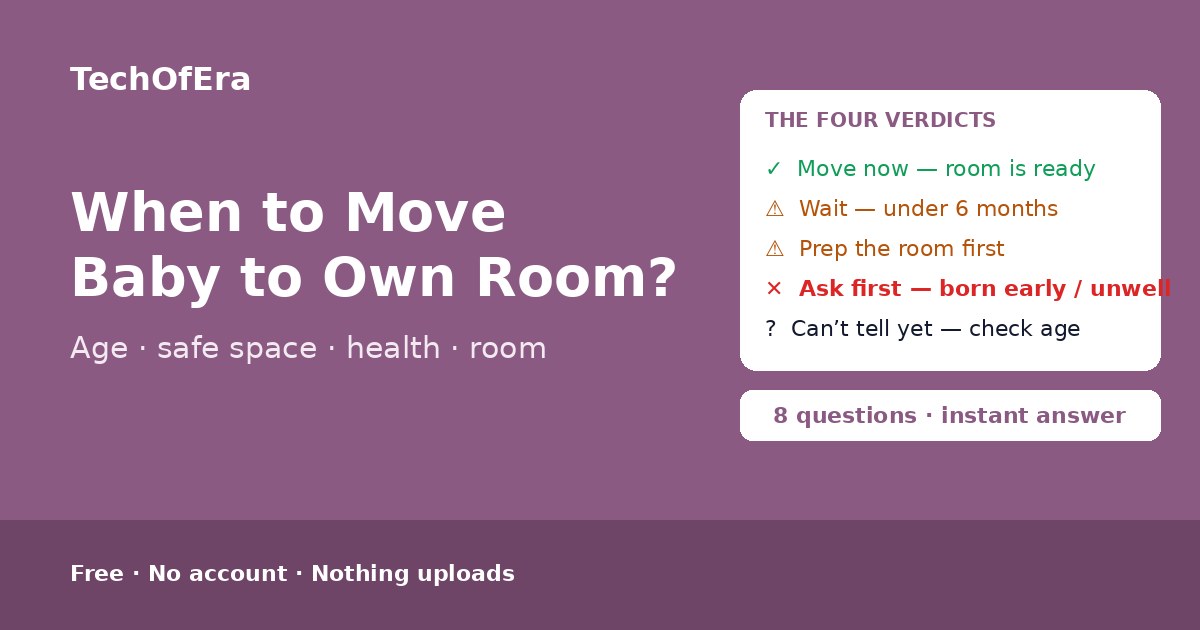
How to decide when to move your baby to their own room
Moving your baby to their own room feels like a milestone — and also like a small loss. The question parents actually ask at 2am is not what the guidance says in general: it is whether this baby, at this age, in this room, is ready. The guidance is clear on the floor and silent on the date. The AAP's 2022 safe-sleep update recommends room-sharing without bed-sharing, "preferably for at least the first six months", and the NHS gives the same 6-month floor — a separate cot or Moses basket in the same room as you, for every sleep. After that, neither sets a date. Most families make the move somewhere between 6 and 12 months. Germany's health institute still advises the parents' room for the whole first year, so you will see both 6 months and 12 months quoted — and the AAP's older wording, "ideally the first year", still circulates on sites that have not caught up with the 2022 update. This checker asks exactly what decides it for your baby.
To use it:
- Check the age first. Under 6 months is wait — the risk of sudden infant death is highest in the early months, and room-sharing can cut it by as much as 50%. At 6 months and over, the move becomes a family decision, not a deadline.
- Check the safe sleep space. Until the first birthday, the new room needs a firm, flat cot with a fitted sheet only — no pillows, quilts, bumpers, blankets or soft toys. The safe-sleep rules do not change with the room.
- Check the room itself. The NHS and The Lullaby Trust suggest 16 to 20°C, dark and quiet, with a monitor whose cords are at least 3 feet from the cot and out of reach.
- Check your baby's health. A baby who was born early, or who has a medical condition, follows their clinician's timeline — and a baby who is unwell right now should not be moved at all. Ask your paediatrician first.
- Move in stages. Familiarise your baby with the nursery in the daytime, move naps first, then bedtime, then full overnights over about a week — keeping the routine exactly the same. Expect a few unsettled nights: broken sleep during the adjustment is normal, not a sign you moved too soon.
- Know the red lines. Never move a baby under 6 months for convenience, never put a baby to sleep on a sofa or in an adult bed, and never let a sibling's room stand in for a parent's room during the recommended early period.
Moving situations and what to do at a glance
The table below is built from the same rules as the checker, so it can never disagree with your verdict. Age, the safe sleep space, health and the room decide together.
| Moving situation | Verdict | What to know |
|---|
What makes this checker different
The pages that rank for this search are guides — thorough explanations of the 6-month floor, the safe-sleep rules, and the two-week transition plan — but they leave you to work out what that means for your baby: whether 5 months counts as too early, whether a cot with a bumper in it counts as a safe sleep space, whether a baby who was born early follows the same timeline, and whether a room that is too warm changes the answer. Some of them even carry their own decision checklist — but a checklist on a page cannot tell you which verdict your combination gives. This page is that answer: eight questions, an instant verdict, the reason named, and the one-week plan laid out instead of buried in the text — with nothing to install, no account, and nothing uploaded. It is a self-assessment, so it says plainly what it cannot know: a web page cannot check your baby's health, measure their room, or see how they sleep, so anything you mark "Not sure" stays on the list until you confirm it.
When is this the right check?
Whenever you are wondering whether now is the time: the nursery is finished and your baby is 5 months old, your baby is 8 months old and wakes every two hours, a new baby is on the way and you need the space, or your baby is already in their own room and you are not sure that was right. Also whenever the picture changes — your baby was born early, is unwell, or the room is not ready yet. And whenever you are not sure what counts: whether the 6-month floor is a minimum or a deadline, whether Germany's 12-month advice applies to you, or whether a monitor makes the move safe on its own. If the answer is "move now", the checker tells you the one-week plan — and if the answer is "wait", it tells you what to prepare while you wait.
Honest limitations
A self-assessment, not a diagnosis
This checker works only from the answers you enter. It cannot examine your baby — no web page can check their health, measure their room, or see how they sleep. If an answer is wrong, the verdict is wrong. When in doubt, call your paediatrician or health visitor.
Six months is a floor, not a deadline
The AAP and the NHS set 6 months as the minimum for room-sharing. After that, there is no fixed date — most families move somewhere between 6 and 12 months, and Germany's health institute advises the parents' room for the whole first year. The checker gives a verdict for your baby, not a date for every baby.
Health overrides everything
A baby who was born early, or who has a medical condition, follows their clinician's timeline — not a general one. A baby who is unwell right now should not be moved to a room of their own. Your paediatrician beats every blog timeline, including this page.
Monitors do not prevent sudden infant death
Heart-rate and breathing monitors have not been shown to prevent sudden infant death. A monitor is a way to hear your baby from another room — it is not a substitute for a safe sleep space, and it does not make an early move safe.
Unsettled nights are the adjustment
Expect a few unsettled nights after the move. Broken sleep during the adjustment is normal, not a sign you moved too soon — and it usually settles within a week. If sleep is still much worse after a week, step back a stage and try again in a few weeks.
Rules from AAP, NHS and Lullaby Trust guidance
The rules here follow the AAP's 2022 safe-sleep policy statement, AAP HealthyChildren.org guidance on safe sleep, NHS guidance on reducing the risk of sudden infant death, and The Lullaby Trust, as they read in November 2026. Guidance can be revised, so re-check if a new edition appears.