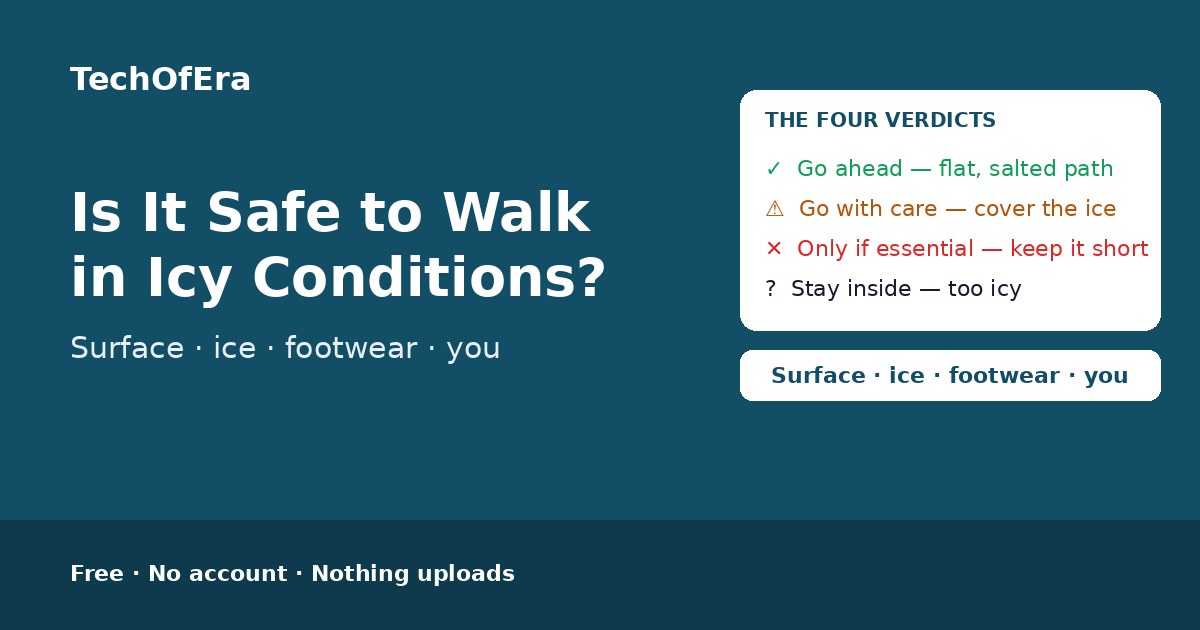
How to decide whether to walk in icy conditions
The temperature on the thermometer is only half the story — the surface under your feet is the other half. A flat, salted pavement at −5°C is a very different walk from icy steps at the same temperature in smooth soles, and black ice — which looks like wet pavement — is dangerous precisely because you cannot see it. The CDC's advice is to stay off the ice whenever possible, because many cold-weather injuries happen from falls on ice-covered sidewalks, steps, driveways and porches. The National Institute on Aging adds the practical rules: nonskid, rubber-soled, low-heeled footwear; handrails; hands free to grab a rail or break a fall; walkways kept clear of snow and ice. This checker asks exactly what decides it.
To use it:
- Look at the surface, not just the weather. Is it flat pavement, a slope, steps, snow-covered ground or a car park? Steps are the worst place to slip, and a slope pulls you downhill the moment a foot slides. What kind of ice is it — black ice, clear sheet ice, ice hidden under snow, slush, refrozen melt or patchy ice? If you are not sure, look for dark, wet-looking patches: that is usually black ice.
- Check the temperature. Above freezing, the ice is melting into slush. Below freezing it stays — and meltwater from the day refreezes overnight into a smooth, hard sheet, so mornings after a thaw are the most dangerous time of all. If the temperature is missing, the checker says so rather than guessing.
- Answer the questions honestly. Your footwear, how steady you are, how long the trip is, whether your hands are free, whether the path has been salted, and whether it is dark and you have a phone — each one changes the answer at the same ice. If you are not sure about the temperature or the path, say so: the checker lists it as something to confirm.
- Read the verdict and the cautions. The verdict is one of four: walk normally, walk with care, only if essential and keep it short, or stay inside. The cautions name each risk factor and what fixes it — change one of them and the verdict can change too.
- Walk like a penguin if you go. Short, flat-footed steps, toes slightly out, knees a little bent, your weight centred over your feet, arms out for balance, hands out of your pockets. Flat feet keep more of your sole in contact with the ground, and short steps keep your weight centred — which is why the technique works. Scan the ground ahead, not your phone, and use handrails on every step and ramp.
- Know what to do if you fall. Do not get up immediately — assess for injuries first, roll to one side, bend your knees and push up slowly. If you cannot get up, or you are hurt, use your phone or alert device to call for help. Dress warmly even for a short trip: a fall can leave you on the ground unable to get up, and cold sets in fast when you cannot move.
Conditions and what to do at a glance
The table below is built from the same rules as the checker, so it can never disagree with your verdict. The surface, the ice and your footwear decide, together with how steady you are and whether the path is treated.
| Condition | Verdict | What to know |
|---|
What makes this checker different
The pages that rank for this search are guides — thorough explanations of the penguin walk, the right footwear, and what to do if you fall — but they leave you to judge your own situation: to weigh a slope against black ice, smooth soles against a salted path, and your age and balance against a trip that cannot wait. The ice calculators that do exist answer a different question: how thick a frozen lake must be to hold a person. Nobody answers the pavement question — the walk to the shops, the mailbox or the car, on the surface outside your door, in the shoes you are actually wearing. This page is that answer: the surface, the ice and your footwear in, a verdict for the exact trip you plan, with every risk factor named and a fix for each one. It is a self-assessment, so it says plainly what it cannot know: a web page cannot see your pavement or examine you, so anything you mark “Not sure” stays on the list until you confirm it.
When is this the right check?
Whenever you are about to walk outside in winter and the ground makes you hesitate: the morning after a freeze, when the pavement looks wet but might be ice; the trip to the shops on a day the forecast calls “icy patches”; the walk to the car across an untreated car park; the steps down to the street when you are not sure whether they have been salted. Also whenever the conditions are borderline and the decision turns on something specific — whether your boots are enough, whether the trip can wait until the sun has worked, or whether being 65 or older changes a day that would be fine for someone else. And whenever you have already slipped once today and want a straight answer before going out again.
Honest limitations
A self-assessment, not a diagnosis
This checker works only from the surface, the ice, your footwear and the answers you enter. It cannot diagnose you — no web page can see the pavement outside your door, measure the ice, or know your medical history. If an answer is wrong, the verdict is wrong. When in doubt, stay inside — or ask someone to come with you.
It cannot see your pavement
Ice varies from one step to the next: a salted stretch, then a shaded patch that never saw the sun. The checker judges the surface you describe, not the one you are actually standing on — so if what you see when you open the door is worse than what you entered, trust your eyes.
Cleats and salt are not guarantees
Ice cleats are the single biggest improvement you can make, and a salted path is the safest ground in icy weather — but cleats still slip on very smooth ice, and salt stops working in very cold weather. No footwear and no treatment makes ice safe; they make it safer.
Cold matters too
A fall is not the only risk: dress warmly even for a short trip, because a fall can leave you on the ground unable to get up, and cold sets in fast when you cannot move. Hypothermia can develop even above freezing when you are wet, tired or inadequately dressed.
Feeling unsteady overrides the verdict
If you step outside and feel unsteady on the surface, go back in — whatever the checker said. The surface is telling you the answer, and no web page knows your pavement better than your own feet do.
Rules from public-health sources
The rules here follow the CDC, the National Institute on Aging, Mayo Clinic and Hospital for Special Surgery guidance, as they read in November 2026. Guidance can be revised, so re-check if a new edition appears.