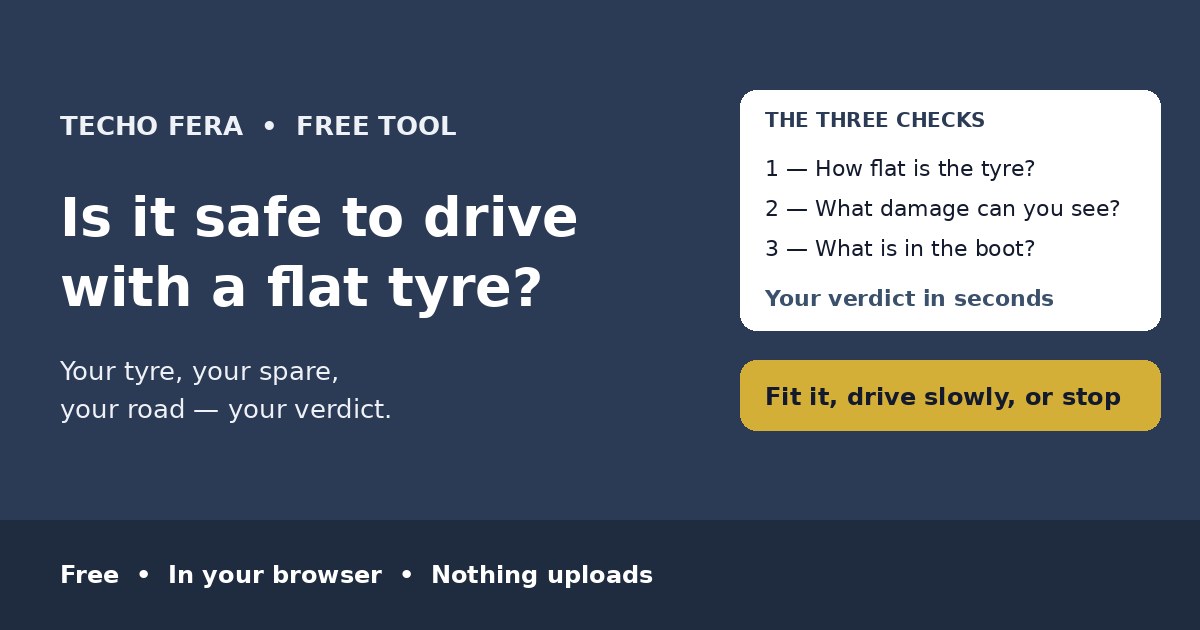
How the flat tyre safety check works
A flat tyre is safe to drive on only in narrow cases — a slow puncture a short way to a garage, a run-flat tyre within its limits, or a spare wheel fitted where it is safe to change a wheel. Everything else means recovery. This checker takes the six things that decide it — how flat the tyre is, what damage you can see, whether you have already driven on it, how far the nearest garage is, where you are, and what is in the boot — and gives you the verdict for your car: fit the spare, drive slowly to a garage, use the sealant kit, drive on the run-flat within its limits, check the pressure first, or do not drive and call recovery.
To use it:
- Pick how flat the tyre is. Look at the tyre from the side: if the rim is touching the ground, the tyre is completely flat and must not be driven on. If it is visibly sagging but still has some air, it is very low. If it still has most of its air, it is a slow puncture. If only the warning light is on and the tyre looks fine, say so — that is a different check.
- Say what damage you can see. Crouch down and look at the sidewall and the tread. A cut, bulge or exposed cord in the sidewall cannot be repaired and cannot be inflated. A nail or screw in the tread is the one kind of damage a sealant kit can deal with. A bent or cracked rim, or a shredded tyre, means the tyre is finished.
- Say whether you have already driven on it. Even a short distance on a flat tyre can damage its inner structure where you cannot see it. More than a mile on a flat tyre means the tyre must be treated as finished, even if it still looks whole.
- Say how far the nearest garage is, and where you are. A slow puncture only stays drivable for a short distance. And where you are decides whether a wheel can be changed at all: it is never safe to change a wheel on a motorway hard shoulder or beside fast traffic.
- Say what is in the boot. A full-size spare, a space-saver spare, a sealant bottle and inflator kit, or run-flat tyres each change the answer — and so does having nothing at all. Check what you actually have: a spare that has sat flat in the boot for years is no help.
- Read the verdict — and what to do next. Do not drive means call recovery. Fit the spare means change the wheel where you are, then drive to a garage. Drive slowly means no faster than 20 mph, hazard lights on, straight to the garage. The checker also names the blockers, the things that do not fit, and what still needs checking.
What makes this checker different
The pages that rank for this search are guides — Protyre's steps to follow if you have a flat tyre, tyre-inflator guides that explain what an inflator cannot fix, a boot-floor puncture check that explains the three spare setups, and a video about the tyre pressure light. Every one of them tells you the same general rules and leaves you to apply them to your own car. None of them asks how flat your tyre is, what damage you can see, whether you have already driven on it, where you are, or what is in your boot — and none of them tells you what to do with a flat tyre on a motorway with no spare, or a slow puncture five miles from a garage with a sealant kit. There is no free, standalone checker that takes your situation and gives you a verdict. This page is that answer: six questions, an instant verdict for your exact car, the blockers named, and the next steps. It is a driving aid, so it says plainly what it cannot know: it cannot see your tyres, your spare or the road, and where an answer is uncertain it says so instead of guessing.
When is this the right check?
When you walk out to the car and one tyre is visibly low — because the question is not what the general rules are, but whether your car can be driven right now. When the warning light comes on and the tyre looks fine — because the answer is a gauge reading, not a guess. When you have a flat tyre on a motorway — because the answer is about where you are as much as the tyre, and changing a wheel on a hard shoulder is never the right call. And when you are standing at the boot wondering whether the sealant kit, the space-saver or nothing at all changes the answer — because it does, and this checker works out how.
Honest limitations
A driving aid, not advice for your car
This checker cannot see your tyres, your spare or the road. It cannot tell you whether your spare is inflated, whether the jack and wheel brace are actually in the boot, or whether the tyre is as damaged as it looks. If you are unsure, do not drive — call recovery and let a professional look at it.
The spare is only as good as its condition
A spare wheel that has sat in the boot for years may be flat, perished or missing its jack and locking wheel nut key. This checker assumes the spare you say you have is inflated and usable — check it before you fit it, and check the locking wheel nut key is there before you start.
A slow puncture can turn into a flat tyre
A tyre that still has most of its air can lose the rest of it quickly, especially at speed or over a pothole. This checker calls a slow puncture drivable only for a short distance, slowly, to the nearest garage — and if the tyre goes flat on the way, the verdict changes to stop and call recovery.
The motorway rule is about people, not tyres
On a motorway, the checker says call recovery even when the tyre itself could be fixed with a spare — because changing a wheel on a hard shoulder puts people in danger from fast traffic. That is a safety judgement about where you are, not about the tyre, and it is the right call even when it feels over-cautious.
Sealant is a temporary fix, not a repair
A sealant kit gets you to a garage — it does not repair the tyre. The tyre still needs a proper repair or replacement, and many garages will not repair a tyre that has had sealant in it. Tell the garage you used sealant, and expect the tyre to need replacing.
Rules from the UK Highway Code and US guidance, dated November 2026
The rules here are the UK Highway Code on tyre condition and the US federal tyre pressure warning rule as they read in November 2026: tyres correctly inflated and free of cuts and defects, at least 1.6 mm of tread, a defective tyre an offence in the UK; the warning light at 25% below the door-label pressure in the US; space-saver and run-flat limits of 50 mph and about 50 miles. Guidance changes: recheck with the Highway Code or your vehicle handbook if anything about your plans changes.