How the stocking stuffer budget check works
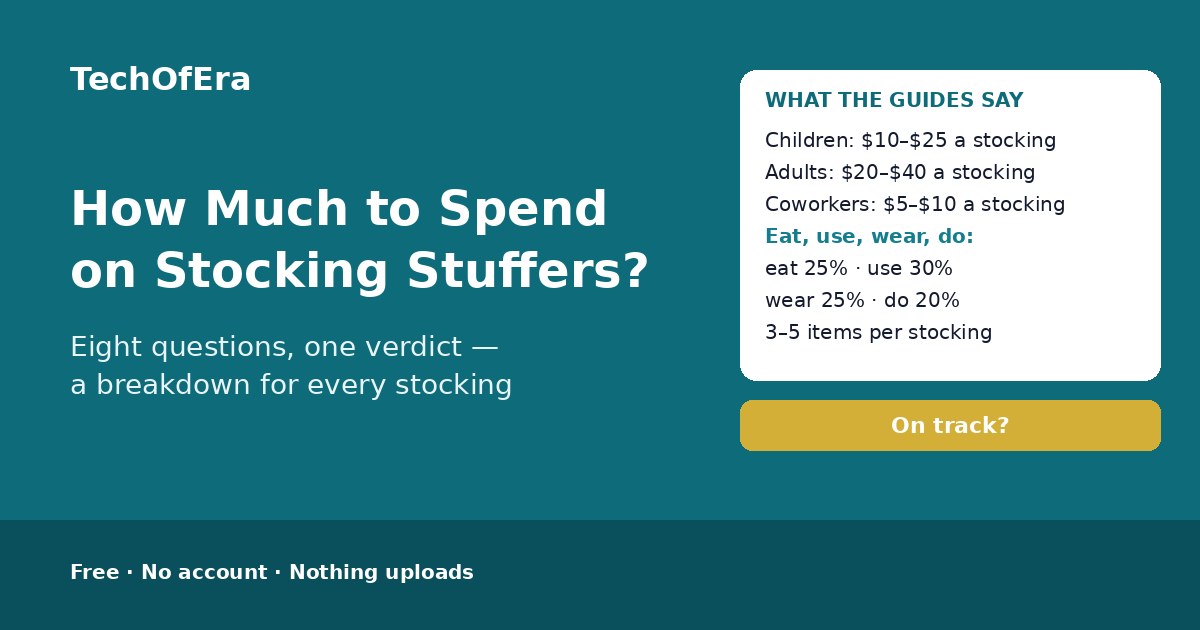
How much to spend on stocking stuffers is one of the most-searched Christmas questions, and the guides that rank for it all say the same thing in different words — but none of them runs your numbers. What decides it is your total budget for the stockings or your per-stocking amount, how many stockings there are, who they are for, how many items go in each, how the items split, whether you split multipacks across stockings, and your monthly take-home pay. The rule is simple: start with your total, divide by the number of stockings, and judge the per-stocking amount against what the guides say — $10–$25 a stocking for children, $20–$40 for adults, $5–$10 for coworkers. Three to five items per stocking is the usual count, and the eat, use, wear, do formula fills one without overspending. And the affordability rule is the checker's own: keep all the stockings under 10% of one month's take-home pay. The guide figures are planning estimates only: silkstonehome puts a stocking at $10–$25, with $15 as the sweet spot; secret.gift puts a full stocking at $30–$75; onlagend puts it at $20–$40. Those are ranges for everyone, not targets.
To use it:
- Pick your currency. The typical $10–$25 per-stocking range comes from US guides — in pounds or euros, treat it as a planning guide, not a conversion. The verdict and the breakdown use the currency you pick.
- Say what your budget is — total or per stocking. Enter either your total budget for all the stockings, or what you plan to spend on each stocking. The checker works from whichever you give, and if you enter both and they disagree by more than 10%, it will say so and use the total as the authority.
- Say how many stockings there are. The per-stocking amount is your total divided by this number, so it decides everything. From 1 to 20.
- Say who the stockings are for. Children, adults, a mix, or coworkers — who they are for sets the range the verdict is judged against: $10–$25 for children, $20–$40 for adults, $5–$10 for coworkers.
- Say how many items go in each stocking. Three to five is the usual count: one bigger item, two or three small ones, and something edible at the toe. Fewer than three feels thin, whatever they cost; more than six and the cost creeps up item by item.
- Say how the items in each stocking split. Eat, use, wear, do — one item you eat, one you use, one you wear, one you do — is the split the guides recommend, and it works at any budget. One bigger item plus small fillers, all small treats, or one premium item plus a small extra are all options, and the breakdown follows whichever you pick.
- Say whether you split multipacks across stockings. One pack of socks, one pack of bath bombs, one box of chocolates split three ways fills three stockings for the price of one pack each — the cheapest way to fill several at once. If you buy each stocking separately with three or more to fill, the checker says so.
- Say what your monthly take-home pay is, if you like. For the affordability check only: all the stockings should stay under 10% of one month's take-home pay, and over that line the checker warns you. That line is the checker's own planning rule, stated as such — no guide publishes a stocking share of pay. Leave it blank if you would rather not say — the per-stocking verdict still works without it.
What makes this calculator different
The pages that rank for this search are gift-idea listicles — silkstonehome's budget picks with the $10–$25 per-stocking band and the eat, use, wear, do formula, secret.gift's 50 ideas under $30 with the $30–$75 per-stocking range, onlagend's 25 picks under $25 with the $20–$40 rule of thumb, techwriteredc's men's picks with the $10–$25 sweet spot, pattybox's coworker guide with the $5–$10 range, and successfulblackparenting's family ideas. None of them runs your numbers: none takes your total or per-stocking budget, your stocking count, who they are for, your item count and mix, your multipacks and your pay — and none gives you a verdict with a breakdown for every stocking. This page is that answer: eight questions, one verdict, with the totals worked out and the reason shown. It is a self-assessment, so it says plainly what it cannot know: it cannot look inside your wallet, read your shopping list, or tell you which stocking stuffers to buy.
When is this the right check?
When the guides have left you no closer to an answer — because the answer genuinely depends on your budget, not on what other families spend. When you have four or more stockings and need to know whether the total has crept past what it should be. When money is tight and you need the eat, use, wear, do formula to make a small budget stretch. When you are filling stockings for a whole team and need them equal. When relatives are filling stockings too and you need to know what is already covered. And when you want a number you can shop against, stocking by stocking, instead of a list of fifty ideas with no total attached.
Honest limitations
A self-assessment, not shopping advice
This calculator cannot look inside your wallet, read your shopping list, or tell you which stocking stuffers to buy. It scores the answers you give against what the Christmas stocking guides say — it cannot tell you what anyone wants, and it is not shopping advice.
Guide figures are estimates, not targets
The $10–$25 per-stocking range for children, $20–$40 for adults and $5–$10 for coworkers are what the guides say as they read in November 2026. Your own budget matters more than any average — the verdict only works from the budget you enter, so re-check it before you shop.
The 10% rule is the checker's own
No guide publishes a stocking share of pay, so keeping all the stockings under 10% of one month's take-home pay is the checker's own planning rule, stated as such. If you spread the buying across several paydays, the total that is safe for you will be different — the checker says so instead of pretending the line is exact.
The item splits are the checker's own estimate
No guide publishes an item-split table, so the splits — eat 25%, use 30%, wear 25%, do 20% — are the checker's own planning estimate, stated as such. The eat, use, wear, do formula itself is the guides'; the percentages are the checker's.
Relatives' stockings are not counted
The checker only knows about the stockings you fill. If grandparents, godparents or other relatives are filling stockings too, their presents do not appear in the total — check what they have planned before you buy, so the big item is not bought twice.
Facts from the Christmas stocking guides, dated November 2026
The facts here are the guides that rank for this question — silkstonehome, secret.gift, onlagend, techwriteredc, pattybox and successfulblackparenting — as they read in November 2026. Guides change and prices do not: recheck the figures if anything about your household changes.