How the Secret Santa budget check works
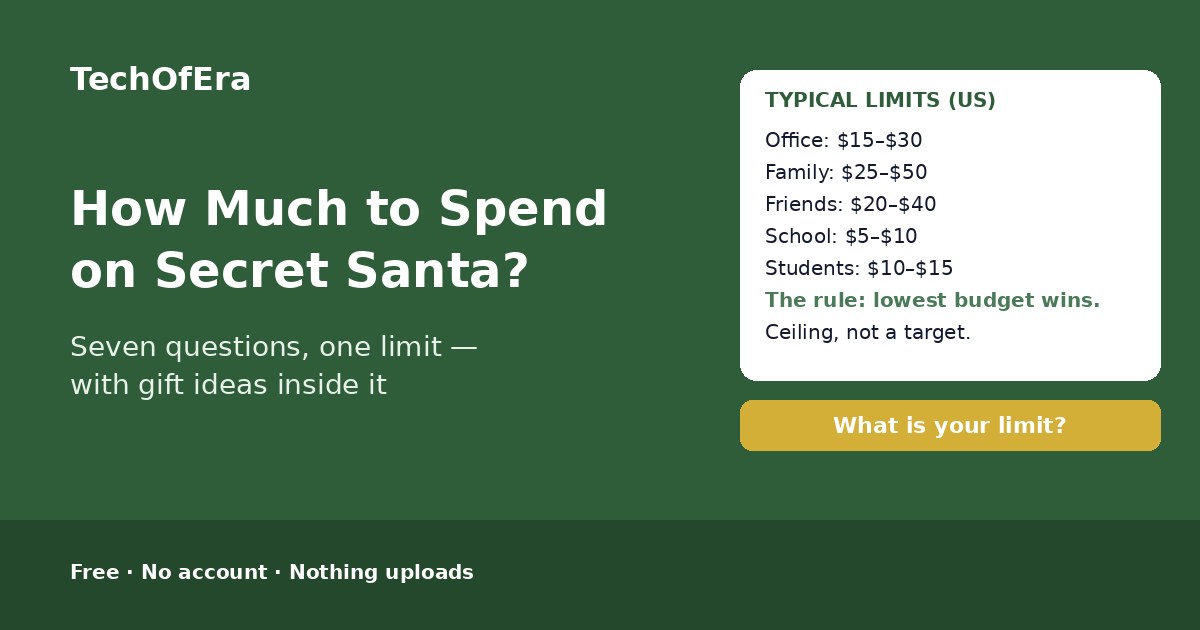
How much to spend on Secret Santa is one of the most-searched Christmas questions, and the guides that rank for it all say the same thing in different words — but none of them runs your numbers. What decides it is seven things: what kind of group it is, which country, how many people are drawing names, the lowest amount anyone in the group can spend without strain, how many exchanges you are in this December, what kind of gift fits, and whether wrapping, shipping and tax count toward the limit. The guide rule is simple: one budget for everyone, agreed before the draw, set by the person in the group with the least to spend — and a ceiling, not a target. Typical limits are $15–$30 for an office exchange in the US, $25–$50 for a family draw, $20–$40 for friends, $5–$10 for school children and $10–$15 for students. In the UK the usual bands are £10–£20 for an office, £20–£40 for family and £15–£30 for friends. Canada and Australia figures are estimates reusing the US ranges in Canadian and Australian dollars, and Germany figures are estimates reusing the UK ranges in euros — no Canadian, Australian or German guide publishes its own ranges, so the calculator says so instead of inventing one.
To use it:
- Say what kind of group it is. This decides the typical range. An office is usually $15–$30 in the US, a family draw $25–$50, friends $20–$40, school children $5–$10 and students $10–$15. A club or team sits between friends and an office.
- Say which country you are in. US limits are $15–$30 for an office and $25–$50 for family; UK limits are £10–£20 for an office and £20–£40 for family. Canada, Australia and Germany figures are estimates based on those ranges, labelled as such.
- Say how many people are drawing names. The total the group spends is the limit times the number of people — with 12 people at $25, the group spends $300 between them. Secret Santa needs at least 2 people; with 2 it is just a gift swap, and the draw adds nothing.
- Say what the lowest amount anyone can spend without strain is. This is the answer the whole limit hangs on. Ask privately, or run an anonymous poll, and enter the lowest figure anyone named. An $8 limit everyone can genuinely meet is better than a $25 limit where some people are stressed.
- Say how many exchanges you are in this December. Work, friends, a club and family can each run their own — five exchanges at 20 come to 100 before you buy a single main gift. The calculator adds them up so you can see what December will really cost you.
- Say what kind of gift fits this group. The style shapes the gift ideas: funny works best at low limits, food and drink is the safe pick at any budget, and homemade counts at every level.
- Say whether wrapping, shipping and tax count toward the limit. Most groups count the shelf price only, but a gift that needs posting can eat a third of a small limit in stamps. Decide before the draw and write it in the invite.
What makes this calculator different
The pages that rank for this search are guides — a Secret Santa rules guide listing $10–$25 for an office and $25–$50 for family, a gift guide with $15–$30 office and $20–$40 friends ranges, a student exchange guide with $10–$15 budgets, and a family guide with $25–$50 adults and $10–$20 children. The two calculators that do rank are thinner than this one: one only divides a total budget you have already agreed by the number of people — it does not help you pick the number at all — and the other is a generic arithmetic page with no ranges, no gift ideas and no message to send the group. None of them takes your group type, your country, your headcount, the lowest amount anyone can spend without strain, how many exchanges you are in, your gift style and whether wrapping counts — and none gives you a recommended limit with a fairness check, gift ideas inside the limit, what December will cost you, and a message to send the group. This page is that answer: seven questions, one limit, with the numbers worked out and the fairness rule stated. It is a self-assessment, so it says plainly what it cannot know: it cannot meet your group, read anyone's bank balance, or know what your office can afford.
When is this the right check?
When the guides have left you no closer to an answer — because the answer genuinely depends on your group, not on whether a limit is right in general. When you are organising an office exchange and need to know what number to put in the sign-up message. When your family draw has adults and children and you need two limits, not one. When you are in three exchanges and need to know what December will cost you before you agree to a fourth. When someone in the group is on a tight budget and you need a number nobody has to be embarrassed about. And when the gift has to be posted and you need to know whether the stamps come out of the limit.
Honest limitations
A self-assessment, not financial advice
This calculator cannot meet your group, read anyone's bank balance, or know what your office can afford. It scores the answers you give against what the Secret Santa guides say — it cannot tell you what to spend, and it is not financial advice.
Guide figures are ranges, not quotes
The $15–$30 office range, the $25–$50 family range and the $5–$10 school range are what the guides say as they read in November 2026. Your group will differ — the limit only works from the answers you enter, so re-check them against what your group actually spends.
Canada, Australia and Germany figures are estimates
No Canadian, Australian or German guide publishes its own Secret Santa ranges, so those figures reuse the US or UK ranges in local currency. They are labelled as estimates on this page — treat them as a sensible starting point, then match what people around you actually spend.
The limit is a ceiling, not a target
A $25 limit means nobody spends more than $25 — it does not mean everyone must spend $25. A thoughtful $12 gift inside a $25 limit is a better gift than a $25 gift bought to hit the number. Say so in the invite.
Homemade counts — say so out loud
Baking, jam, a handwritten letter or something crafted is worth more than its price, but only if the group knows it counts. If the invite never says so, the person who brings something homemade can feel they have cheated. Write it in the message.
Facts from the Secret Santa guides, dated November 2026
The facts here are the guides that rank for this question — Elfster, SpinFair, Keepwell, MySanta, the student exchange guide and the family guide — as they read in November 2026. Guides change and norms do not: recheck the figures if anything about your group changes.