How the Christmas card count works
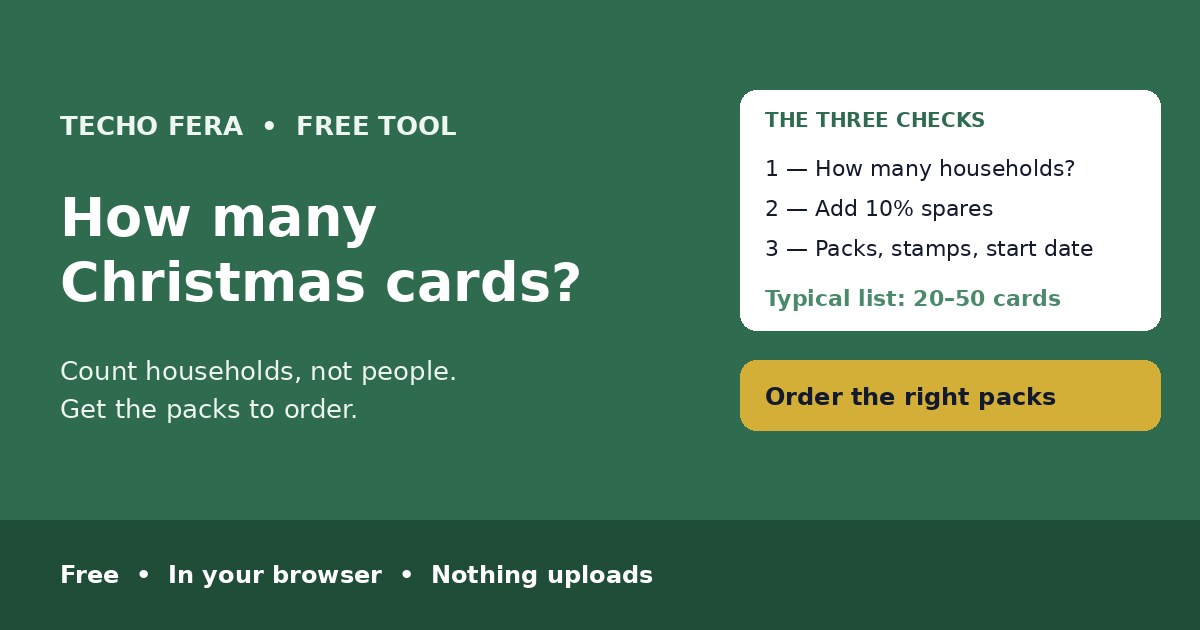
The rule is simple, and the guides that rank for this search all say the same three things: count households, not people; a typical list runs 20 to 50 cards; and order about 10% more than the number on your list. What none of them does is the arithmetic for your list — the packs to buy, the stamps to buy, the evenings of writing and the date to start. This checker asks fourteen questions — households in four groups, extra individual cards, spares, cards and stamps already on hand, pack size, card type, overseas cards, writing pace, and optionally the pack price — and gives one answer: the packs to order, the stamps to buy, and the date to start writing.
To use it:
- Count the households. Family, friends, neighbours, work — one card per address. A family of four at one address gets one card, not four. Grouping the people who live together first usually cuts a long list down sharply.
- Add extra individual cards. Only for people at a shared address who should each get their own card — adult children, flatmates, carers. Leave it at 0 if one card per household covers everyone.
- Pick the spares. About 10% extra is the usual rule — it covers people you remember later, new addresses, last-minute additions and cards that get smudged while writing.
- Say what you already have. Cards already bought and stamps already on hand are subtracted from the order, so you never buy twice.
- Pick the pack size and card type. Cards are sold in packs of 10, 12, 20, 24, 25, 40 or 50 — the checker rounds up to whole packs and names the leftover cards. Photo cards ordered online take about a week to print and deliver, so the checker names an order-by date for them.
- Say how many cards go overseas and how fast you write. Overseas cards need international postage and an earlier send-by date, and your writing pace decides the date to start — 10 cards a night over four or five evenings beats 50 in one sitting.
Typical lists at a glance
| List | Households | Cards to send (with 10% spares) | Packs of 10 | Stamps to buy | Evenings at 10 a night |
|---|---|---|---|---|---|
| Small list | 15 | 17 | 2 | 17 | 2 |
| Typical list | 35 | 39 | 4 | 39 | 4 |
| Big list | 75 | 83 | 9 | 83 | 8 |
What makes this checker different
The pages that rank for this search are card sellers and organisation guides — and every one of them gives you the same static answer: "count your list, add 10%". None of them asks how your list breaks down, what you already have in a drawer, what size packs you are buying, whether your cards are photo cards or boxed packs, how many go overseas, or how fast you write — and none of them gives you an order quantity, a stamp count, a writing schedule or a date to start. The stamp guides come closest, but they only answer the stamp question, not the card question. There is no free, standalone checker that takes a real list and turns it into packs to order, stamps to buy, evenings of writing and an order-by date. This page is that answer: fourteen questions, an instant order for your exact list, the leftover cards named, and the next steps. It is general information, so it says plainly what it cannot know: it cannot see your list, your envelopes or your stamps, and where the guidance is thinner — the photo-card lead time — it tells you that is its own estimate instead of inventing a postal rule.
When is this the right check?
When you are standing in a shop in November looking at packs of 10, 20 and 40 and you do not know which one to buy — because a list of 35 households needs 39 cards with spares, which is 4 packs of 10, and guessing wrong means a half-empty box in mid-December and two different card designs. When you order photo cards online and you are not sure whether they will arrive in time — because printing and delivery take about a week, and the checker names the order-by date from your writing plan. When you are about to buy stamps and you are not sure how many — because the count is the envelopes you will actually mail, minus the stamps already in your drawer. And when you keep putting the writing off — because 10 cards a night over four evenings beats 50 in one exhausted sitting, and the checker tells you the date to start.
Honest limitations
General information, not postal advice
This checker cannot see your list, your envelopes or your stamps. It cannot tell you how many households are really on your list, whether your envelopes fit your cards, or whether a finished card needs more than standard postage — only you can. If the postage is unclear, weigh one finished card at the post office.
The send-by dates are for Christmas 2026
The dates here are the US First-Class Mail date of Thursday 17 December 2026 and the international date of 9 December for most destinations. Postal deadlines change every year: check your own postal service's Christmas last posting dates before you rely on them.
The photo-card lead time is the checker's own estimate
Printing and delivery for photo cards ordered online take about a week — that is the checker's own estimate, not a postal rule, and it varies by printer and by how busy December is. Order early, and pay for faster delivery if it is offered.
One card per household is a choice, not a rule
The checker assumes one card per household. If two people at one address should each get their own card — adult children, flatmates, carers — add them as extra individual cards. The checker counts what you tell it, and it says so.
Spares are a planning choice, not a requirement
The 10% spares cover the people you remember later, new addresses, last-minute additions and cards damaged while writing. If your list is final and you never smudge a card, pick no spares — but ordering too few is the most common Christmas card mistake, and a half-empty box in mid-December means a picked-over shop.
Rules from Shutterfly, Tidy Home Printables, Embrace and Jofete, dated November 2026
The rules here are the card-counting rules as they read in November 2026: count households, not people; a typical list runs 20 to 50 cards; order about 10% more; divide by the pack size and round up; stamps are the envelopes to mail minus the stamps on hand; write in batches of about 10 a night. Guidance changes: recheck with your postal service if anything changes.