How the turkey rest check works
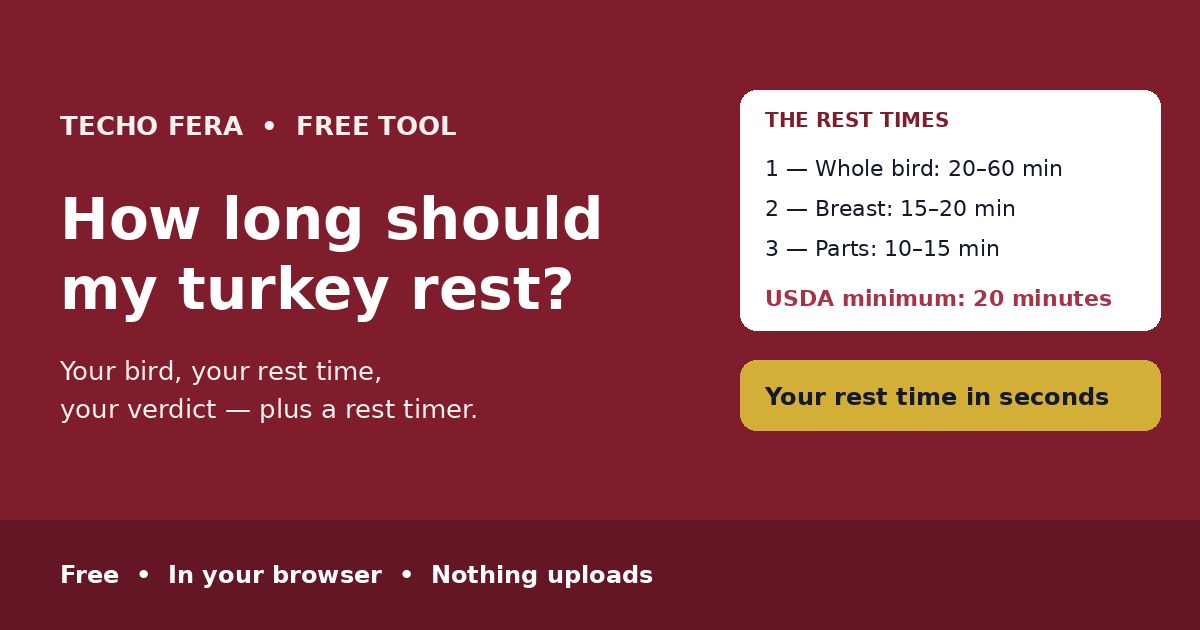
A turkey should rest for at least 20 minutes before carving — that is the USDA minimum — and longer for a bigger bird: 30 to 40 minutes is ideal for a 12 to 16-pound bird, and up to 60 minutes for a bird over 20 pounds. Resting lets the juices redistribute so the meat stays moist, and lets carryover cooking finish the job: the internal temperature often rises another 5–10°F while the bird rests. This checker takes the weight, the cut, the cooking method, the temperature you pulled it at, and how long it has already rested, and gives you an exact rest time — a minimum and an ideal — plus a verdict: rest longer, nearly there, carve now, or too long out.
To use it:
- Pick what you are resting. A whole bird rests longest; a breast, a crown, a spatchcocked bird or parts cool faster and need less time. A stuffed bird rests about 10 minutes longer than an unstuffed bird of the same weight.
- Enter the weight. Use the ready-to-cook weight from the label, in pounds or kilograms. The weight sets the rest: a 10-pound bird and a 22-pound bird do not rest the same.
- Say how you cooked it, and what temperature you pulled it at. A smoked bird rests a little longer than a roasted bird of the same size; a fried bird rests shorter. The pull temperature is optional — if you enter it, the checker estimates how much hotter the bird gets while it rests, and warns you if carryover cannot finish it.
- Say how long it has already rested, and how soon you need to carve. The checker counts down from where you are: if the bird has rested 35 minutes of a 40-minute ideal, it says so. If dinner is on a clock, it says whether the rest fits your carving time.
- Read the verdict — and start the rest timer. Rest longer means wait; nearly there means carving now is fine but waiting is better; carve now means the rest is done. The timer counts down the remaining ideal rest, and reminds you to re-check 165°F when it finishes.
What makes this checker different
The pages that rank for this search are guides — Simply Recipes' resting guide, Taste of Home's cooking guide, Tasting Table, ChefsResource — and they disagree with each other: one says 20 minutes, another says 45 minutes to an hour, a third says three to five hours. Every one of them gives you a range and leaves you to guess where your bird falls in it. None of them asks how much your bird weighs, how you cooked it, what temperature you pulled it at, or how long it has already rested. One dedicated resting-time calculator exists, on a small cooking site, but its numbers are not grounded in named sources and it gives no verdict — only a table. There is no free, standalone checker that takes your bird's details and gives you an exact rest time, a carve-now or rest-longer verdict, a carryover estimate, a serving-time fit and a rest timer. This page is that answer: nine questions, an instant verdict for your exact bird, the blockers named, and the next steps. It is a resting aid, so it says plainly what it cannot know: it cannot see your turkey, your thermometer or your oven, and where a reading looks impossible it says so instead of trusting it.
When is this the right check?
When the turkey is out of the oven and you are standing over it with a carving knife in your hand — because the question is not how long turkeys rest in general, but how long yours needs, right now. When the bird has rested 20 minutes and dinner is in 30 — because the checker tells you whether to wait or carve. When you pulled the bird at 158°F and wonder whether the rest will finish it — because the carryover estimate answers that before you carve into an underdone bird. And when the bird has been sitting out for over an hour — because the checker tells you the room-temperature limit is coming, and when it has passed.
Honest limitations
A resting aid, not food-safety advice
This checker cannot see your turkey, your thermometer or your oven. It cannot tell you whether your thermometer is calibrated, whether you measured the thickest part, or whether your bird is really at the temperature you entered. If you are unsure, measure again — in a different spot, with the tip away from bone.
Carryover is an estimate, not a guarantee
A large turkey often rises another 5–10°F as it rests, but ovens, birds and rest times vary. This checker uses the conservative end — 5°F for a roasted or smoked whole bird, 3°F for a fried bird or for parts — and always tells you to re-check with the thermometer after resting. Never serve a bird on the strength of the estimate alone.
Resting cannot finish a bird that is far under
If you pulled the bird at 150°F, carryover adds about 5°F — nowhere near the 165°F safe minimum. Resting is for finishing a bird that is close, and for letting the juices settle. A bird that far under needs the oven, not the resting board.
The 2-hour limit is the hard stop
Cooked turkey must not sit at room temperature for more than 2 hours in total — 1 hour if the kitchen is above 90°F. That limit counts from the moment the bird leaves the oven, rest included. A long rest is good; an endless hold is not. When the limit passes, carve it and refrigerate the leftovers.
Stuffing is its own check
Stuffing cooked inside the bird must reach 165°F in the centre, even when the meat is done — the stuffing heats more slowly than the meat around it. Take all the stuffing out after the rest and before carving, and check its temperature. If it is under, bake it separately until it reaches 165°F.
This is the resting question, not the doneness question
This checker answers how long to rest a bird that is already out of the oven. It does not answer whether the bird is done — that is the Is My Turkey Done? Checker — or when to start thawing it, whether cooked turkey can be frozen, or whether it can be reheated. Those are different questions, with their own checkers, linked below.