How the buy-now-or-wait check works
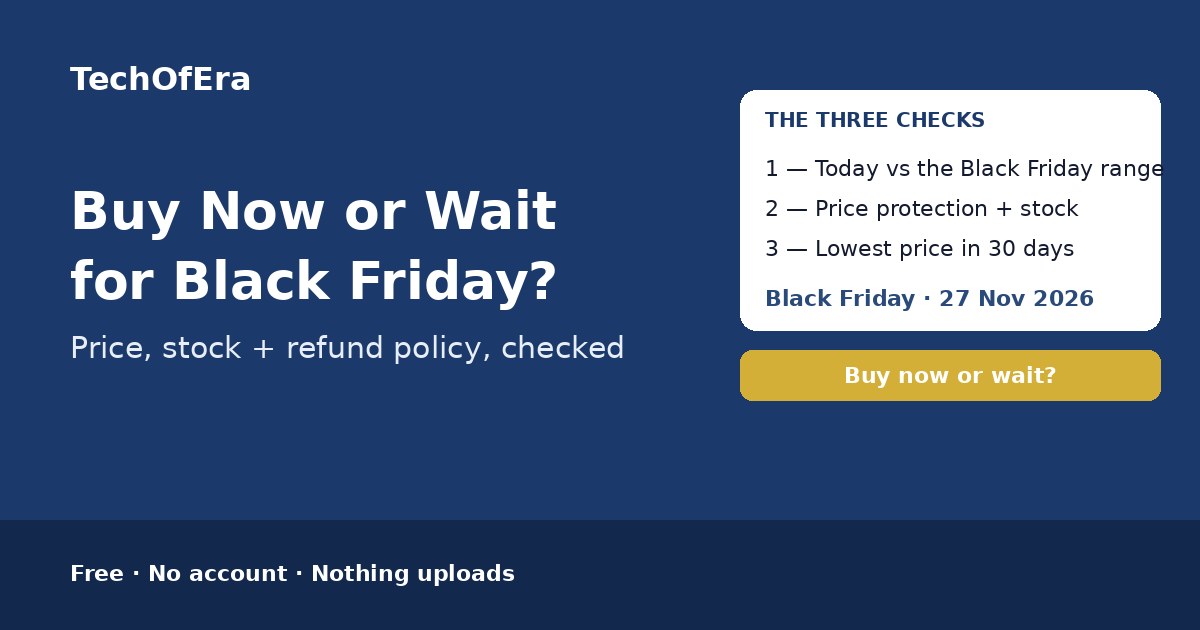
Black Friday 2026 is Friday 27 November, and the sale season is already running: early deals started in October, and Amazon’s Black Friday Week starts 19 November. But most Black Friday prices do not wait for the day itself — a German price-tracking study found only 15 of 376 electronics deals from two big chains actually landed on Black Friday itself last November. So “wait for Black Friday” is not always the right call, and “buy now” is not always wrong. This checker compares today’s price with the typical Black Friday discount range for the item’s category, then weighs the three things that change the answer: how soon you need it, how much stock is left, and whether the store refunds price drops.
To use it:
- Pick the item and the currency. The typical Black Friday discount depends on the category — TVs drop 20–40%, games consoles only 5–15%. The maths is the same in dollars, pounds, euros, Canadian dollars and Australian dollars.
- Enter today’s price. What the item costs right now, in the shop you would actually buy it from — not a price from another store.
- Enter the regular price. What it cost before the sale — the price it sat at for weeks, not the crossed-out “was” price on the deal page. Without it there is nothing to compare today’s price against.
- Enter the lowest price you have seen in the last 30 days, if you know it. This catches the fake deal: if today’s price is higher than the lowest you saw recently, the price went up before the sale. Check a price tracker if you are not sure.
- Say how soon you need it, how much stock is left, and whether the store refunds price drops. Needing it today changes the answer completely; low stock beats a saving; and a store that refunds drops — Best Buy through 15 January, Target through 24 December — makes buying now safe, because a later drop comes back to you.
What makes this checker different
The pages that rank for “should I buy now or wait for Black Friday” are guides — Rakuten’s early-deals blog, CNN Underscored’s 64 early discounts, Skimwire’s price log, and category tables that tell you TVs drop in November and leave you to do the sums for your exact deal. The one interactive rival, NeedOrWants’ Wait or Buy calculator, is generic: it compares buying today with waiting 30, 60 or 90 days on savings and hypothetical price changes, with no Black Friday date, no category discount ranges, no price-protection check and no stock check. Our own Best Time to Buy Checker is a sale calendar — it tells you which sale window is next for the item. This page is the other half of the question: it takes the deal in front of you, right now — today’s price, the regular price, the lowest price in the last 30 days, how soon you need it, the stock and the store’s refund policy — and gives you a verdict: buy now, wait for Black Friday, or skip this deal because the price went up. No other free, no-sign-up page does that for this exact question.
When is this the right check?
Right now, in Black Friday week — because the decision is live for eight days, not all year. When a deal page shows a big crossed-out “was” price and you want to know whether the cut is real. When you need the item this week and want to know what waiting would have saved. When the store refunds drops and you want to know whether buying now is safe. And when the price looks too good to be true — because the lowest price in the last 30 days is the number that catches it.
Honest limitations
General information, not financial advice
This checker compares prices and ranges — it does not know your budget, your needs or your finances. If the purchase is a big one, check the store’s own price-adjustment policy and a price tracker before you buy.
The ranges are typical, not promises
The discount ranges come from the published buying guides as they read in November 2026. A shop can discount less, and a doorbuster can discount more. This checker says so wherever it uses a range.
It cannot see the store’s stock
The stock check is only as good as what you enter. Check the listing itself — “only a few left” on the page is the real signal, and this checker cannot read it for you.
It cannot predict the Black Friday price
Nobody can. The expected price is the middle of the typical range for the category — a planning line, not a forecast. If the actual price is lower, the saving is bigger; if it is higher, the wait was wasted.
Price-protection policies change
Best Buy through 15 January and Target through 24 December are the policies as reported in November 2026. Stores change them — confirm the policy on the store’s own site before you rely on it, and keep the receipt.
Rules from published sources, dated November 2026
The discount ranges are from NerdWallet, Rakuten, CNN Underscored and this site’s Best Time to Buy Checker; the price-protection dates are from Skimwire’s price log, re-checked 16–18 November 2026. Prices and policies change: recheck before you buy.