How the tortoise-in-winter check works
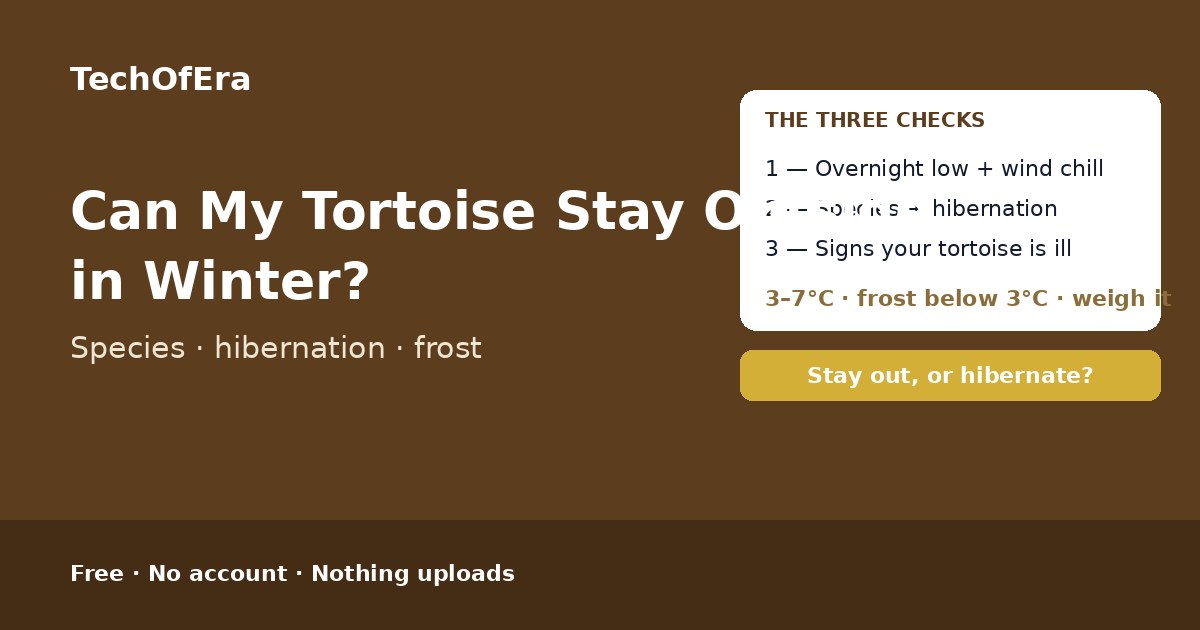
The ideal hibernation temperature for a tortoise is 3–7°C (37–45°F) — Millpledge Veterinary puts the ideal at 5–6°C. Below 3°C a tortoise risks frost damage, and exposure to sub-zero temperatures must never happen. Above 10°C (50°F) a hibernating tortoise wakes and burns the energy reserves it needs to hibernate safely. But those numbers are for a healthy, wound-down Mediterranean tortoise in a dry, frost-free spot — and your tortoise may be none of those. Mediterranean tortoises (Hermann’s, spur-thighed, marginated and Horsfield’s) hibernate; tropical species (red-footed, leopard and sulcata) never hibernate, and rarely meet nights below 21°C (70°F) in the wild. A tortoise must be wound down with no food for 3–4 weeks, weighed, and healthy before hibernation — an underweight or unwell tortoise must not hibernate. This checker does the same sums for your tortoise: it works out the wind chill from the temperature and the wind, takes about 5°F off for rain or snow and about 9°F off for frost, weighs the daytime high — a tortoise that cannot warm up and bask during the day copes far worse with a cold night — and adjusts for your tortoise’s species, hibernation readiness, health and weight, enclosure, shelter and age — and gives you a verdict for tonight, with tonight’s action checklist.
To use it:
- Enter tonight’s overnight low. Check the weather forecast for tonight — the overnight low, not the daytime high. Enter it in °C or °F.
- Enter today’s daytime high. A tortoise needs a warm day to cope with a cold night. If the days stay below 15°C, your tortoise cannot warm up and bask properly.
- Enter the wind speed, and say what the weather will be. Wind chill is what your tortoise actually feels — the wind strips away the warm air trapped around its shell. Rain, snow or frost wets the shell and the substrate, and a hibernating tortoise must never be exposed to sub-zero temperatures. Leave the wind blank if you do not know it, and the checker uses the air temperature.
- Say what species your tortoise is. The species decides the whole answer: Mediterranean tortoises hibernate, tropical species never do. If you do not know the species, do not hibernate until a vet or a tortoise society has identified it.
- Say whether your tortoise is ready to hibernate. Ready means wound down, not fed for 3–4 weeks, weighed and healthy. Still eating normally means not ready yet — undigested food can decay in the stomach during hibernation.
- Say how your tortoise’s health and weight are, what the enclosure is like, what shelter it has tonight, and how old it is. An underweight or unwell tortoise must not hibernate. A hatchling should stay indoors for the first couple of years. A damp or waterlogged enclosure is in trouble whatever the thermometer says.
- Tick any signs your tortoise is showing. Lethargy, not eating, a runny nose, swollen eyes, rapid weight loss or a soft shell all mean bring your tortoise in and talk to a vet — the tortoise is the thermometer that matters most, whatever the numbers say.
What makes this checker different
The pages that rank for this search are guides — Millpledge Veterinary’s tortoise care guide, Reptile Knowledge’s wintering articles, Tortoise Expert’s UK outdoors guide, Vet Exotics’ hibernation guide, and the Tortoise Trust’s outdoor habitat guide. They give you the thresholds and leave you to do the sums on a freezing doorstep. There is no free, standalone checker that takes tonight’s overnight low and the daytime high, works out the real wind chill, takes the rain, snow or frost into account, asks about the species and whether it is ready to hibernate, adjusts for your tortoise’s health, enclosure, shelter and age, and listens to the signs your tortoise is showing — and gives you a verdict: yes, yes with tonight’s precautions, borderline, bring it in, hibernate outdoors with preparation, hibernate in a fridge or box indoors, do not hibernate this year, or check first because the tortoise disagrees with the numbers — with tonight’s action checklist. This page is that answer: ten questions, an instant verdict for your exact tortoise and your exact night, the blockers named, and the next steps. It is a self-assessment, so it says plainly what it cannot know: it cannot feel your tortoise or read your thermometer, and where your tortoise’s signs disagree with the numbers it says so instead of guessing.
When is this the right check?
On the first freezing night of the year — because the tortoise that loved the garden in October is a different tortoise in January once the frost arrives. When autumn turns and you have to decide whether this is the year your tortoise hibernates, or whether it stays awake and warm indoors. When a hatchling or a young tortoise joins the house, and the cold limits you knew for your old tortoise no longer apply. When frost is forecast overnight, and the same temperature becomes a different night because the ground freezes. When the tortoise has stopped eating halfway through a cold snap — because that is when a guide leaves you guessing and a checker earns its keep.
Honest limitations
A self-assessment, not veterinary advice
This checker cannot feel your tortoise or read your thermometer. It cannot check the overnight low outside or whether your tortoise is lethargic or has a runny nose. If you are worried about your tortoise, talk to your vet.
The tortoise’s signs beat the numbers
A tortoise showing signs of illness in weather the numbers call fine is a tortoise that needs to come in and see a vet. The bands are guidance for an average tortoise of that species and setup — your tortoise’s own signs are the verdict that counts.
Wind chill is an estimate
The National Weather Service formula is for a person standing in the wind, and it is the best public estimate there is for what a tortoise feels. A sheltered enclosure, sunshine and how hard your tortoise is basking all move it — which is why the signs matter as much as the sum.
Rain, snow and frost are our estimate, not a published rule
No veterinary source publishes a wet-weather penalty. The checker takes about 5°F off for rain or snow and about 9°F off for frost, because wet shells and wet substrate chill a tortoise — and it says so, instead of dressing the estimate up as a rule.
Species and age ranges are approximate
The age bands use the usual ranges — hatchling under 2 years, juvenile 2 to 5, adult over 5 — but species and individuals vary. Where your tortoise falls between two bands, use the more vulnerable one: it is the safer reading.
Rules from official sources, dated November 2026
The rules here are the Tortoise Trust, Vet Exotics, Millpledge Veterinary and Reptile Knowledge guidance, as they read in November 2026. Guidance changes: recheck with your vet if anything about your tortoise changes.