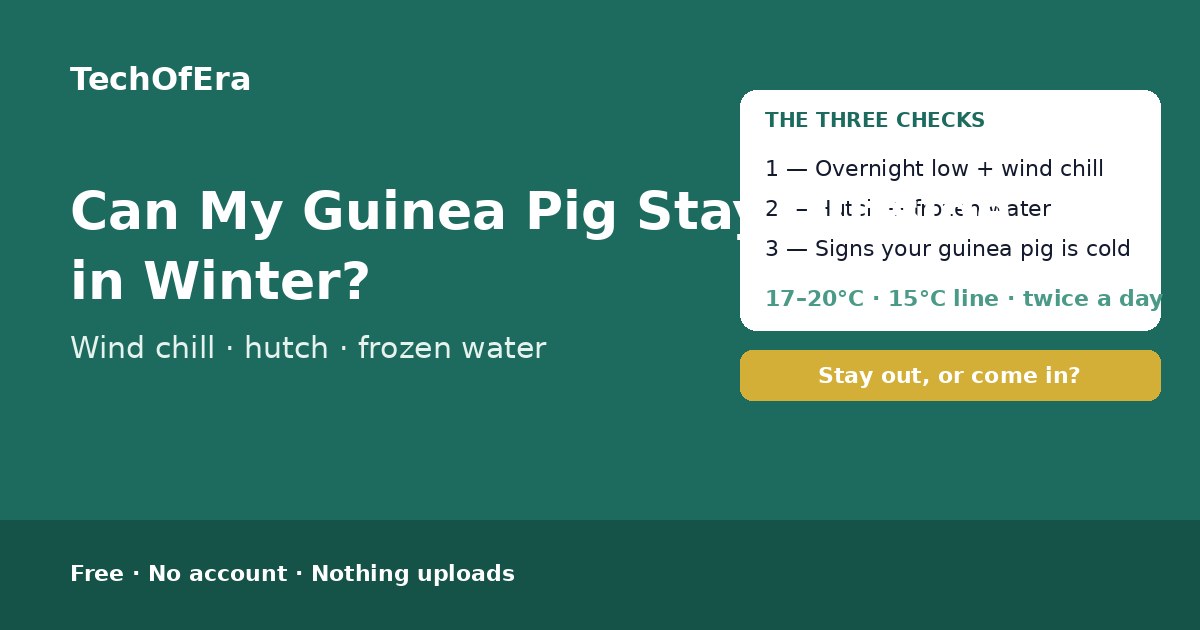
Can your guinea pig stay outside in winter?

It is freezing tonight, and your guinea pigs are in the hutch — but is 60°F fine for a bonded group in an insulated hutch, and dangerous for a single indoor guinea pig in a damp one? The RSPCA says 17–20°C is ideal and 15°C is the line, but those numbers are for an average guinea pig in a dry hutch, and your guinea pigs are neither average nor in a dry hutch. Enter tonight’s low, the wind, the weather and your hutch — this checker gives you the verdict in seconds, with tonight’s action checklist, free, in your browser, nothing uploads.

  • RSPCA 15°C guidance
  • Wind chill + wet weather
  • Tonight’s action checklist
  • Free, no account, nothing uploads
Can my guinea pig stay outside in winter?

Check whether your guinea pigs can stay outside tonight

Try a preset:
0 of 12 answered

Your result

Answer the questions Your verdict appears here as you answer.
What tonight calls for

Enter tonight’s overnight low above and what the night calls for will appear here.

Blockers

Things that do not fit

Things to check

Still to confirm

What to do next

    Your result summary


    Answer the questions above — the verdict updates live.

    Privacy you can verify, not just trust

    Checking whether your guinea pigs can stay outside in winter by uploading your guinea pigs’ details to a website would be backwards — the check should never be the leak. This one can't: your answers are checked with plain JavaScript on your device, and they never leave the device — the only third-party requests are the site's own analytics, which count page views. Don't take our word for it:

    New cross-origin requests during use: 0
    1. Press F12 to open developer tools, then the Network tab.
    2. Answer a question above. Watch: apart from the site's analytics, nothing new is requested — no uploads, and no data ever leaves your device.
    3. Extra credit: disconnect your internet after this page loads — the checker still works.

    How the guinea-pig-in-winter check works

    The RSPCA, the UK animal charity, puts the ideal temperature for guinea pigs at 17–20°C (63–68°F) — and draws its line at 15°C (59°F): below that, outdoor guinea pigs should be moved indoors. Temperatures above 26°C (79°F) can cause heatstroke, and guinea pigs do not cope well with big changes in temperature — so if you bring them inside for the winter, wait until the weather is much warmer and consistent before moving them back outside. But those numbers are for an average guinea pig in a dry hutch — and your guinea pigs are neither average nor necessarily in a dry hutch. The Vet Desk puts the comfortable range at roughly 18–23°C (64–73°F) and says that below 15°C keeping an outdoor shelter safe gets much harder. Woodgreen Pets Charity says guinea pigs can struggle in the cold winter months, that they like to snuggle up together when it is cold, and that older or poorly guinea pigs in particular benefit from living indoors over the winter. This checker does the same sums for your guinea pigs: it works out the wind chill from the temperature and the wind, takes about 5°F off for rain or snow and about 9°F off for sleet, moves the band for your guinea pigs’ age, health, bonded group, coat and acclimatisation, and for the hutch and the water — and gives you a verdict for tonight, with tonight’s action checklist.

    To use it:

    1. Enter tonight’s overnight low. Check the weather forecast for tonight — the overnight low, not the daytime high. Enter it in °C or °F.
    2. Enter the wind speed, and say what the weather will be. Wind chill is what your guinea pig actually feels — the wind strips away the warm air trapped in their fur. Rain or snow wets the fur, and wet fur chills a guinea pig far faster than dry cold. Leave the wind blank if you do not know it, and the checker uses the air temperature.
    3. Describe the hutch. The hutch is your guinea pig’s winter coat: insulated and dry, with deep hay, raised off the ground and draft-free but ventilated — or basic, or poor and damp. A guinea pig in a damp hutch is in trouble whatever the thermometer says.
    4. Say how the water is protected. A bottle’s thin metal spout freezes first, so a bottle alone can look full while your guinea pig has no drinkable water. A bowl is less likely to freeze, which is why the RSPCA advises providing both — and checking the water at least twice a day.
    5. Say how old your guinea pigs are, how their health is, whether they live in a bonded group, what kind of coat they have, and whether they live outside all year. Young and senior guinea pigs chill faster than healthy adults. A single guinea pig has no one to snuggle with for warmth. A skinny pig is hairless and has no fur at all. And an indoor guinea pig has no thick winter coat at all.
    6. Tick any signs your guinea pigs are showing. Shivering, hunching up, lethargy, cold ears or feet, not eating, or wet fur all mean bring your guinea pigs in — the guinea pig is the thermometer that matters most, whatever the numbers say.

    What makes this checker different

    The pages that rank for this search are guides — The Vet Desk’s vet-reviewed outdoor guide, Omlet’s winter blog, Woodgreen’s cold-weather tips, and MyPetGuineaPig’s outdoor-housing articles. They give you the thresholds and leave you to do the sums on a freezing doorstep. There is no free, standalone checker that takes tonight’s overnight low and the wind, works out the real wind chill, takes the rain or snow into account, asks about the hutch insulation and the water protection, adjusts for your guinea pigs’ age, health, bonded group, coat and acclimatisation, and listens to the signs your guinea pigs are showing — and gives you a verdict: yes, yes with tonight’s precautions, borderline, bring them in, or check first because the guinea pigs disagree with the numbers — with tonight’s action checklist. This page is that answer: ten questions, an instant verdict for your exact guinea pigs and your exact night, the blockers named, and the next steps. It is a self-assessment, so it says plainly what it cannot know: it cannot feel your guinea pig or read your thermometer, and where your guinea pigs’ signs disagree with the numbers it says so instead of guessing.

    When is this the right check?

    On the first freezing night of the year — because the guinea pigs that loved the garden in October are different guinea pigs in January once the wind picks up. When a young guinea pig or a senior guinea pig joins the house, and the cold limits you knew for your old guinea pigs no longer apply. When rain is forecast overnight, and the same temperature becomes a different night because the fur and the bedding get wet. When the water bottle has frozen once already, and you need to know whether a bowl would have saved the night. And whenever your guinea pig starts hunching up, shivering or stops eating halfway through a cold snap — because that is when a guide leaves you guessing and a checker earns its keep.

    Honest limitations

    A self-assessment, not veterinary advice

    This checker cannot feel your guinea pig or read your thermometer. It cannot check the overnight low outside or whether your guinea pig is hunched up and shivering. If you are worried about your guinea pig, talk to your vet.

    The guinea pigs’ signs beat the numbers

    A guinea pig showing cold stress in weather the numbers call fine is a guinea pig that needs to come in. The bands are guidance for an average guinea pig of that age and setup — your guinea pigs’ own signs are the verdict that counts.

    Wind chill is an estimate

    The National Weather Service formula is for a person standing in the wind, and it is the best public estimate there is for what a guinea pig feels. A sheltered hutch, sunshine and how hard your guinea pigs are running all move it — which is why the signs matter as much as the sum.

    Rain and snow are our estimate, not a published rule

    No veterinary source publishes a wet-weather penalty. The checker takes about 5°F off for rain or snow and about 9°F off for sleet, because wet fur chills a guinea pig — and it says so, instead of dressing the estimate up as a rule.

    Breed and age ranges are approximate

    The age bands use the usual ranges — young under 6 months, senior from 4 years — but breeds and individuals vary. Where your guinea pig falls between two bands, use the more vulnerable one: it is the safer reading.

    Rules from official sources, dated November 2026

    The rules here are the RSPCA, Woodgreen Pets Charity, The Vet Desk and Omlet cold-weather guidance, as they read in November 2026. Guidance changes: recheck with your vet if anything about your guinea pig changes.

    Frequently asked questions

    Can guinea pigs stay outside in winter?

    Yes — healthy, outdoor-acclimatised guinea pigs in a dry, insulated hutch can stay outside in winter, but only in a group that snuggles together for warmth, and only while the hutch stays dry and the water does not freeze. Guinea pigs are far less cold-hardy than rabbits: the RSPCA says outdoor guinea pigs should be moved indoors below 15°C (59°F), and Woodgreen Pets Charity says older or poorly guinea pigs in particular benefit from living indoors over the winter. A single guinea pig, a skinny (hairless) pig, or an indoor guinea pig should come inside sooner.

    How cold is too cold for guinea pigs to stay outside?

    The RSPCA puts the ideal temperature for guinea pigs at 17–20°C (63–68°F), and draws its line at 15°C (59°F): below that, outdoor guinea pigs should be moved indoors. The Vet Desk puts the comfortable range at roughly 18–23°C (64–73°F) and says that below 15°C keeping an outdoor shelter safe gets much harder. Temperatures above 26°C (79°F) can cause heatstroke. But a hardy, acclimatised group of three or more in an insulated hutch can cope a little below 15°C with precautions — which is why this checker works from the feels-like temperature and your guinea pigs’ hutch, water, age, health, bonded group, coat and acclimatisation, not just the air temperature.

    Will my guinea pigs’ water freeze overnight?

    In freezing weather, yes — and a water bottle is the first thing to freeze, because the thin metal spout ices up while the bottle still looks full. A bowl is less likely to freeze than a bottle, which is why the RSPCA advises providing both. Check drinking water at least twice a day to make sure it has not frozen, wrap the bottle in bubble wrap or an old sock, and put an animal-safe heat pad under the bowl if you have one. A guinea pig with no drinkable water is in trouble long before the cold is.

    How do I keep my guinea pigs warm outside in winter?

    Keep the hutch dry, draft-free and raised at least 10 cm (about 4 inches) off the ground, facing away from the prevailing wind and rain, with a sloped, watertight roof. Insulate the walls with cardboard, blankets or insulation boards — keeping them out of chewing reach — and keep the hutch ventilated. Give your guinea pigs deep, dry hay to bury themselves in, with plenty of warm, dry hiding places such as wooden boxes and tunnels, and remove wet bedding every day: wet bedding freezes on cold nights and can make a guinea pig ill. Cover most of the hutch at night, leaving a gap for air, move the hutch to a sheltered spot or a shed if you can, give extra food and hay to fuel the warmth, and check the water twice a day.

    Should I bring my indoor guinea pig outside in winter?

    No. An indoor guinea pig has no thick winter coat — the RSPCA says not to put a guinea pig outside in the middle of autumn or winter, and The Vet Desk says a guinea pig must acclimatise gradually before living outside. A guinea pig that is going to live outside needs to be moved out in early autumn, while the nights are still mild, so its coat has time to thicken before winter arrives. If your guinea pig lives indoors, keep it indoors for the winter — and do not bring an outdoor guinea pig in for one night and put it back out the next day, because guinea pigs do not cope well with big changes in temperature.

    Can a single guinea pig stay outside in winter?

    It is much harder for a single guinea pig. Guinea pigs snuggle up together when it is cold, and a guinea pig on its own has no one to share body heat with — The Vet Desk says guinea pigs should live in groups of at least three to four animals, as they are social and should not be housed alone. A bonded group of three or more is the safest setup for winter. If your guinea pig is single, give it extra hay to bury into tonight and bring it into a shed or the house on the coldest nights. Guinea pigs are social animals: bonded companions are the best long-term fix.

    What are the signs my guinea pig is too cold?

    Shivering or trembling, hunching up and sitting very still, lethargy or confusion, ears or feet that feel very cold to the touch or look pale, not eating or eating much less than usual, and wet fur or wet bedding under them. Any one of them means bring your guinea pig inside and warm them up — the guinea pig is the thermometer that matters most, whatever the numbers say. If your guinea pig is lethargic or confused, or has stopped eating, go to a vet urgently: that can mean hypothermia, not just being cold.

    Does this checker give veterinary advice?

    No. This checker is a self-assessment: it runs your answers against the RSPCA, Woodgreen Pets Charity, The Vet Desk and Omlet cold-weather guidance as they read in November 2026, entirely in your browser, and nothing you enter leaves your device. A web page cannot feel your guinea pig or read your thermometer — it cannot check the overnight low outside or whether your guinea pig is hunched up and shivering — so it says plainly what still needs checking, and where your guinea pigs’ signs disagree with the numbers it says so instead of guessing. The only third-party requests are the site’s own analytics, which count page views. If you are worried about your guinea pig, talk to your vet.