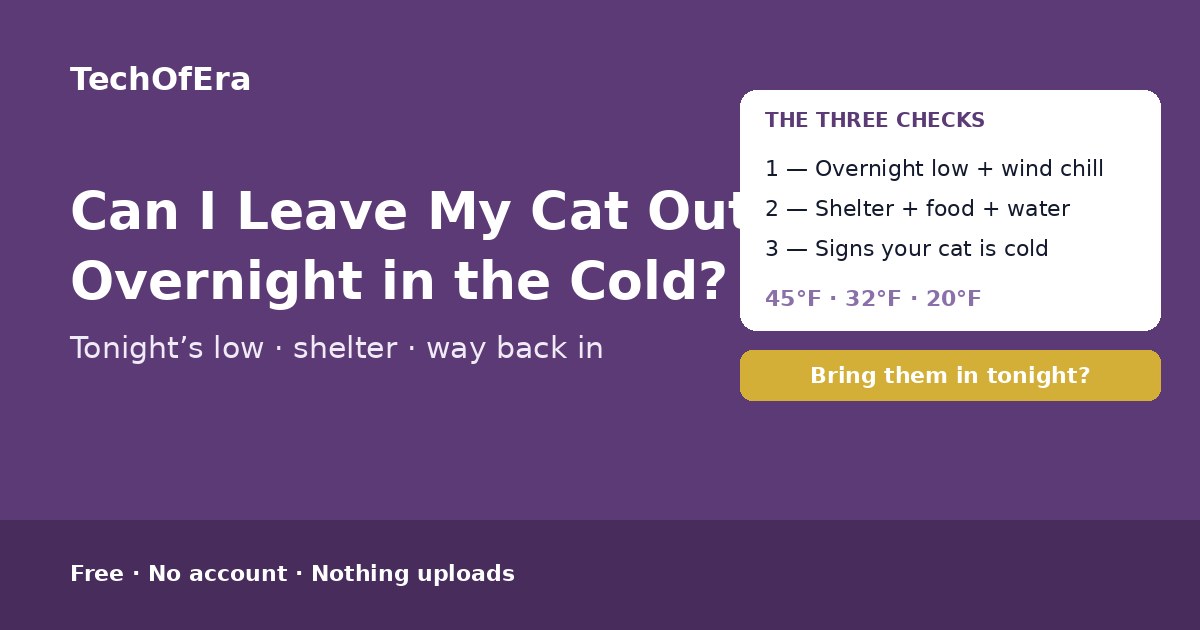
Can your cat stay out overnight in the cold?

It is 10pm, the forecast says 34°F by dawn, and your cat is at the back door asking to go out — but is that a mild night for a thick-coated outdoor cat, or a dangerous one for a kitten? The vets say 45°F and 32°F, but those numbers are for an average cat in still air, and tonight is neither average nor still. Enter tonight’s low, the wind, the wet and your cat — this checker gives you the verdict in seconds, with an overnight plan, free, in your browser, nothing uploads.

  • 45–32°F vet thresholds
  • Wind chill + wet weather
  • Shelter, food & water plan
  • Free, no account, nothing uploads
Can I leave my cat out overnight in the cold?

Check whether your cat can stay out overnight in the cold

Try a preset:
0 of 12 answered

Your result

Answer the questions Your verdict appears here as you answer.
What tonight calls for

Enter tonight’s lowest temperature above and the overnight plan for this night will appear here.

Blockers

Things that do not fit

Things to check

Still to confirm

What to do next

    Your result summary


    Answer the questions above — the verdict updates live.

    Privacy you can verify, not just trust

    Checking whether your cat can stay out overnight by uploading your cat’s details to a website would be backwards — the check should never be the leak. This one can't: your answers are checked with plain JavaScript on your device, and they never leave the device — the only third-party requests are the site's own analytics, which count page views. Don't take our word for it:

    New cross-origin requests during use: 0
    1. Press F12 to open developer tools, then the Network tab.
    2. Answer a question above. Watch: apart from the site's analytics, nothing new is requested — no uploads, and no data ever leaves your device.
    3. Extra credit: disconnect your internet after this page loads — the checker still works.

    How the cat-out-overnight check works

    Cats Protection, the UK cat charity, puts the line at about 45°F (7°C): below that, staying outside can start to be unsafe, especially for long periods. PetMD says the same — most cats begin feeling uncomfortable below 45°F, and below 32°F (0°C), freezing temperatures are a significant risk for all cats: frostbite and hypothermia. Below freezing, most cats should not be outside for more than 10 to 15 minutes without a warmer place to go. But those numbers are for an average cat in still air — and your cat is neither average nor standing in still air, and tonight is a whole night, not a ten-minute trip. The Cornell Feline Health Center says low temperatures, wind, and snow or ice together predispose cats to hypothermia and frostbite. This checker does the same sums for your cat: it works out the wind chill from tonight’s low and the wind, takes about 5°F off for rain or snow and about 2°F off for wet ground, moves the band for your cat’s age, coat, health and lifestyle, and gives you a verdict for tonight — with the shelter, the food and water, and whether your cat can come back in all counted.

    To use it:

    1. Enter tonight’s lowest temperature. Check the overnight low in the weather forecast — the coldest hour is usually just before dawn, not the evening temperature when your cat goes out. Enter it in °C or °F.
    2. Enter the wind speed, and say whether it will rain or snow. Wind chill is what your cat actually feels — the wind strips away the warm air trapped in their fur. Rain or snow wets the fur, and wet fur chills a cat far faster than dry fur. Leave the wind blank if you do not know it, and the checker uses the air temperature.
    3. Say how old your cat is, and what kind of coat they have. Kittens and seniors chill faster than healthy adults, and a hairless Sphynx is a different animal in the cold from a thick-coated Maine Coon.
    4. Say how your cat lives, and how their health is. An indoor-only cat is not used to the cold, and a health condition or medication can lower cold tolerance further. A community cat lives outside, with no owner and no warm room to fall back on.
    5. Say what shelter your cat has, and whether food and water are out. An insulated shelter with straw holds body heat; a porch or an uninsulated box only blocks the wind. Cats need more calories in the cold, and water that cannot freeze matters as much as food.
    6. Say whether your cat can come back in. A cat flap or a door open all night means your cat can choose warmth the moment they feel cold. A cat locked out until morning has no way back if it gets colder than forecast.
    7. Tick any signs your cat is showing. Shivering, hunching up, cold ears, paws or tail, or not eating or drinking all mean bring your cat in — the cat is the thermometer that matters most, whatever the numbers say. Weakness, slowness or confusion, or shivering that stops while your cat is still cold, means vet now.

    What makes this checker different

    The pages that rank for this search are guides — PetMD’s cold-weather mistakes article, Reader’s Digest’s vet-explained guide, Tractive’s and Compare Pet Coverage’s temperature tables, and a handful of question-and-answer pages about cats staying out all night. They give you the thresholds and leave you to do the sums at 10pm, on the doorstep, with a cat asking to go out. There is no free, standalone checker that takes tonight’s overnight low and the wind, works out the real wind chill, takes the rain or snow into account, adjusts for your cat’s age, coat, health and lifestyle, checks the shelter, the food and the water, asks whether your cat can come back in, and listens to the signs your cat is showing — and gives you a verdict: yes, only with a proper shelter, bring them in, or vet now — with an overnight plan. This page is that answer: twelve questions, an instant verdict for your exact cat and your exact night, the blockers named, and the next steps. It is a self-assessment, so it says plainly what it cannot know: it cannot feel your cat or read your thermometer, and where your cat’s signs disagree with the numbers it says so instead of guessing.

    When is this the right check?

    On the first cold night of the year — because the cat that loved the garden in October is a different cat in January once the wind picks up. When the forecast says rain or snow overnight, and the same temperature becomes a different night. When a new kitten or a senior cat joins the house, and the cold limits you knew for your old cat no longer apply. When you look after a community cat and need to know whether tonight is a shelter night or a bring-them-in night. And whenever your cat starts shivering, hunching up or refusing food at bedtime — because that is when a guide leaves you guessing and a checker earns its keep.

    Honest limitations

    A self-assessment, not veterinary advice

    This checker cannot feel your cat or read your thermometer. It cannot check the temperature outside or whether your cat is shivering. If you are worried about your cat, talk to your vet.

    The cat’s signs beat the numbers

    A cat showing cold stress on a night the numbers call mild is a cat that needs to come in. The bands are guidance for an average cat of that age and coat — your cat’s own signs are the verdict that counts.

    Wind chill is an estimate

    The National Weather Service formula is for a person standing in the wind, and it is the best public estimate there is for what a cat feels. Sheltered spots, sunshine and how hard your cat is running all move it — which is why the signs matter as much as the sum.

    Wet weather is our estimate, not a published rule

    No veterinary source publishes a wet-weather penalty. The checker takes about 5°F off for rain or snow overnight and about 2°F off for wet ground, because wet fur chills a cat — and it says so, instead of dressing the estimate up as a rule.

    The shelter benefit is our estimate, not a published rule

    No veterinary source publishes how much warmer an insulated shelter is. The checker moves the band one step warmer for an outdoor cat with an insulated shelter and straw, and never lets a shelter turn a dangerously cold night into a mild one — and it says so, instead of dressing the estimate up as a rule.

    Rules from official sources, dated November 2026

    The rules here are the Cats Protection, PetMD, Cornell Feline Health Center, Texas A&M and Alley Cat Allies cold-weather guidance, as they read in November 2026. Guidance changes: recheck with your vet if anything about your cat changes.

    Frequently asked questions

    Can I leave my cat out overnight in the cold?

    It depends on the cat and the night. Below about 45°F (7°C), staying outside can start to be unsafe, especially for a whole night — that is the line the UK charity Cats Protection uses — and below 32°F (0°C) every cat is at risk of frostbite and hypothermia. A healthy outdoor-acclimated cat with an insulated shelter, straw, extra food and water that cannot freeze can ride out a mild cold night. A pet cat, a kitten, a senior, a thin-coated or hairless cat, or an unwell cat belongs indoors once the overnight low drops below 45°F. This checker takes tonight’s low, the wind, the wet and your cat, and gives you the verdict for this night.

    How cold is too cold for a cat to stay out overnight?

    Below about 45°F (7°C), staying outside can start to be unsafe, especially for long periods — that is the line the UK charity Cats Protection uses, and PetMD says most cats begin feeling uncomfortable below 45°F. Below 32°F (0°C), freezing temperatures are a significant risk for all cats, with frostbite and hypothermia. Kittens, seniors, thin-coated or hairless cats and cats with health conditions are at risk sooner, some below 50–60°F. The coldest hour is usually just before dawn, so judge the night by the overnight low, not the evening temperature — and wind chill and wet fur move those lines further than the thermometer reading alone, which is why this checker works from the feels-like temperature of tonight’s low.

    Can a community cat survive a night outside in winter?

    A community cat that lives outside can survive a cold night, but only with help. They need an insulated shelter, small and raised off the ground, with a small entrance facing away from the wind, filled with straw — not blankets, which hold moisture and freeze — plus extra food, because cats need more calories in the cold, and water that cannot freeze. Below freezing, even a hardy outdoor cat is at risk, and below 20°F the night is dangerously cold for any cat. If you can bring a community cat in, do — and check the shelter at first light either way.

    What should an outdoor cat shelter have in winter?

    An insulated shelter, small enough that your cat’s body heat warms it, raised off the ground on bricks or a pallet, with a small entrance facing away from the wind, and filled with a thick layer of straw — straw repels moisture, so it stays dry and warm. Do not use blankets or towels: they hold moisture, freeze, and pull heat out of the cat. Put the shelter somewhere dry and sheltered from the wind, and check the straw is dry and deep enough for your cat to burrow into. A cardboard box lined with insulation and filled with straw is better than nothing for one night.

    Should I leave food and water out for my cat overnight?

    Yes, if your cat is spending the night outside: cats need more calories in the cold, because staying warm burns energy, and water that cannot freeze matters as much as food — a cat that cannot drink dehydrates, and a dehydrated cat chills faster. Use a heated bowl, or a wide, deep bowl, and check it before bed and again at first light. A pet cat that sleeps indoors needs nothing left out — they eat and drink inside.

    What are the signs my cat is too cold?

    Shivering or trembling, hunching up or curling into a tight ball, ears, paws or a tail that feel cold to the touch, and not eating or drinking. Any one of them means bring your cat in and warm them up — the cat is the thermometer that matters most, whatever the numbers say. Weakness, slowness or confusion, or shivering that stops while your cat is still cold, is different: that can mean hypothermia, not just being cold. Go to an emergency vet now, wrap your cat in a warm towel, and warm them slowly on the way.

    Does this checker give veterinary advice?

    No. This checker is a self-assessment: it runs your answers against the Cats Protection, PetMD, Cornell Feline Health Center, Texas A&M and Alley Cat Allies cold-weather guidance as they read in November 2026, entirely in your browser, and nothing you enter leaves your device. A web page cannot feel your cat or read your thermometer — it cannot check the temperature outside or whether your cat is shivering — so it says plainly what still needs checking, and where your cat’s signs disagree with the numbers it says so instead of guessing. The only third-party requests are the site’s own analytics, which count page views. If you are worried about your cat, talk to your vet.