How the chickens-in-winter check works
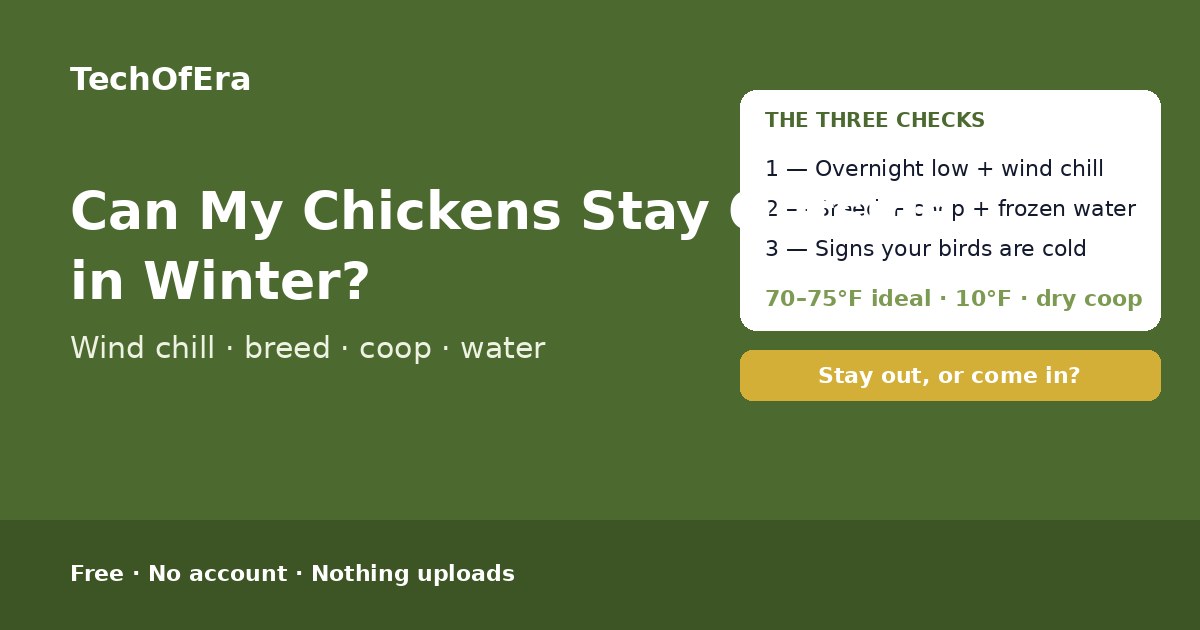
Purina, the animal-feed company, puts a chicken’s ideal temperature at 70–75°F — and says most cold-hardy breeds can withstand winter without supplemental heat. An acclimated flock can tolerate 10°F or lower. The University of Minnesota says to add heat only below 35°F in the coop, and the University of Maine says acclimated birds in a dry, draft-free coop need no extra heat at all. But those numbers are for an average flock in a dry coop — and your flock is neither average nor necessarily in a dry coop. Penn State Extension puts the real rule in one line: poultry can handle cold very well if they are dry. This checker does the same sums for your flock: it works out the wind chill from the temperature and the wind, takes about 5°F off for rain or snow and about 9°F off for sleet, moves the band for your birds’ breed, age, coop, ventilation, water, heat source and flock size — and gives you a verdict for tonight, with tonight’s action checklist.
To use it:
- Enter tonight’s overnight low. Check the weather forecast for tonight — the overnight low, not the daytime high. Enter it in °C or °F.
- Enter the wind speed, and say what the weather will be. Wind chill is what your birds actually feel — the wind strips away the warm air trapped in their feathers. Rain or snow wets the feathers, and wet feathers chill a bird far faster than dry cold. Leave the wind blank if you do not know it, and the checker uses the air temperature.
- Say what breed your chickens are. Cold-hardy breeds with small combs — Orpington, Wyandotte, Plymouth Rock, Australorp, Rhode Island Red, Brahma — cope far better than large-combed breeds such as Leghorns, or Silkies, whose soft feathers do not stand up to cold and wet.
- Say how old your birds are. Chicks under 6 weeks cannot stay outside at all — they need a heated brooder at 90–95°F, dropping 5°F a week. Young and senior or moulting birds chill faster than adults.
- Describe the coop and the ventilation. The coop is your flock’s winter coat: insulated and dry, with deep litter, raised off the ground and draft-free but ventilated — or basic, or poor and damp. And the vents must stay open up high, above roost height: sealing the coop shut traps the moisture your birds breathe out, and damp air is what gives birds frostbite.
- Say how the water is protected, whether there is extra heat, and how big the flock is. A drinker freezes solid overnight, so a heated waterer or twice-daily checks matter. A heat lamp is a well-known cause of coop fires — a flat-panel heater is the safer choice. And birds huddle together on the roost for warmth, so a single bird loses heat far faster than a flock.
- Tick any signs your birds are showing. Puffed-up feathers, shivering, a pale or blackened comb, lethargy, not eating, or frostbite all mean bring your birds into shelter — the birds are the thermometer that matters most, whatever the numbers say.
What makes this checker different
The pages that rank for this search are guides — Purina’s winter-chicken page, Happily Outside’s winter-care guide, Pam’s Backyard Chickens’ snow tips, Elliott Homestead’s cold-tolerance guide, and the Farm Store’s keeping-chickens-warm page. They give you the thresholds and leave you to do the sums on a freezing doorstep. There is no free, standalone checker that takes tonight’s overnight low and the wind, works out the real wind chill, takes the rain or snow into account, asks about the breed hardiness and the birds’ age, the coop insulation and the ventilation, the water protection, the heat source and the flock size, and listens to the signs your birds are showing — and gives you a verdict: yes, yes with tonight’s precautions, borderline, bring them in, or check first because the birds disagree with the numbers — with tonight’s action checklist. This page is that answer: eleven questions, an instant verdict for your exact flock and your exact night, the blockers named, and the next steps. It is a self-assessment, so it says plainly what it cannot know: it cannot feel your birds or read your thermometer, and where your birds’ signs disagree with the numbers it says so instead of guessing.
When is this the right check?
On the first freezing night of the year — because the flock that loved the garden in October is a different flock in January once the wind picks up. When a young bird or a senior bird joins the flock, and the cold limits you knew for your old birds no longer apply. When rain is forecast overnight, and the same temperature becomes a different night because the feathers and the litter get wet. When the drinker has frozen once already, and you need to know whether a heated waterer would have saved the night. When a heat lamp is hanging in the coop, and you want to know whether it is doing more harm than good. And whenever your birds start puffing up, shivering or stop eating halfway through a cold snap — because that is when a guide leaves you guessing and a checker earns its keep.
Honest limitations
A self-assessment, not veterinary advice
This checker cannot feel your birds or read your thermometer. It cannot check the overnight low outside or whether your hens are puffed up and hunched on the roost. If you are worried about your birds, talk to your vet.
The birds’ signs beat the numbers
Birds showing cold stress in weather the numbers call fine are birds that need to come in. The bands are guidance for an average flock of that breed and setup — your birds’ own signs are the verdict that counts.
Wind chill is an estimate
The National Weather Service formula is for a person standing in the wind, and it is the best public estimate there is for what a bird feels. A sheltered coop, sunshine and how hard your birds are moving all shift it — which is why the signs matter as much as the sum.
Rain and snow are our estimate, not a published rule
No poultry source publishes a wet-weather penalty. The checker takes about 5°F off for rain or snow and about 9°F off for sleet, because wet feathers chill a bird — and it says so, instead of dressing the estimate up as a rule.
Breed and age ranges are approximate
The breed bands use the usual groupings — cold-hardy, average, delicate — but breeds and individuals vary. Where your birds fall between two bands, use the more vulnerable one: it is the safer reading.
Rules from official sources, dated November 2026
The rules here are Purina, University of Minnesota and University of Maine Extension, and Penn State Extension cold-weather guidance, as they read in November 2026. Guidance changes: recheck with your vet if anything about your flock changes.