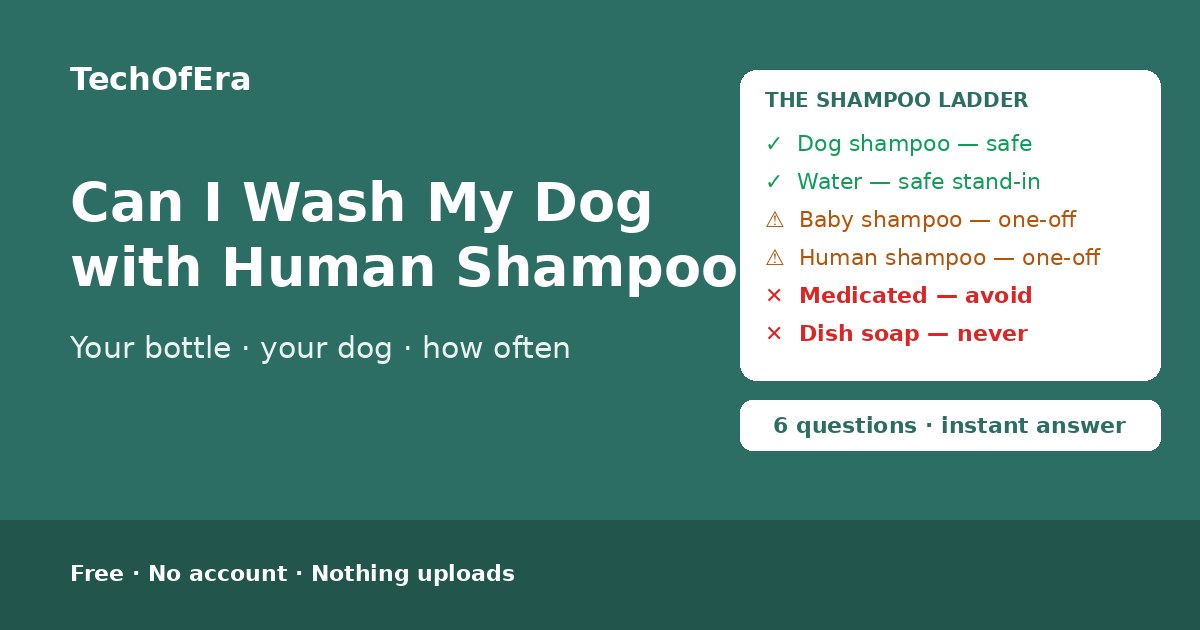
Why your shampoo is not your dog's shampoo
Your dog's skin is built differently from yours, and shampoo is built to match the skin it is made for. Human skin is more acidic than dog skin: Purina puts human shampoo around pH 5.4 to 5.9 and dog skin at 6.2 to 7.4; the American Kennel Club gives dog skin as 5.5 to 7.5 and human skin as 4.0 to 6.0. The ranges differ by source, but every source agrees the two are different. Dog skin is also thinner — 3 to 5 layers of skin cells against 10 to 15 in people — so it is more sensitive to the wrong pH and to the fragrance, dyes and additives in a human bottle. And the acid mantle — the thin protective film that keeps bacteria and viruses out and moisture in — is built for one pH, not the other. Wash a dog with human shampoo and you strip that film: the skin dries, flakes and itches, and can develop a new smell, which sends owners into a cycle of overbathing that makes it worse. This checker asks exactly what decides it.
To use it:
- Pick the bottle first. Dog shampoo and plain water are safe; baby and regular human shampoo are one-off stand-ins at best; medicated human shampoo and dish soap are not bath products for a dog at all.
- Say who the dog is. A healthy adult can take a single emergency wash. A puppy, a senior, or a dog with skin problems should never get human shampoo — every veterinary source gets cautious there.
- Say how often. One wash and a routine are two different answers. The AKC's groomer source puts it plainly: one or two baths won't hurt the dog, but repeated use takes the lustre out of the coat.
- Say whether it already happened. A wash that already happened cannot be undone — the advice becomes rinse again with plenty of lukewarm water and watch the skin.
- Check the skin and coat now. Dry, flaky or itchy skin is the first sign the wrong shampoo has already done its work; red or sore skin needs a vet if it does not settle.
- Check the rinse. Human shampoo can be harder to rinse out of a dog's coat than dog shampoo, and leftover shampoo irritates the skin on its own. The rinse should take much longer than the lather.
Every bottle, and what to do with it, at a glance
The table below is built from the same rules as the checker, so it can never disagree with your verdict. Which bottle it is, who the dog is, and how often it would be used decide together.
| Bottle | Verdict | What to know |
|---|
What makes this checker different
The pages that rank for this search are articles — Purina, the American Kennel Club, Dogster, Petful and Adopt a Pet all explain the pH difference, the acid mantle and why routine use is a bad idea, thoroughly and well. But they leave you to work out what that means for the bottle in your hand: whether baby shampoo is the same as your shampoo, whether once is the same as every bath, whether a puppy gets the same answer as a healthy adult, and what to do if you already washed the dog yesterday. There is no interactive checker among them — no page that takes your bottle, your dog and how often, and gives you a verdict. This page is that answer: six questions, an instant verdict, the reason named, and the red flags stated plainly instead of buried in the text — with nothing to install, no account, and nothing uploaded. It is a self-assessment, so it says plainly what it cannot know: a web page cannot examine your dog's skin, smell the coat, or know your dog's history, so anything you mark “Not sure” stays on the list until you confirm it.
When is this the right check?
Whenever you are standing in the bathroom with a wet dog and the wrong bottle: out of dog shampoo and wondering whether yours will do, about to use your anti-dandruff shampoo on an itchy dog, or reaching for the dish soap because the dog rolled in something foul. Also the morning after — when you already washed the dog with your shampoo and want to know whether to worry, what to watch for, and whether to rinse again. And whenever you are about to make your shampoo the routine and want to know what that costs the coat before the damage shows.
Honest limitations
A self-assessment, not a diagnosis
This checker works only from the answers you enter. It cannot diagnose your dog — no web page can examine your dog's skin, smell the coat, or know your dog's history. If an answer is wrong, the verdict is wrong. When in doubt, call your vet.
The pH ranges differ by source
Purina puts human shampoo around pH 5.4 to 5.9 and dog skin at 6.2 to 7.4; the AKC gives dog skin as 5.5 to 7.5 and human skin as 4.0 to 6.0; VCA gives people 5.2 to 6.2 and dogs 6.2 to 7.5. The numbers vary, but every source agrees on the point that matters: the two are different, and human shampoo is made for human skin.
One wash is not a routine
The whole verdict turns on how often. A single emergency wash with a gentle human shampoo is likely fine for a healthy adult dog; the same bottle every bath dries the coat out wash by wash. If you are not sure how often it would be used, the checker says so instead of guessing.
Puppies, seniors and sore skin are different
A bottle that is a one-off for a healthy adult is a risk for a puppy, a senior, or a dog whose skin is already itchy, flaky or sore. The checker treats them as a different answer, and so should you — use a dog shampoo, and ask your vet if the skin does not settle.
The rinse matters as much as the bottle
Human shampoo can be harder to rinse out of a dog's coat than dog shampoo, and leftover shampoo irritates the skin on its own. The rinse should take much longer than the lather — and if you already washed the dog, rinse again with plenty of lukewarm water.
Rules from veterinary sources
The rules here follow Purina, the American Kennel Club, Dogster, PetMD, VCA Animal Hospitals and Elanco guidance, as they read in November 2026. Guidance can be revised, so re-check if a new edition appears.