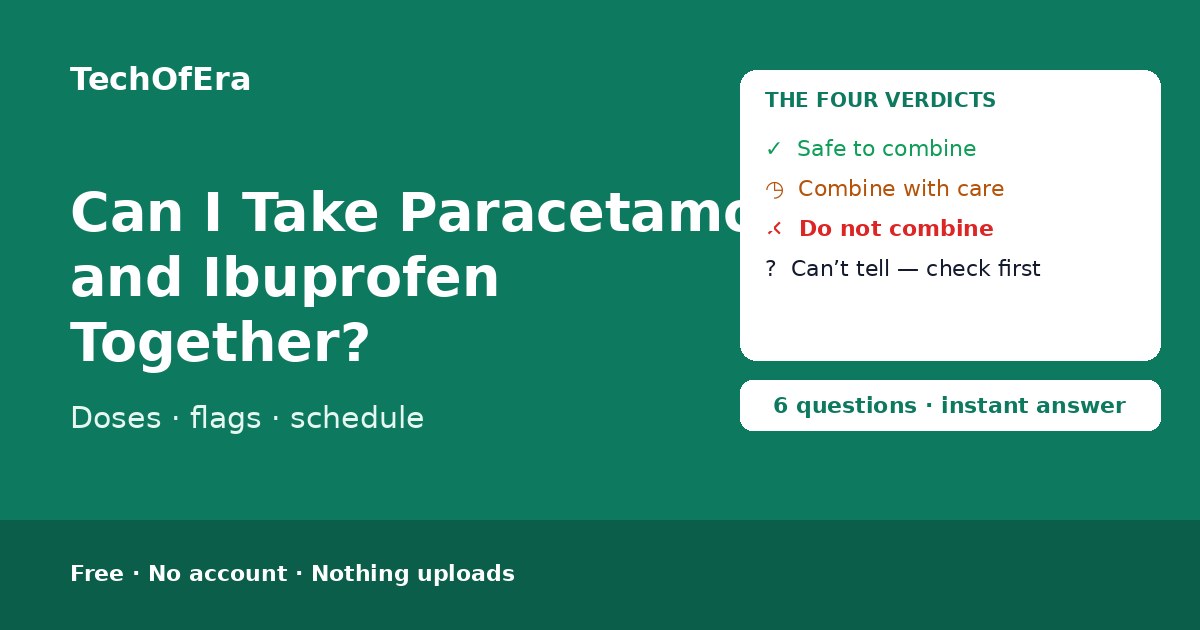
How to tell whether you can take paracetamol and ibuprofen together
Paracetamol and ibuprofen are the two most widely used over-the-counter painkillers in the world — and whether they can be taken together is one of the most searched medicine questions there is. The answer is yes for most adults, but it turns on the dose, what else you are taking, and what else is true about you. The two drugs work through different pathways and are processed differently — paracetamol by the liver, ibuprofen mainly by the kidneys — so they do not interfere with each other, and together they relieve pain better than either one alone. (In the US the same medicines go by their American names — acetaminophen, sold as Tylenol, for paracetamol, and Advil or Motrin for ibuprofen — the rules are the same either way.) This checker asks exactly the questions that decide the answer.
To use it:
- Say who it is for. An adult answer does not apply to a child: children are dosed by weight, not age, and a child under 6 needs a pharmacist or doctor to check the dose first.
- Find the active ingredients. Read both boxes and find the active ingredients — not the brand names. Paracetamol plus one NSAID is usually safe; two NSAIDs or two paracetamol products are not. A cold or flu remedy may contain paracetamol already, so check every ingredient.
- Check the dose of each. The usual adult dose is paracetamol 500–1,000 mg every 4–6 hours, up to 4,000 mg in 24 hours, and ibuprofen 200–400 mg every 6–8 hours, up to 1,200 mg in 24 hours. More than 1,000 mg of paracetamol at once is too much, and 600 mg or more of ibuprofen is prescription-strength.
- Think about what else you take. A cold remedy may already contain paracetamol — adding more is the commonest way to take too much. A blood thinner, or another NSAID already taken today, changes the answer completely.
- Check the flags that change everything. A stomach ulcer or bleeding, kidney problems, pregnancy, or blood thinners mean do not take the NSAID at all — paracetamol alone is usually the answer. Liver problems or heavy drinking lower the safe paracetamol dose, and asthma and age 65 or over raise the NSAID risk.
Paracetamol and ibuprofen combinations at a glance
The table below is built from the same rules as the checker, so it can never disagree with your verdict. The active ingredients decide the answer, not the brand names.
| Combination | Verdict | What to know |
|---|
What makes this checker different
The pages that rank for this search are guides — thorough explanations of why the two medicines can be combined and what the daily limits are, but they leave you to work out what that means for the tablets in your hand, at your doses, with your other medicines and your health, today. The nearest rival that does anything interactive is a general medicines interaction checker that covers every medicine at once, not this pair. None of them turns who it is for, which two medicines, the dose of each, what else you take and your risk flags into a safe-to-combine, combine-with-care or do-not-combine verdict — with an alternating schedule built from your doses and a check for hidden paracetamol in the other medicines you take. The closest tools on this site answer different questions: the ibuprofen empty-stomach checker is about food timing for one medicine, the painkillers while pregnant checker is about which painkiller to choose in pregnancy, and the alcohol and cold medicine checker is a different combination altogether. This page is the answer to this question: six questions, an instant verdict, an alternating schedule, a combination-risk score, and the reason named — with nothing to install, no account, and nothing uploaded. It is general information, so it says plainly what it cannot know: a web page cannot examine you, so anything you mark “Not sure” stays on the list until you confirm it, and every verdict ends with asking your doctor or pharmacist.
When is this the right check?
Whenever you reach for a second painkiller because the first one is not enough: a headache that paracetamol alone is not shifting, a toothache in the night, period pain, a sports injury, or a fever that keeps coming back. Also whenever you are about to take a cold remedy on top of paracetamol, or you are not sure whether the tablet in your hand is paracetamol or an NSAID at all. If the answer is "do not combine", the checker names what to take instead, and who to ask.
Honest limitations
General information, not medical advice
This checker works only from the answers you enter. It cannot examine you — no web page can know your medical history, your dose, or what else you are taking. If an answer is wrong, the verdict is wrong. When in doubt, ask your doctor or pharmacist.
The pair is the decision
Most paracetamol-and-ibuprofen questions turn on one thing: which two medicines they actually are. Paracetamol plus one NSAID is usually safe; two NSAIDs or two paracetamol products are not. Brand names hide what matters — read the active ingredient on each box.
The risk score and schedule are estimates
The combination-risk score (0–10) and the alternating schedule are this checker’s own conservative estimates, not medical guidance. They summarise the factors you entered so you can see what is driving the verdict. They are not a measurement of your body and they are not a dose recommendation.
Hidden paracetamol is the commonest mistake
Many cold and flu remedies already contain paracetamol, and doubling up is the commonest way to take too much. Taking more than the recommended dose of paracetamol can cause fatal liver damage — and the symptoms may not appear at first. Add up the paracetamol in everything you take.
Daily pain is a reason to be seen
No painkiller should be taken every day for more than a few days without asking a doctor or pharmacist. Daily pain means the cause needs checking, and the right painkiller for daily use is a clinician’s decision, not a web page’s.
Rules from health authorities
The rules here follow NHS guidance on paracetamol and ibuprofen, Patient.info’s paracetamol-and-ibuprofen guidance, Tufts Medicine and Your Everyday Pharmacist on combining acetaminophen and ibuprofen, Barnsley Hospital NHS guidance on giving both to children, and the US FDA safety communications on NSAIDs including the 2020 pregnancy warning, as they read in November 2026. Authorities can revise guidance, so re-check if a new edition appears.