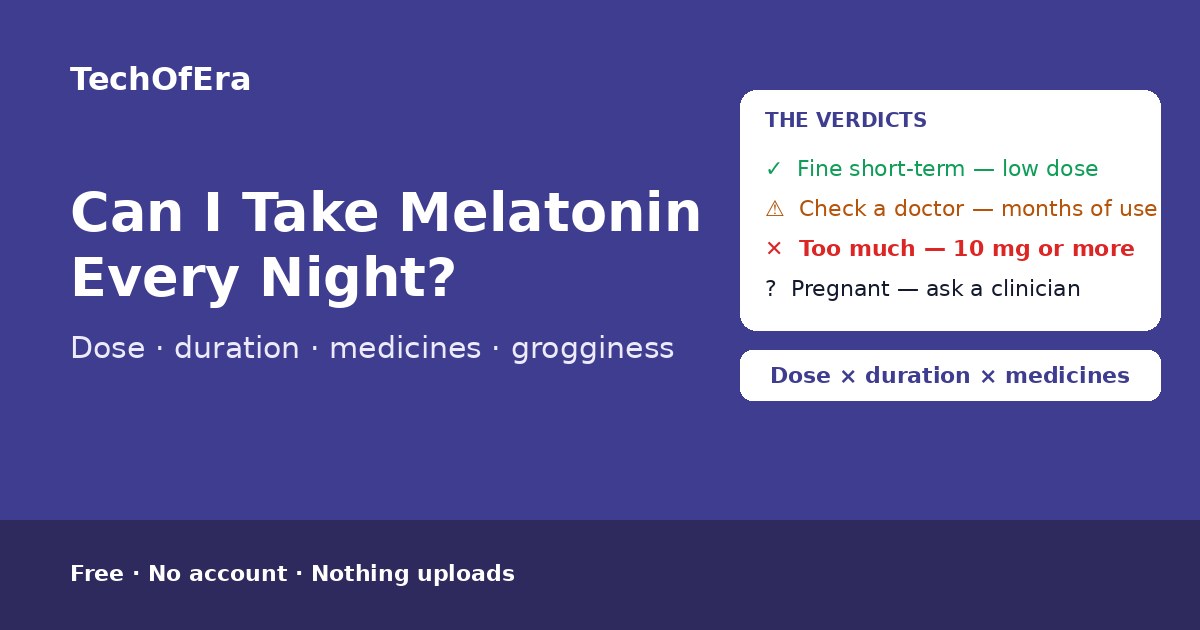
Can you take melatonin every night — or should you stop?

Short-term, usually yes; long-term, the evidence runs out. The NCCIH says short-term use is considered safe for most adults, but there is not enough evidence to recommend nightly use over the long term. Your dose, how long you have taken it, your medicines and your grogginess decide it — answer 8 questions and get a personal verdict, with a dose and timing plan. Entirely in your browser.

  • Personal verdict — fine short-term, check with a doctor, or stop nightly use
  • Dose, duration, medicines and grogginess scored together
  • Dose and timing plan, plus a two-week test
  • Free, no account, nothing uploads
Can you take melatonin every night — or should you stop?

Check your nightly melatonin

Try a preset:
7 of 8 answered

Your result

Pick your dose Your verdict appears here once you pick your dose above.
What this means for you

Pick your dose above and what this means for you will appear here.

Blockers

Cautions

Still to confirm

Things to check

What to do next

    Your result summary


    Pick your dose above — the verdict updates live.

    Privacy you can verify, not just trust

    Checking a health question by uploading details of your body to a website would be backwards — the check should never be the leak. This one can't: your answers are checked with plain JavaScript on your device, and they never leave the device — the only third-party requests are the site's own analytics, which count page views. Don't take our word for it:

    New cross-origin requests during use: 0
    1. Press F12 to open developer tools, then the Network tab.
    2. Pick a dose above. Watch: apart from the site's analytics, nothing new is requested — no uploads, and no data ever leaves your device.
    3. Extra credit: disconnect your internet after this page loads — the checker still works.

    How to decide whether you can take melatonin every night

    The short answer is that it depends on four things: the dose, how long you have taken it, what else you take, and how you feel in the morning. Melatonin is a hormone your brain releases as evening light fades — its job is to tell your internal clock that night has begun. It does not knock you out, and it was never designed to. The US National Center for Complementary and Integrative Health says short-term melatonin use is considered safe for most adults, but there is not enough evidence to recommend nightly use over the long term. This checker asks exactly what decides it.

    To use it:

    1. Check the dose on the packet. The dose is on the front, in milligrams (mg) — if it is a gummy, check how many gummies make one dose. Sleep-medicine experts say 0.5 to 3 mg is the appropriate dose for most adults, and never more than 5 mg a night. Most shop shelves sell 5 mg and 10 mg — far more than most people need.
    2. Count how long you have taken it nightly. A few nights is a different answer from a few months. Experts usually advise regular use for one to two months at most, and GoodRx advises up to a week or two at a time for daily use. Needing it longer usually means a chronic sleep issue that a healthcare professional should look at.
    3. Match the reason to what melatonin actually does. It helps most with falling asleep and with jet lag — a timing signal for the body clock. It is a weak tool for staying asleep, and the American Academy of Sleep Medicine does not recommend it for chronic insomnia. The first-line treatment for persistent poor sleep is cognitive behavioural therapy for insomnia (CBT-I), not a supplement.
    4. Check your other medicines. Melatonin can interfere with blood thinners, diabetes medicines, immunosuppressants, blood pressure medicines and sedatives. If you take any prescription medicine, your clinician or pharmacist should know you are taking it.
    5. Listen to the morning. Morning grogginess, vivid dreams or daytime sleepiness are the commonest signs the dose is too high or the timing is too late. Drop to 0.5 mg and take it 1 to 2 hours before bed, in dim light — and if the grogginess stays, stop and talk to a doctor.
    6. Know when to see a doctor. If you have needed a sleep aid nightly for more than a few weeks, if melatonin does not help after two weeks, if you feel sleepy in the day, or if your partner reports snoring or gasping, book a visit rather than reaching for a higher dose.

    Nightly use at a glance

    The table below is built from the same rules as the checker, so it can never disagree with your verdict. The dose, the duration, the reason and your medicines decide, together.

    SituationVerdictWhat to know

    What makes this checker different

    The pages that rank for this search are guides — thorough explanations of why melatonin is safe short-term, why the long-term evidence is thin, and the general advice to keep the dose low — but they leave you to do the work yourself: to judge whether your dose is high, whether three months is too long, whether your blood thinner matters, and whether your morning grogginess means anything. The melatonin calculators that do exist only work out a dose in milligrams — they do not answer the question as it is actually asked: “I have taken this dose every night for this long, can I keep going?” This page is that answer: the dose, the duration, the reason, the medicines and the grogginess scored together, and a verdict for your exact situation — usually fine for a short stretch, check with your doctor, or do not take it nightly — with a dose and timing plan and a two-week test to find out whether it is actually helping. It is a self-assessment, so it says plainly what it cannot know: a web page cannot examine you or know your medical history, so anything you mark “Not sure” stays on the list until you confirm it.

    When is this the right check?

    Whenever you have been taking melatonin nightly and are wondering whether to carry on: the 10 mg gummies you have taken for months, the 3 mg tablets that stopped working, the nightly dose you started for jet lag and never stopped, the question of whether your blood pressure medicine changes the answer, or the morning grogginess that has crept in. Also whenever the conditions are borderline and the decision turns on something specific — whether one month is different from three, whether 5 mg is different from 1 mg, whether waking in the night is a different problem from falling asleep, or whether you can drive to work after a groggy morning. And whenever you are about to start melatonin for the first time and want a straight answer about the dose, the timing and how long to take it, instead of a general article to interpret.

    Honest limitations

    A self-assessment, not medical advice

    This checker works only from the dose and answers you enter. It cannot diagnose you — no web page can examine you, know your medical history, or know what is in your medicine cabinet. If an answer is wrong, the verdict is wrong. When in doubt, do not take it nightly — or ask a doctor or pharmacist.

    The risk score and duration limits are estimates

    The 0–100 risk score and the one-to-two-month limit are this checker’s own conservative estimates, built from the published guidance — not measurements of your body. There is no single agreed limit on how long melatonin can be taken, and the long-term effects are not studied. They are not a guarantee.

    The checker cannot read your packet

    The verdict is only as good as the dose you pick. Melatonin is sold as a dietary supplement in the US, so the FDA does not verify that the contents match the label — one study found the actual content often differed from the label. Look for a USP Verified seal, and ask a pharmacist if you are unsure.

    Melatonin cannot fix bad sleep habits

    Melatonin cannot fix a bright bedroom, a late phone, alcohol in the evening or an irregular bedtime. A dark, cool, quiet room and the same wake time every morning do more than any supplement — and a “usually fine” verdict is not a recommendation to take it.

    Daytime sleepiness overrides the verdict

    Feeling groggy or sleepy in the day is a safety problem, not just a nuisance. Do not drive or operate machinery while it lasts, whatever the checker said — and stop taking melatonin and talk to a doctor if it does not clear.

    Rules from public-health sources

    The rules here follow the NCCIH, Sleep Foundation, GoodRx and American Academy of Sleep Medicine guidance, as it read in November 2026. Guidance can be revised, so re-check if a new edition appears. In the UK and much of Europe melatonin is prescription-only — check your own country’s rules.

    Frequently asked questions

    Can I take melatonin every night?

    For most healthy adults, yes — for a short stretch. The US National Center for Complementary and Integrative Health says short-term melatonin use is considered safe for most adults, but there is not enough evidence to recommend nightly use over the long term. Sleep-medicine experts usually advise regular use for one to two months at most, at 0.5 to 3 mg a night. Melatonin is not addictive the way sedatives are, but nightly use can become a psychological habit — you believe you need it every night to sleep. If you have needed it nightly for more than a few weeks, talk to a doctor: the cause of the poor sleep deserves a proper look. This checker asks your dose, how long you have taken it, your medicines and your grogginess, and works it out for your exact situation.

    How long can you take melatonin for?

    There is no single agreed limit, and that is the honest answer. GoodRx advises that it is probably OK to take melatonin every night, but only for up to a week or two at a time — needing it longer usually means a chronic sleep issue that a healthcare professional should look at. Sleep-medicine experts quoted elsewhere advise regular use for one to two months at most. Studies have used daily melatonin for up to six months in adults and three months in children, but the long-term effects of years of nightly use are still unknown. The practical rule this checker uses: a few nights to a few weeks is a short stretch; past one to two months, set a stop date and get the sleep problem properly looked at.

    What dose of melatonin should I take?

    Start at 0.5 to 1 mg — the lowest effective dose for most people. Sleep-medicine experts say 0.5 to 3 mg is the appropriate dose for most adults, and never more than 5 mg a night. Take it one to two hours before bed, in dim light. Higher doses do not work better: they keep melatonin circulating into the morning, which causes grogginess, headaches and worse mood the next day. If 1 mg does nothing after a couple of weeks, go up slowly — but if 3 mg does nothing either, a higher dose is unlikely to help, and the sleep problem needs a different answer. This checker scores your dose against that range and says plainly when it is too high.

    Is melatonin safe for children?

    Only with a doctor's advice. The American Academy of Sleep Medicine issued a health advisory in 2022 warning parents to be careful about giving melatonin supplements to their children, and the long-term safety of melatonin in children is not established. Studies have used 0.5 to 3 mg in children for up to three months, but that was under medical supervision, for specific sleep problems. Do not give a child melatonin every night on your own say-so — talk to your child's doctor first, and ask about the cause of the sleep problem and about sleep habits before reaching for a supplement.

    Can I take melatonin if I am pregnant or breastfeeding?

    Experts generally recommend against it. There is not enough reliable evidence about the safety of melatonin in pregnancy, and melatonin passes into breast milk, so its safety while breastfeeding is not established either. There is also some evidence that melatonin may affect fertility in both men and women, so people trying to conceive may want to avoid it. If you are pregnant, breastfeeding or trying to conceive and struggling to sleep, talk to your clinician or midwife — they can advise on safe options without judgment. This checker treats pregnancy and breastfeeding as reasons not to take melatonin nightly until a clinician says otherwise.

    What medicines interact with melatonin?

    Melatonin can interfere with several medicines: blood thinners (anticoagulants such as warfarin), diabetes medicines, immunosuppressants, blood pressure medicines, and antidepressants, anti-anxiety medicines and sedatives — it adds drowsiness on top of the last group. The Sleep Foundation lists blood thinners, diabetes medicines and immunosuppressants specifically, and sleep-medicine experts add that people taking any prescription medicine should check with their healthcare team first. If you take any of these, tell your clinician or pharmacist before taking melatonin — they can check your exact medicines in seconds. This checker asks about them and scores each one.

    Does melatonin cause grogginess or vivid dreams?

    Yes — those are the commonest side effects. The NCCIH lists headache, dizziness, nausea and daytime drowsiness as the usual side effects of melatonin, and sleep-medicine experts add morning grogginess, vivid dreams and worse mood the next day, especially at higher doses. Grogginess is the commonest sign the dose is too high or the timing is too late: melatonin is still circulating when you wake. The fix is to drop to 0.5 mg and take it earlier in the evening. Do not drive or operate machinery while you feel groggy or sleepy in the day — no verdict on this page overrides that.

    Does this checker diagnose me or upload anything?

    No to both. This checker is a self-assessment: it works only from the dose and answers you enter, runs entirely in your browser, and nothing you enter leaves your device. It cannot diagnose you — a web page has no way to examine you, know your medical history, or know what is in your medicine cabinet — so every answer you are unsure about is reported as something to confirm, and the result says so plainly. It is not medical advice: if your sleep problems last more than a few weeks, or you feel very drowsy in the day, talk to a doctor. The only third-party requests are the site's own analytics, which count page views. You can verify it yourself with the network-request counter in the privacy section below the checker.