How the duvet check works
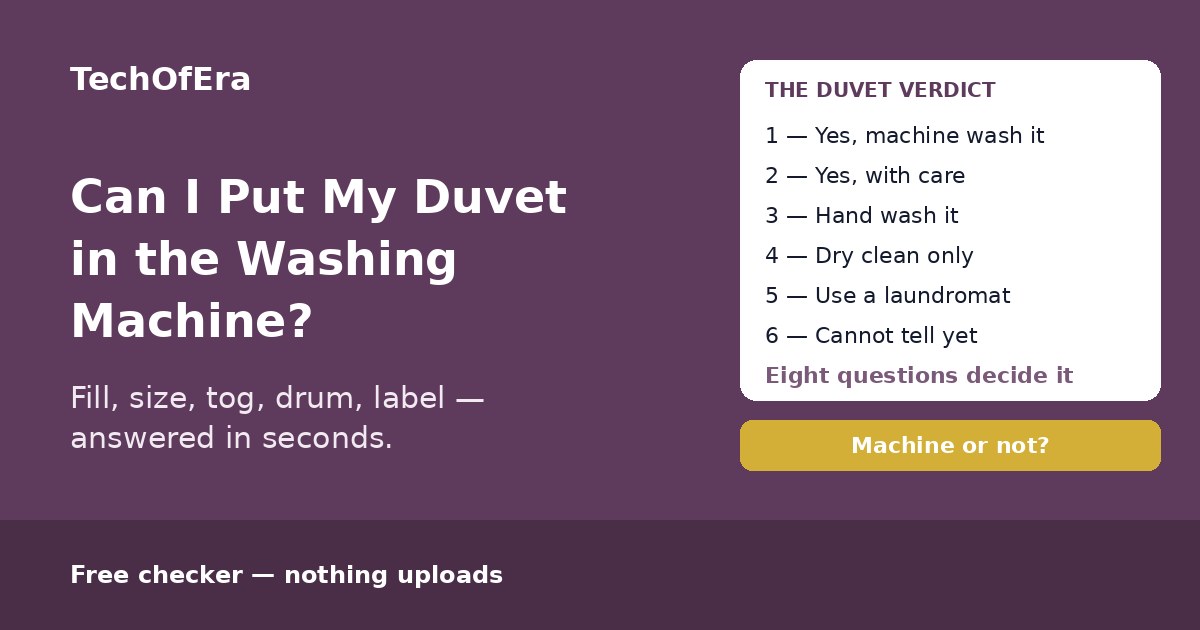
Whether a duvet can go in the washing machine is a fill problem, a fit problem and a label problem at the same time. The fill is the first test: a synthetic duvet is usually machine washable, down and feather are machine washable when the label allows it, and wool and silk usually need a professional cleaner. The fit is the second: a king-size duvet needs a washer of at least 5.0 cubic feet, and a duvet that fills the drum will not rinse or spin properly. The label is the third — it is written for the exact duvet on your bed, and it beats any guide. This checker weighs all eight answers — the fill, the size, the tog, the drum, the care label, the kind of machine, the duvet's condition, and how you can dry it — and gives you a verdict: yes, machine wash it; yes, with care; hand wash it; dry clean only; too big for your machine, use a laundromat; or cannot tell yet.
To use it:
- Say what the duvet is filled with. Down, feather, a down and feather mix, synthetic (polyester or hollowfibre), wool, silk, or cotton. Down, feather, synthetic and cotton can usually be machine washed when the label allows it; wool and silk usually need a professional cleaner.
- Say what size it is. Single, double, king, or super king. A single duvet needs a drum of at least 7 kg, a double 8 kg, a king 9 kg, and a super king 11 kg — those are the checker's own planning estimates, built from the published figures.
- Say what tog it is. Light (4.5 tog or less), medium (7.5 to 10.5 tog), or heavy (13.5 tog or more). A heavy tog is thick and bulky, so it needs about 1 kg more drum than a medium duvet of the same size.
- Say how big the washing machine drum is. Small (under 7 kg), standard (7 to 8 kg), large (9 to 10 kg), or extra large (11 kg or more, or a laundromat machine). The duvet should fill no more than three-quarters of the drum — if you have to force it in, the drum is too small.
- Say what the care label says. Machine washable, hand wash only, dry clean only, or no label found. The label is on a tag near a corner of the duvet. Woolmark's golden rule is to always check the care label first — and if it says dry clean only, that is the answer.
- Say what kind of washing machine it is. Front loader, top loader with a centre agitator, or top loader, high-efficiency (no agitator). A front loader is ideal for a duvet; an agitator machine can be used if it is big enough and the duvet is not delicate, but it is rougher on the fill.
- Say what condition the duvet is in. Clean, a few light stains, heavily soiled, or a torn seam or leaking fill. A torn seam changes the answer: a machine would pull the fill out through the tear, so the seam has to be sewn first.
- Say how you would dry it. A large tumble dryer is available, or no dryer and you would air dry it. A duvet must be dried fully — damp down clumps and can mildew, and air drying a down duvet takes days.
Drum size vs duvet size
The table in your result is the heart of the check. In brief: a single duvet needs a drum of at least 7 kg, a double 8 kg, a king 9 kg (5.0 cubic feet, as Maytag recommends), and a super king 11 kg — with about 1 kg more for a heavy tog. Those figures are the checker's own planning estimates, built from the published guidance: Maytag's 5.0 cubic feet for a king, Consumer Reports' 4.5 to 5.0 cubic feet for most king-size coverings, and John Lewis's warning to check the manufacturer's advice for duvets before washing in a domestic machine due to bulk. The rule behind them is the same everywhere: fill no more than three-quarters of the drum, because a duvet that fills the drum will not rinse or spin properly, and it can strain the motor. If your machine is smaller than the table says, the honest answer is a laundromat machine — not a smaller wash.
Drying a duvet after washing it
Drying is the step that most often goes wrong, so the checker asks about it before you start. The steps depend on the fill:
- Down and feather: dry on low heat in a large dryer with clean tennis balls or dryer balls to stop the fill clumping, shaking the duvet out every 30 minutes, until no damp spots remain — plan on 2 to 3 hours. Never put it back on the bed half dry: damp down clumps and can mildew.
- Synthetic: dry on low heat, or air dry flat, turning it often. Synthetic fill dries faster than down, but it still has to be fully dry before it goes back on the bed.
- Wool: dry it flat and supported, out of direct sun, and never in a hot dryer. Wet wool is heavy and its fibres are weaker, so spread it over several lines to carry the weight.
- Silk: dry it flat and out of the sun — and remember that a silk duvet should not have been machine washed in the first place.
- Cotton: dry it flat, turning it often. A heavy wet cotton duvet sags and lumps if it hangs, and the batting clumps under its own weight.
The six verdicts, and what each one means
Yes — machine wash it
The label allows it, the fill is washable, and the duvet fits the drum with room to move. Wash it on its own on a gentle cycle with a mild detergent, add an extra rinse, and dry it fully.
Yes, with care
It can go in the machine, but something needs care: an agitator machine with a down duvet, a snug fit with a heavy tog, no dryer for a down duvet, a cotton fill that clumps, or a missing label. Read the care note before you start.
Hand wash it — not the machine
The label says hand wash only, or the seam is torn. Wash it by hand in a bath with cool water and a mild detergent — and sew a torn seam first, or the fill will escape.
Dry clean only
The label says dry clean only, or the fill is wool or silk without a machine-washable label. Take it to a professional cleaner and say what it is filled with.
Too big for your machine — use a laundromat
The duvet needs a bigger drum than your machine has. A duvet that fills the drum will not rinse or spin properly. Use one of the large front-load machines at a laundromat, and dry it there on low heat.
Cannot tell yet — answer the questions
The checker cannot judge a duvet without knowing what it is filled with or what the care label says. Answer one of those two questions and the verdict appears.
What makes this checker different
The pages that rank for this search are articles — a Consumer Reports guide, a Sleep Foundation guide, a Casper guide, and a laundromat guide. None of them asks what your duvet is filled with, what size it is, what tog it is, or how big your drum is — and none of them gives you a verdict for your duvet, or the minimum drum size for it. This page is the answer the articles do not give: eight questions, an instant verdict, the blockers named, and the drum-size table for your duvet. It is also a different question from the two checkers it sits beside: the How Often Should I Wash My Bedding? Checker answers when to wash your bedding, not whether the duvet can go in the machine — and the Can I Put This in the Washing Machine? Checker answers the same question for nineteen household items at once, with one line per item, while this page is duvet-only, with the fill, tog and drying steps that a one-line answer cannot carry.
When is this the right check?
When you are standing over the machine with the duvet in your arms and you are not sure whether it will fit — because a king duvet in a 7 kg drum will not rinse properly, and the checker will say so instead of guessing. When the care label is missing and you are not sure whether a wool duvet can be washed at home — because it usually cannot, unless the label says so. When you have a down duvet and no dryer — because air drying it takes days, and the checker will tell you to use a laundromat dryer before you start. And when the seam has torn and you are wondering whether the machine will make it worse — because it will, and the checker will say hand wash it after sewing the seam.
Honest limitations
A self-assessment, not laundry advice from a professional
This checker cannot see your duvet, your machine, or your care label. It cannot tell whether your duvet will survive a wash. If the label says dry clean only, that is the answer — the label is written for the exact duvet on your bed.
The drum sizes are the checker's own estimates
The minimum drum for each duvet size comes from the published guidance, but the figures are the checker's own planning estimates — they are labelled as such wherever they appear, not as measurements of your machine. Check your machine's manual for its own duvet guidance.
Without the care label, the verdict is weaker
The label is the only instruction written for the exact duvet on your bed. Without it, the checker works from the fill alone, and the verdict drops to low confidence — check the manufacturer's website for the care instructions for this exact duvet if you can.
“About 7 to 8 kg” is a judgement, not a measurement
Most people judge the drum size from the machine's model plate or the manual, and a 7 kg drum and an 8 kg drum can look identical from the outside. If you are not sure which one yours is, the checker treats a standard drum as 8 kg — and says so in the answer, rather than pretending it measured it.
Other bedding in the house counts too
This checker looks at one duvet at a time. It does not check the duvet cover, which is washed separately with the other bedding, and it does not ask whether anyone else in the house has a duvet that needs washing — so run it once per duvet.
Rules from official sources, dated November 2026
The rules here are the published guidance from the Sleep Foundation, Consumer Reports, Maytag, Casper, Woolmark and John Lewis, as they read in November 2026. Guidance changes: recheck the care label if anything about your duvet changes.