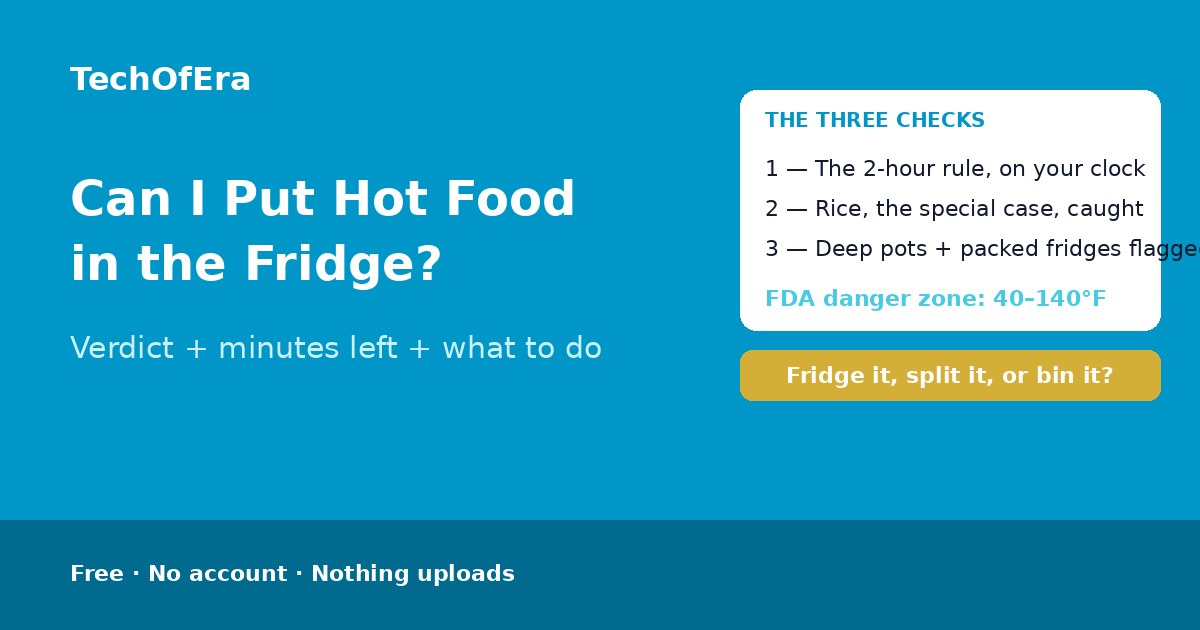
How the hot food in the fridge check works
Most of us grew up hearing “never put hot food in the fridge” — and most of us were taught wrong. The US FDA and USDA say to refrigerate perishable cooked food within 2 hours of cooking (1 hour if the room is above 90°F / 32°C), and food-safety specialists say the same: you should put hot food in the refrigerator. Modern refrigerators hold a constant temperature and can handle hot food — the old warning dates from pre-1970s models whose condensers cycled off and struggled. What matters is not whether the food is hot, but how fast it cools through the danger zone, 40°F to 140°F (4°C to 60°C), where bacteria grow fastest. This checker turns seven answers — what the food is, how long it has been out, how warm the room is, what container it is in, how much of it there is, what state your fridge is in, and who will eat it — into a risk score, names the verdict, and works out how many minutes of the safe window you have left.
To use it:
- Say what the food is. Rice is the special case — Bacillus cereus spores survive cooking, so rice gets the shortest window of all. Baked goods and whole fruit do not need the fridge at all: the fridge dries bread out and does nothing for whole fruit.
- Work out how long it has been out. The clock starts when the food comes off the heat, not when you sit down to eat. The FDA and USDA limit is 2 hours at room temperature, 1 hour if the room is above 90°F (32°C).
- Say how warm the room is. Above 90°F the safe window halves. A hot kitchen on a summer day counts — so does food left out at a barbecue or a picnic.
- Say what container it is in. A deep pot cools slowly in the middle — the centre can sit in the danger zone for hours while the outside feels cool. Shallow containers no more than 2 inches deep cool fast, and leaving them uncovered until the food has cooled helps more than a lid does.
- Say what state the fridge is in. A fridge warmer than 40°F (4°C) cannot keep food safe, whatever the clock says — and a packed fridge has poor airflow, so a hot container can warm the food around it.
- Say how much of it there is, and who will eat it. Large batches cool slowest of all, and for vulnerable eaters — pregnant, over 65, under 5, or a weakened immune system — the 2-hour limit is a hard line, not a guideline.
What makes this checker different
The pages that rank for this search are guides — the Center for Science in the Public Interest’s food-safety Q&A, The Kitchn’s “Can I Put Hot Food in the Fridge?”, ScienceABC’s explainer, and a string of myth-busting articles. All of them say the same things: yes, you can; the 2-hour rule; shallow containers; rice is the exception. None of them asks what your food is, how long it has been out, how warm your room is, what container it is in, or who will eat it — and none of them gives you a verdict for your exact leftovers, or tells you how many minutes of the safe window you have left. There is no free, standalone checker that takes your food, your clock, your container and your fridge and gives you a score, a verdict (fridge it now, split it first, no fridge needed, or throw it away), and the next steps. This page is that answer: seven questions, an instant verdict for your exact food, the blockers named, and the time left on the clock. It is a self-assessment, so it says plainly what it cannot know: it cannot take the temperature of your food or your fridge, and where the food has been out too long it says throw it away instead of guessing.
When is this the right check?
When dinner is over and the pot is still on the stove — because the question is not whether the food is hot, it is how long the clock has left. When you made a big batch of rice and are wondering whether it can wait until morning — because rice has the shortest window of any leftover, and the answer is usually no. When someone says “let it cool properly first” and you want a number — because the 2-hour rule and the minutes left on the clock settle the argument better than a feeling. And when you find last night’s soup in the fridge and wonder whether it is still safe — because the same clock, run backwards, tells you whether it was fridged in time.
Honest limitations
A self-assessment, not an inspection
This checker cannot take the temperature of your food or your fridge, measure how hot the middle of a pot is, or know whether the food was kept hot before it came off the heat. If you are unsure, a food thermometer in the middle of the pot and a fridge thermometer on the shelf are the only honest answers.
The clock is your judgement, not a measurement
The checker takes your word for how long the food has been out. If you are guessing, guess long: pick the longer band. The clock starts when the food comes off the heat, not when you sit down to eat — and a pot left on a cooling hob is still in the danger zone.
Minutes left are an estimate, not a guarantee
The minutes left come from the middle of the time band you picked, against the 2-hour limit (1 hour above 90°F). A deep pot cools slower than a shallow tub, so the real window for the middle of a big pot is shorter than the number shown.
Rules differ by place
The guidance here follows the US FDA and USDA as they read in November 2026 — the 2-hour rule, the 1-hour rule above 90°F, the 40–140°F danger zone, and the FDA Food Code cooling standard. The UK Food Standards Agency gives the same 2-hour advice; check your local guidance if anything about your kitchen changes.
Reheating does not rescue food left out too long
Some bacteria leave behind toxins that survive cooking — Bacillus cereus in rice is the classic case. If the food has been out too long, reheating it until steaming hot does not make it safe. When in doubt, throw it out.
Rules from official sources, dated November 2026
The rules here are the FDA and USDA 2-hour rule (1 hour above 90°F / 32°C), the 40–140°F (4–60°C) danger zone, the FDA Food Code cooling standard (140°F to 70°F within 2 hours, then to 40°F within 4 more), and the rice guidance from Dr Benjamin Chapman at North Carolina State University, as they read in November 2026. Guidance changes: recheck with your local food-safety authority if anything about your kitchen changes.