How the baby honey checker works
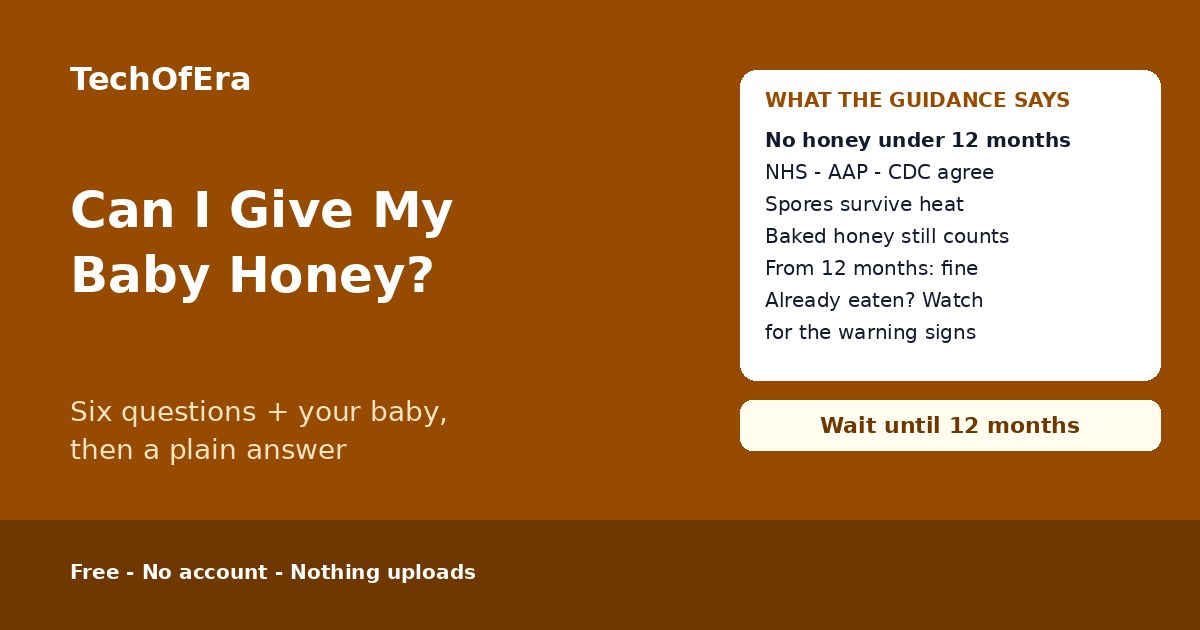
There is one rule, and it is the same everywhere: no honey for a baby under 12 months, in any form. The NHS, the American Academy of Pediatrics and the CDC all say it, and the reason is infant botulism — honey can carry spores of Clostridium botulinum, which can cause a severe food poisoning that affects nerve function and can lead to muscle paralysis. Most cases happen in babies under 6 months, and waiting until 12 months gives the digestive tract time to mature. From 12 months the NHS says honey is fine — but it is still added sugar, and the AAP advises no foods with added sugar under 2. This checker turns that guidance into a plain answer for your baby: their age in months, the form of honey, how much, and whether honey has already been eaten.
To use it:
- Say how old your baby is. The answer turns on 12 months. Under 12 months, no honey in any form — not raw, not pasteurised, not baked into food and not in a drink. From the first birthday, honey is fine, starting with a small taste.
- Say what form the honey is in. Raw honey is the form most likely to carry the spores — but pasteurising does not remove them, and baking does not either: the spores are relatively heat-resistant. So the form changes the explanation, never the verdict: every form waits until 12 months.
- Say how much honey. Even a tiny taste counts under 12 months. From 12 months the amount is about sugar, not safety: a taste on toast is fine, honey every day is more sugar than a toddler needs.
- Say whether honey has already been eaten. If it has, the answer is what to do next. Most of the time nothing happens after a taste — the NHS says honey only occasionally contains the bacteria — but stop the honey, watch for the signs, and mention it at the next checkup.
- Say whether there are warning signs. Poor feeding, a weak cry, constipation, floppiness or drooping eyelids after honey need a doctor at once. Serious signs — a weak cry, floppiness, drooping eyelids, trouble swallowing — mean calling emergency services now.
- Say where you are. The country sets the emergency number in your answer: 911 in the United States and Canada, 999 in the United Kingdom, 112 in Germany, 000 in Australia. The 12-month rule is the same in every country.
What makes this checker different
The pages that rank for this search are guides — Cleveland Clinic, KidsHealth and parenting sites — explaining the same 12-month rule in paragraphs. None of them answers the question for your baby: a 6-month-old offered raw honey is a different answer from a 14-month-old offered honey on toast, and both are different again from an 8-month-old who already ate honey in cereal and seems well. No ranked page gives a personalised verdict by age in months, honey form, amount and whether honey was already eaten, with the warning signs to watch for and the emergency number for your country. This page is that answer: six questions, one plain verdict, and the next steps. It is also a different question from our Is This Safe for My Baby to Chew? Checker, which scores 16 chew items and toys for choking and breakage risk and does not cover honey at all — this page answers honey only, with infant-botulism guidance and what to do if honey was already given.
When is this the right check?
When grandma holds out a spoonful of honey and you hesitate. When a recipe or a cereal lists honey and your baby is under one. When someone suggests honey on a pacifier to soothe a teething baby. When your baby already had a taste of honey and you are wondering whether to worry. When your baby is over one and you want to know how much honey is reasonable. And when you are about to offer honey for the first time and want the answer for your baby's exact age, not a general rule.
Honest limitations
General information, not medical advice
This checker cannot see your baby. It gives a plain answer from the published guidance — it cannot diagnose your baby, and it is not medical advice. If your baby has eaten honey and shows any warning sign, call emergency services or your paediatrician or GP at once.
The guidance is dated November 2026
The facts here are the NHS, the AAP and the CDC guidance on honey and infant botulism, as they read in November 2026. Guidance changes: recheck the numbers if anything about your baby changes.
The 12-month rule is the same everywhere
The rule does not change by country — only the emergency number and the named guidance change. If your country's guidance differs from the NHS, AAP and CDC, follow your own paediatrician's advice.
Most tastes cause nothing — but watch anyway
The NHS says honey only occasionally contains the bacteria, so most of the time nothing happens after a taste. That is reassuring, not a reason to skip watching: the signs can take days to appear, and botulism is a medical emergency.
Honey is still sugar from 12 months
From the first birthday honey is safe, but it is still added sugar. The AAP advises no foods with added sugar under 2 — so keep honey occasional and small, and use fruit for everyday sweetness.
Facts from the guides, dated November 2026
The facts here are the NHS, the American Academy of Pediatrics and the CDC, as they read in November 2026. Where the facts are thinner — your baby's health, what else they ate, how much honey they had — the checker says so instead of inventing a rule.