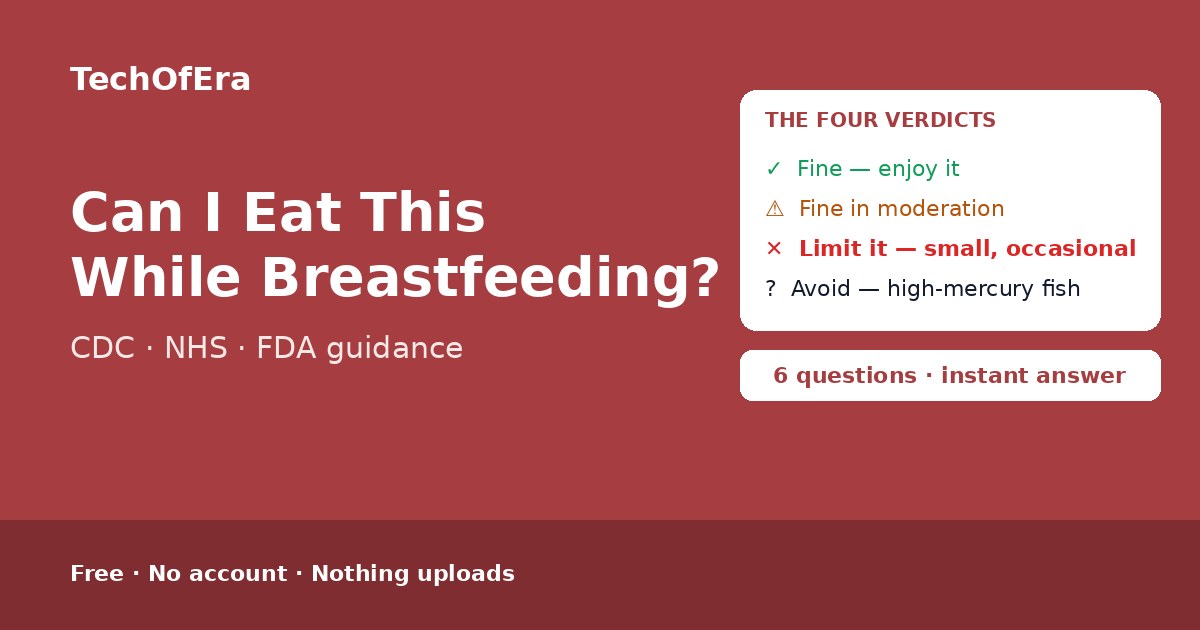
How to decide what to eat while breastfeeding
The reassuring starting point is that you do not need a special diet while breastfeeding. The CDC and the NHS say the same thing: eat a varied, healthy diet and drink to thirst. Only a few things need limits, and they are short: high-mercury fish, alcohol, and caffeine. Spicy food, garlic, dairy and peanuts do not need to be avoided routinely — the flavours pass into milk in tiny amounts, and they may even help your baby accept new flavours later. This checker asks exactly what decides the exceptions: the food or drink, how it is served, how much of it, how old your baby is, when the next feed is, and anything that makes it riskier.
To use it:
- Pick the food or drink. Start with what is actually in front of you — the list covers the foods and drinks breastfeeding mothers ask about most, from salmon to sushi to coffee. If yours is not listed, pick the closest match, and if it is a fish, the species matters more than anything else: salmon and swordfish are both fish, and they get opposite answers.
- Say how it is served. Preparation changes the answer: cooked fish is fine, raw fish is a food-poisoning risk for you, and unpasteurised dairy carries listeria. Pasteurised soft cheese is fine; the unpasteurised version is the one to skip.
- Be honest about the amount. For caffeine, mercury and alcohol the amount is the whole question — the guidance is a daily or weekly total, not a yes-or-no. About 300 mg of caffeine a day, 8 to 12 oz of lower-mercury fish a week, and one standard drink of alcohol a day at most.
- Say how old your baby is. Newborns and premature babies clear caffeine much more slowly, so the same cup of coffee affects them more. The NHS advises cutting down especially before the baby is 6 months old.
- Say when the next feed is. This decides alcohol more than anything else: alcohol clears from milk as it clears from blood, about one standard drink every 2 hours. If you are about to feed, wait — or feed the expressed milk you have ready.
- Watch your baby, not just the rules. If your baby is fussy, restless or sleeping badly, caffeine is the first thing to cut back on — even if you are under the daily limit. And only restrict a food if your baby has reacted to it: routine avoidance of allergens is not the guidance.
Food situations and what to do at a glance
The table below is built from the same rules as the checker, so it can never disagree with your answer. Where the food sits — enjoy it, fine in moderation, limit it, or avoid — decides together with how it is served, how much of it, and how old your baby is.
| Food situation | Verdict | What to know |
|---|
What makes this checker different
The pages that rank for this search are guides — thorough lists of foods to avoid while breastfeeding, the caffeine and alcohol limits, and the reassurance that you do not need a special diet — but they leave you to work out what that means for the food in front of you right now: whether your salmon counts when it is served raw, whether a second cup of coffee is still fine with a three-week-old, whether a glass of wine is safe when the next feed is in an hour, and whether the fish on your plate is one of the seven the FDA says to avoid. The apps that do answer the question are trackers and meal planners you have to install, several with paid features. This page is the answer itself: pick a food, say how it is served and how old your baby is, and get an instant answer with the reason named — free, with no account, no install, and nothing uploaded. It is general information, so it says plainly what it cannot know: a web page cannot know your baby, your medical history, or how your body is reacting today, so anything you mark “Not sure” stays on the list until you confirm it.
When is this the right check?
Whenever you are about to eat or drink something and you are not sure how it fits: the sushi menu at a restaurant, the fish on your plate at a family meal, the second cup of coffee on a sleepless morning, the glass of wine at a celebration, the energy drink before a long day, the soft cheese on a cheese board, the deli sandwich at lunch. Also whenever your baby is fussy or sleeping badly and you want to know whether caffeine could be part of it — the checker will tell you whether to cut back and by how much. And whenever you are feeding a newborn or a premature baby and want to be stricter than usual: the checker is stricter for the first few weeks, exactly when caffeine matters most. If the answer is “avoid for now”, the checker names the low-mercury or alcohol-free version of the same meal that usually works instead.
Honest limitations
General information, not medical advice
This checker works only from the answers you enter. It cannot give medical advice — no web page can know your baby, your medical history, or how your body is reacting today. If an answer is wrong, the verdict is wrong. When in doubt, ask your clinician, health visitor or lactation consultant.
The guidance is totals, not yes-or-no
Caffeine, mercury and alcohol are all judged by totals — about 300 mg of caffeine a day, 8 to 12 oz of lower-mercury fish a week, one standard drink a day. The checker can only judge the one food you enter, so it cannot add up your whole day. Count the rest yourself.
Herbal teas are thin evidence
Most common herbal teas are fine in normal amounts, but the evidence for some herbs is thin, and large amounts of sage or peppermint are traditionally linked to a lower milk supply. The checker says so plainly instead of pretending certainty — and a herbalist is not a substitute for your clinician.
Allergies need your clinician, not a list
Only restrict a food if your baby has reacted to it, and follow the plan your clinician set. Cutting whole food groups on your own can do more harm than good — for you and for your baby.
Medicine is a different question
This checker only judges food and drink. Most medicines are compatible with breastfeeding, but this page cannot tell you about yours — check each medicine separately in the US National Library of Medicine’s LactMed database, and tell your doctor and pharmacist that you are breastfeeding.
Rules from CDC, NHS and FDA
The rules here follow CDC maternal-diet guidance, NHS breastfeeding-and-diet guidance, and FDA advice about eating fish, as they read in November 2026. Guidance can be revised, so re-check if a new edition appears.